Leh, February 24, 2026: The 2-Day Pashmina Conclave 2026, themed “From Changthang Fibre to Global Luxury Standards,” commenced today at The Dragon Hotel, Leh.
The conclave is being organised by the Administration of the Union Territory of Ladakh with the objective of strengthening the Pashmina value chain and positioning Ladakh’s premium fibre in the global luxury market.
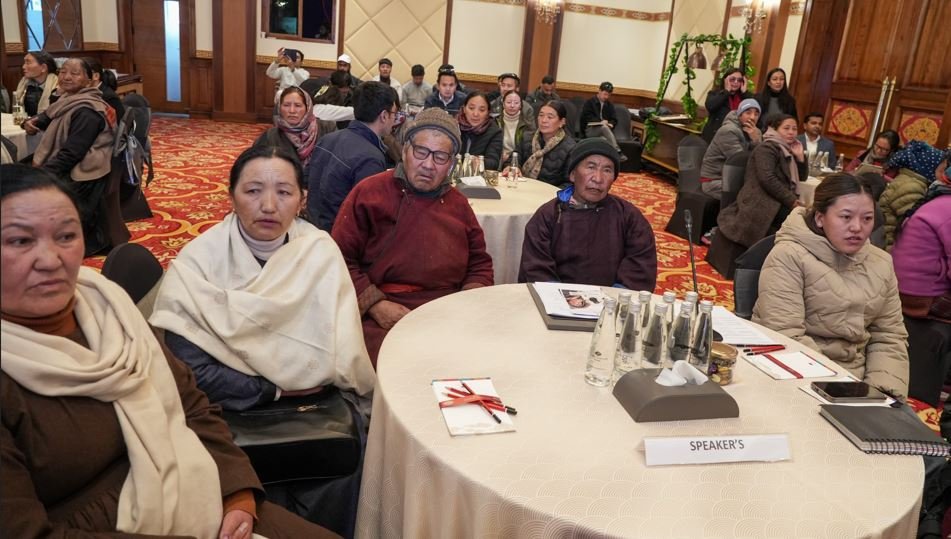
The event brings together designers from Delhi and Ladakh, local weavers, yarn makers, entrepreneurs, cooperative representatives, policymakers, and herders of the famed Changthang Pashmina goat from the Changthang region.
The platform aims to foster collaboration across stakeholders involved in the production, processing, branding, and marketing of Ladakh’s world-renowned Pashmina.
The first session focused on the source and sustainability of Changthang fibre.
Dr. Asif Hussain, Nodal Officer, Pashmina Ladakh, elaborated on the origin of Ladakh Pashmina and emphasised the importance of sustainable practices in preserving its unique quality and global reputation.
Thinles Nurboo, General Secretary of the All Changthang Pashmina Growers Cooperative Marketing Society Ltd., highlighted the key features of Ladakh Pashmina and outlined the society’s mission, strategic objectives, and milestones achieved in driving socio-economic transformation among pastoral communities.
Tara Sharma of Jungwa Foundation provided a historical overview of Pashmina in Changthang and discussed the impact of climate change, stressing the need for sustainable and climate-resilient approaches to production.
The second session centred on processing, purity, quality grading, and standardisation gaps in the Pashmina value chain.
Huma Khan, District Registrar of Cooperatives (DRC), spoke about challenges related to quality control, grading mechanisms, and the urgent need for standardised practices to strengthen market credibility.
Amina Bano of Looms of Ladakh discussed value addition through traditional weaving and underscored the importance of maintaining authenticity in finished Pashmina products.
Konchok Stanzin of Pangong Craft Institute emphasised the welfare of Pashmina growers and sustainable livestock management in Changthang, highlighting the direct link between animal health and fibre quality.
The third session focused on artisan livelihoods and design integration.
Tundup Wangail, District Development Council (DDC) member and NABARD representative, shared insights into the role of NABARD in promoting and sustaining the Pashmina sector in Ladakh through financial inclusion, institutional support, and livelihood initiatives.
Rigzin Wangmo Lachic, a Ladakh-based entrepreneur, highlighted the contribution of local growers and entrepreneurs in sustaining the heritage craft while adapting to contemporary market demands.
Tashi Dorjey of Oden Collectives elaborated on the importance of structured design processes, innovation, and design integration in enhancing product appeal and market competitiveness.
In the concluding technical session, Dr. Stanzin Thakchos delivered a detailed presentation on branding, market positioning, and value capture strategies for Ladakh Pashmina. He discussed current market trends, emerging opportunities, key challenges, and the forces shaping the future of the Pashmina industry.
Local representatives Kunzes Wangmo of LehValle and Deskit Angmo of Coral Hue also shared their perspectives on brand building, market expansion, and strengthening the value proposition of Ladakh Pashmina in national and international markets.
The sessions collectively underscored the need for sustainable production, quality standardisation, design innovation, and strategic branding to ensure long-term growth and global recognition of Changthang Pashmina.
During the inaugural ceremony, the Hon’ble Lieutenant Governor of Ladakh, Kavinder Gupta, highlighted Ladakh’s vision to transform its iconic Pashmina into a globally recognised luxury brand.
The conclave brought together shepherds, artisans, self-help groups, cooperatives, industry representatives, financial institutions, researchers, and government officials under one roof to chart a sustainable and inclusive path for the Pashmina sector.
Chief Secretary Ashish Kundra emphasised the need to unite all stakeholders—from herders to designers and government agencies—to protect Ladakh’s Pashmina value chain. Noting that Ladakh produces 40–50 tonnes annually, he observed that much of the profit currently goes to traders outside the region. He stressed adopting a holistic approach to enable Ladakh to produce luxury cashmere shawls, attract the younger generation, and position Pashmina as a high-end global product benefiting all stakeholders.
Secretary, Cooperatives, Bhupesh Chaudhary, highlighted the role of the Cooperatives Department in the sector’s growth, addressing challenges such as climate change and emphasising collective approaches, including cooperative farming and learning from successful models like Amul.
Secretary, Youth Services & Sports, Moses Kunzang, spoke about the Pashmina Matrix adopted by the Department of Industries and Commerce, stressing collaborative functioning across departments with focused interventions.
Secretary, Rural Development Department, Shashanka Ala, briefed participants on the day’s sessions, covering fibre sustainability, processing and purity, grading gaps, artisan livelihoods, design relevance, and brand positioning strategies.
The conclave witnessed participation from Central Government bodies, including the Central Wool Development Board and the Textile Committee under the Ministry of Textiles, Government of India. Officials from the Departments of Industries & Commerce, Sheep/Animal Husbandry, Handloom & Handicrafts, Rural Development, and Social & Tribal Welfare were also present.
Pashmina herder representatives from Changthang, processing and dehairing units, women-led MSMEs, cooperatives, self-help groups, local designers, entrepreneurs, and prominent fashion industry leaders—including Samir Mehra (Founder, EZMA), Suket Dhir (SUKETDHIR), Rajesh Pratap Singh (Rajesh Pratap Singh Label), Kulbhushan Ahuja (Founder, Ahujasons), and Karan Ahuja (Director, Ahujasons)—attended the conclave.
The two-day conclave is expected to lay a strong foundation for positioning Changthang Pashmina as a sustainable, premium, and globally competitive luxury fibre while ensuring inclusive growth for Ladakh’s pastoral and artisan communities.