


Speaker Rejects Amendments on Article 370, PSA Repeal & 1987 Rigging, Sparks Opposition Outrage
Speaker rejects amendments on Article 370, PSA repeal, and 1987 rigging; Sajad Lone protests, walks out, calling it an attempt to silence critical discussions in Assembly.
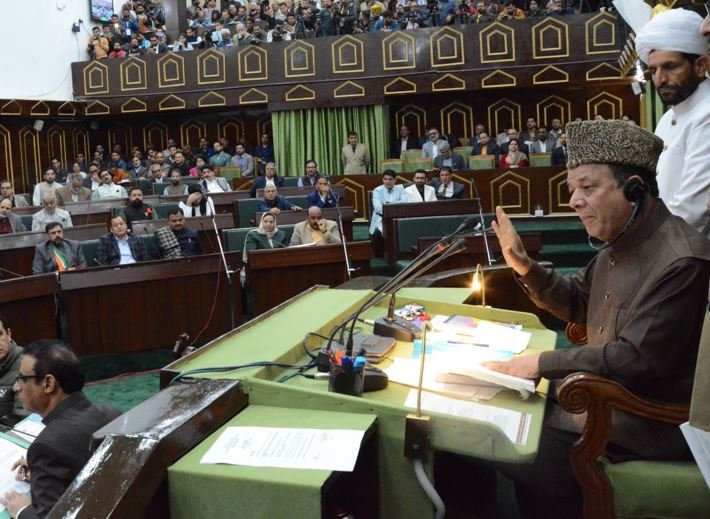
Significant Decision by Chair on Sajjad Lone’s Proposals
JAMMU, Mar 4: In a crucial ruling that sets the tone for legislative discussions in Jammu and Kashmir, Assembly Speaker Abdul Rahim Rather today declared that Article 370 would not be debated in the House for the next year. The decision stems from the fact that the matter had already been deliberated upon in the form of a government resolution in the first session of the Assembly in November last year.
The ruling was issued after People’s Conference Chairman and MLA Sajjad Gani Lone sought to move an amendment to Lieutenant Governor Manoj Sinha’s Address, seeking a fresh discussion on the abrogation of Article 370. However, the Speaker rejected the amendment along with three other proposals by Lone concerning the alleged rigging of the 1987 elections, the repeal of the Public Safety Act (PSA), and the police verification process.
The Speaker’s decision effectively puts to rest any further discussions on these contentious issues in the House at least until November. The announcement came in response to Sajjad Lone’s statement before the beginning of the debate on the Motion of Thanks to the LG’s Address, wherein he expressed dismay that four of his six proposed amendments had been disallowed by the Chair.
Lone had sought to introduce six amendments to the LG’s Address, covering a wide range of issues, including the debate on Article 370, the alleged electoral malpractice of 1987, the police and CID verification procedures for employment and passport clearances, the repeal of the PSA, and proposals to provide 12 free LPG cylinders and 200 units of free electricity to citizens. While his last two amendments regarding LPG and electricity were admitted, the others were dismissed by the Speaker.
Expressing his dissatisfaction, Lone questioned the rationale behind the Speaker’s ruling and sought an explanation for the rejection of his amendments. In response, Speaker Rather cited Assembly rules that prohibit a previously debated issue from being discussed again for at least one year. He argued that the government’s resolution in November had already addressed the matter of Jammu and Kashmir’s special status.
However, Lone countered that the resolution in question did not explicitly mention Article 370, Article 35-A, or the Jammu & Kashmir Reorganisation Act of 2019. He challenged the government to provide proof that these specific references were made in the resolution, offering to apologize if such evidence was found. The Speaker, however, maintained that the term ‘special status’ implicitly included Articles 370 and 35-A.
The rejection of a debate on the alleged rigging of the 1987 elections also triggered a sharp exchange between Lone and the Speaker. Rather justified his decision by stating that Assembly rules only permit discussions on issues of recent relevance and that an incident dating back 37 years does not qualify for deliberation.
Lone, however, contended that the events of 1987 had far-reaching consequences, leading to bloodshed and political turmoil in Jammu and Kashmir. “Thousands of lives have been lost post-1987, and yet you are saying we cannot investigate what led to this situation?” he questioned.
On the PSA repeal and verification procedures, the Speaker argued that these issues fall under the jurisdiction of the Union Ministry of Home Affairs and, therefore, cannot be discussed within the Assembly. “Unless Jammu and Kashmir’s Statehood is restored, such matters remain under the purview of the Centre,” he clarified. Congress MLA Nizam-ud-Din Bhat also weighed in, noting that service verification rules are formulated by the General Administration Department (GAD) of the Union Territory.
Lone, however, remained unconvinced and insisted that stringent police verification procedures were discriminatory against the people of Jammu and Kashmir. He criticized the policy of denying passports or government jobs based on familial backgrounds, calling it a form of “collective punishment.” He cited his personal experience, stating that he had been placed under the Prior Approval Category (PAC) and barred from obtaining a passport in 2012. “Why are we subjected to different rules? The verification standards applicable in Punjab should apply to us as well. Are we not equal citizens of India?” he asked.
Not satisfied with the Speaker’s responses, Lone staged a dramatic walkout from the Assembly, accusing the government of suppressing dissent. Speaking to reporters outside the House, he alleged that his proposals had been rejected to silence voices questioning the government’s policies.
“I had introduced amendments seeking discussions on the restoration of Article 370, the repeal of PSA, the verification process, and an inquiry into the 1987 elections. However, five out of my seven amendments were rejected. It is ironic that the National Conference, which campaigned on these very issues during elections, is now unwilling to even discuss them,” Lone asserted.
Leader of the Opposition Sunil Sharma dismissed the idea of revisiting Article 370, calling it “foolishness.” He emphasized that the matter was settled and upheld by the Supreme Court, making any further discussion redundant. “Debating Article 370 at this stage is a complete waste of time and an attempt to mislead the people,” Sharma said.
He also criticized Lone for walking out over the issue, alleging that his actions were motivated by personal ties to Pakistan. “His love for Pakistan is evident because his in-laws are there. He barely won his election and is now seeking attention by raising these outdated issues,” Sharma remarked.
Meanwhile, President Tariq Hameed Karra of the Pradesh Congress Committee (JKPCC) presented a nuanced stance on the special status issue. He clarified that, post the Supreme Court verdict, Congress considers the restoration of full Statehood as the only viable form of special status for Jammu and Kashmir.
“For Congress, after the Supreme Court’s decision, special status translates into Statehood. This remains our primary demand, and we will continue to fight for it,” Karra told reporters. He also criticized the government’s lack of clarity on Statehood restoration, arguing that there is no defined roadmap for its implementation.
When asked whether Congress would advocate for Article 371 as an alternative, Karra avoided specifying any constitutional provision but called for legal safeguards for Jammu and Kashmir’s land, jobs, and resources.
The Speaker’s ruling marks a decisive moment in the Assembly, setting clear boundaries on what can and cannot be debated in the near future. While the government maintains that the discussion on Article 370 has been settled, the opposition continues to challenge the decision, signaling that these issues will remain a focal point in Jammu and Kashmir’s political discourse. With Lone’s protest walkout and Congress’ push for clarity on Statehood, the debate over the region’s constitutional and administrative future is far from over.

