


Sajad Lone Decries ‘Rigged’ Reservation System, Claims Stark Regional Imbalance Against Kashmir
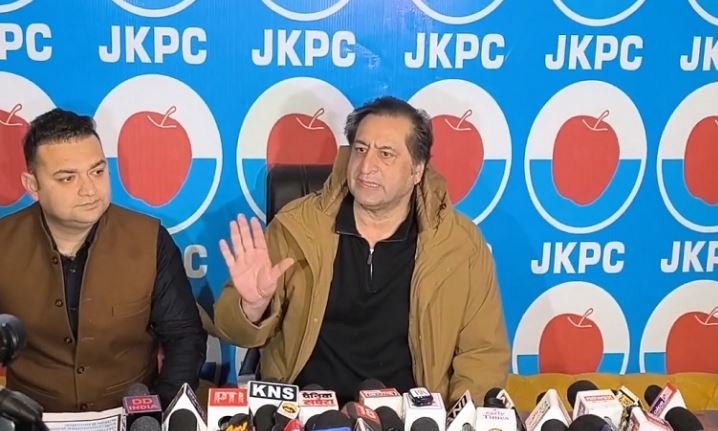
Srinagar, March 15: People’s Conference Chairman Sajad Gani Lone has strongly criticized the reservation system in Jammu and Kashmir, alleging that the process is deeply skewed against the Kashmiri-speaking population. Citing official data received in response to a query in the Assembly, Lone pointed out glaring regional disparities in the issuance of reservation certificates, with Jammu overwhelmingly dominating the allocations across all categories.
Addressing a press conference in Srinagar, the Handwara MLA termed the findings a “shocker,” stating that the numbers expose an undeniable bias against Kashmir. According to the data, every single one of the 67,112 Scheduled Caste (SC) certificates issued in Jammu and Kashmir since April 1, 2023, was granted in Jammu, leaving Kashmir with none.
He further highlighted the disparity in the Scheduled Tribe (ST) category, where 4,59,493 certificates—accounting for a staggering 85.3%—were issued in Jammu, whereas Kashmir received only 79,813 (14.7%). Similarly, in the Economically Weaker Sections (EWS) category, Jammu secured 92.3% of the certificates, leaving a mere 7.7% for Kashmir.
“The imbalance extends to other categories as well,” Lone continued. “For the Actual Line of Control (ALC) category, 94.3% of certificates were issued in Jammu, with only 5.7% in Kashmir. In the International Border (IB) category, the allocation was a clean 100% in favor of Jammu. Even in the Reserved Backward Area (RBA) category, Jammu holds a slight majority, with 52.8% compared to Kashmir’s 48.2%.”
Lone argued that these figures reveal a systematic deprivation of quotas for the Kashmiri-speaking population, significantly disadvantaging those from ST and EWS backgrounds residing in the Valley. “The entire reservation framework is rigged against Kashmiris,” he asserted. “Even the ST population in Kashmir is getting far fewer certificates, making up only 15% of the total applicants.”
He also took a swipe at the Jammu and Kashmir administration for failing to address the issue, criticizing the committee established on December 10 to review the disparities. “This committee has no fixed timeline for submitting its report, despite initial indications of a six-month deadline. This is just another bureaucratic delay that serves to maintain the status quo.”
Lone went on to suggest that Kashmiri bureaucrats themselves are complicit in perpetuating the imbalance. “The biggest culprits are the officers in Kashmir who are not issuing reservation certificates here, while in Jammu, they are distributed freely. Is this a deliberate policy, or are they acting on their own? We need answers,” he demanded.
Clarifying his stance, Lone emphasized that he is not opposed to the concept of reservation but is against what he termed the “murder of merit.” He argued that the skewed reservation system is a key reason why Kashmiri aspirants struggle to secure positions in competitive exams like the Kashmir Administrative Service (KAS).
“The issue isn’t incompetence,” he asserted. “It’s the flawed reservation mechanism that is choking opportunities. Consider this—if 100 candidates appear for an exam, 60% of seats are reserved. Out of those, 50.78% go to Jammu, leaving only 9.22% for Kashmir. Before the competition even begins, Kashmiris are already at a severe disadvantage.”
Lone blamed successive governments for allowing this system to persist since 1989. “For over three decades, this injustice has continued unnoticed. Academically, it will take a century to undo the damage,” he lamented.
As a step forward, the People’s Conference leader announced that his party would organize a seminar, inviting experts and academicians to deliberate on the issue and explore potential solutions. “This is not just a political issue; it’s an academic crisis that must be addressed before it further erodes the future of Kashmir’s youth,” he concluded.

