


Pakistani Troops Target Indian Forward Posts in 8 Sectors Along LoC; Indian Army Responds with Precision
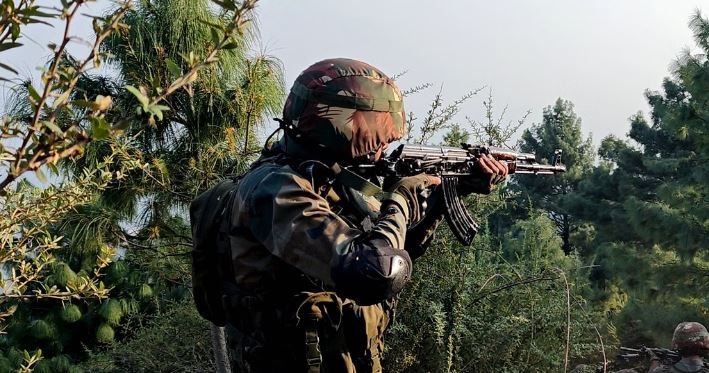
Jammu, May 6: Escalating tensions along the Line of Control (LoC) have led to yet another night of unprovoked ceasefire violations by Pakistani forces, with heavy firing reported across eight sectors in Jammu and Kashmir. The Indian Army responded swiftly and proportionately to the provocations, ensuring the safety of forward posts and civilian areas.
According to a defence spokesperson based in Jammu, the violations occurred during the night of May 5–6, with Pakistani troops initiating indiscriminate small-arms fire across multiple sectors, including Kupwara, Baramulla, Poonch, Rajouri, Mendhar, Naushera, Sunderbani, and Akhnoor. The Indian Army responded with calibrated retaliation, targeting only the origin points of aggression with precision firepower.
This marks the 12th consecutive night of ceasefire violations by Pakistan, underscoring a pattern of heightened hostility since the brutal terrorist attack in Pahalgam on April 22, which claimed the lives of 26 people, most of whom were tourists. That attack has significantly deteriorated diplomatic relations between the two countries and set the stage for a renewed phase of border skirmishes.
The cross-border firing has so far affected five of the seven border districts in Jammu and Kashmir — namely Baramulla, Kupwara, Poonch, Rajouri, and Jammu. Notably, the ceasefire appears to be holding along the International Border in Samba and Kathua districts, where no hostile action has been reported.
The current hostilities have once again cast a shadow on the February 2021 ceasefire agreement between India and Pakistan, which was intended to reinforce the 2003 ceasefire understanding and bring stability to the 740-kilometre-long LoC. However, persistent violations by Pakistani forces have rendered the agreement ineffective, with repeated breaches undermining both military trust and diplomatic efforts for peace.
The situation along the LoC deteriorated rapidly following India’s announcement on April 24 to suspend the implementation of the Indus Waters Treaty, a decision taken in the aftermath of the Pahalgam terror strike. Since then, Pakistan has ramped up military provocations along the northern LoC sectors of Kupwara and Baramulla, gradually extending its offensive to southern districts such as Poonch and Rajouri.
In retaliation to India’s strategic policy shifts, Pakistan has adopted a confrontational approach by shutting its airspace to Indian carriers, suspending bilateral trade, and closing the Wagah border crossing. Islamabad has further warned that any diversion of river waters under the Indus Waters Treaty would be perceived as an “Act of War.”
India and Pakistan share a 3,323-kilometre-long border, comprising three distinct segments — the International Border (IB) extending approximately 2,400 km from Gujarat to Akhnoor in Jammu, the 740-km-long Line of Control (LoC) running from Jammu to Ladakh, and the 110-km-long Actual Ground Position Line (AGPL) that stretches across the Siachen Glacier from NJ9842 to Indira Col.
Analysts note that the ceasefire violations are not merely tactical in nature but serve as a part of Pakistan’s broader strategy to provoke India at a time of strained diplomatic ties. The Indian Army, however, has been instructed to exercise restraint while maintaining operational readiness and giving a robust response wherever required.
The security apparatus along the border has been placed on high alert, and civilian populations in vulnerable areas are being advised to remain indoors during night hours. Bunkers, relief shelters, and contingency evacuation plans have been activated in forward villages across Rajouri, Poonch, and Jammu districts.
As the region braces for potential escalations, defence officials have reaffirmed India’s commitment to protecting its territorial integrity and ensuring that every act of aggression is met with decisive and proportionate retaliation.

