


Masood Azhar Confirms Family, Aides Among Those Killed in Indian Strike on JeM Base in Bahawalpur
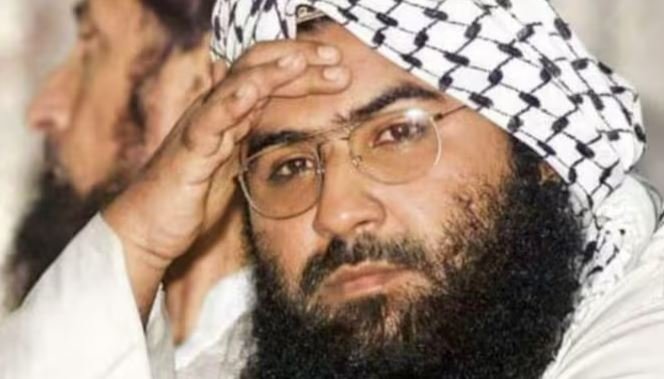
Lahore, May 7: In a rare public acknowledgment, Jaish-e-Mohammad (JeM) chief Maulana Masood Azhar has confirmed that a targeted Indian missile strike on the terror outfit’s headquarters in Bahawalpur claimed the lives of 10 of his family members and four of his close aides. A statement circulating in militant-linked networks and attributed to Azhar revealed that the casualties included his elder sister and her husband, a nephew and his wife, another niece, and five children from his extended family. Additionally, the strike reportedly killed one of Azhar’s longtime associates along with his mother and two more companions who were integral to the JeM’s operations.
The statement, couched in emotionally charged rhetoric, accused India of carrying out an act of “brutality” and warned that “there should be no expectation of mercy now.” It also reaffirmed Azhar’s narrative of victimhood and religious grievance, a hallmark of his messaging used to rally supporters.
The Indian strike on the Jamia Masjid Subhan Allah, a sprawling complex known to double as the ideological and logistical headquarters of JeM, marks a significant escalation in India’s posture against cross-border terrorism. Bahawalpur, where the strike took place, has long served as the central command for JeM activities, especially after Azhar was released by Indian authorities in 1999 in exchange for hostages from the hijacked Indian Airlines flight IC-814.
Since that controversial release, Azhar has orchestrated some of the most devastating terror attacks on Indian soil. These include the 2001 attack on the Indian Parliament, the 2000 assault on the Jammu and Kashmir Legislative Assembly, the 2016 Pathankot Air Force base infiltration, and the 2019 Pulwama suicide bombing which killed 40 CRPF personnel. Despite being designated a global terrorist by the United Nations Security Council in May 2019—after a protracted diplomatic effort led by India—Azhar has remained elusive. Intelligence reports have placed him in a “protected and undisclosed” location in Bahawalpur, with the Pakistani state accused of offering him tacit sanctuary.
Pakistan’s initial reaction to the Indian strikes has been cautious, with the Punjab province’s Information Minister Azma Bokhari confirming that the injured have been shifted to Bahawalpur’s Victoria Hospital, where they are receiving advanced medical care. Meanwhile, the Pakistan military acknowledged that 26 individuals were killed in the operation, while 46 others sustained injuries—signaling that the strike was far more than symbolic and likely inflicted substantial damage on JeM’s infrastructure.
While Islamabad has yet to officially comment on the nature of the target, the death of Masood Azhar’s immediate kin and trusted aides raises serious questions about the depth of Indian intelligence and the surgical precision of its operation. It also places Pakistan in an increasingly uncomfortable position internationally, as it faces renewed scrutiny over its continued tolerance—if not outright facilitation—of internationally proscribed terror outfits operating within its borders.
This development may further harden India’s counter-terrorism stance and increase diplomatic pressure on Islamabad to take decisive action against groups like JeM, whose activities undermine regional stability. Simultaneously, the public acknowledgment by Azhar of the toll inflicted upon his inner circle suggests a potentially significant blow to the operational core of the terror outfit.

