


CM Omar Abdullah Rules Out Revival of Old Pension Scheme, Cites Fiscal Stability Concerns
J&K Debt at Rs 1.37 Lakh Crore, Debt-to-GDP Ratio Improves to 48 Per Cent
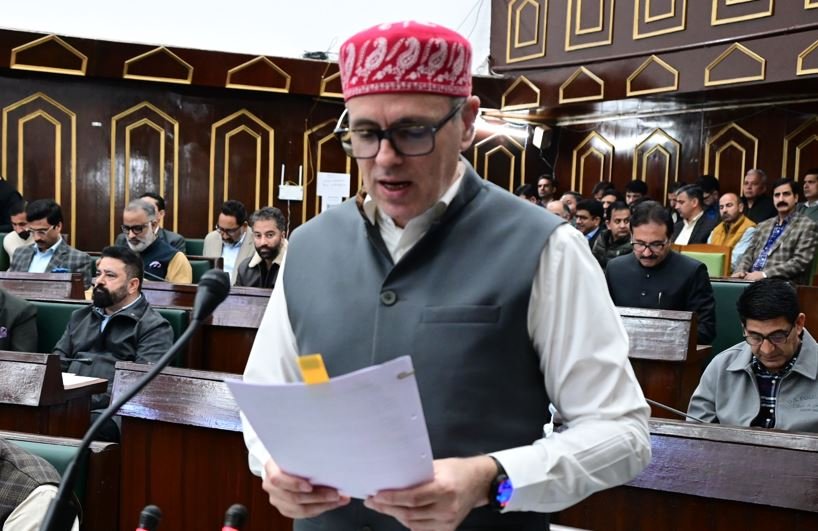
- Omar Defends NPS Shift, Says OPS May Jeopardize Financial Sustainability
JAMMU, Feb 18: Chief Minister Omar Abdullah on Tuesday categorically ruled out the revival of the Old Pension Scheme (OPS) for government employees in Jammu and Kashmir, stating that such a move could pose serious risks to the Union Territory’s long-term financial stability. At the same time, he informed the Assembly that the issue of enhancing the upper age limit for candidates appearing in the Jammu and Kashmir Combined Competitive Examination (JKCCE) is currently under examination.
Replying as Minister in charge of the Finance and General Administration Departments during the debate on grants in the Legislative Assembly, the Chief Minister said there is no proposal under consideration to reintroduce OPS, which has been revived in some other states.
“The transition to the National Pension System was a conscious decision aimed at ensuring fiscal sustainability while providing social security to employees,” Omar said. He pointed out that Jammu and Kashmir, being an expenditure-driven Union Territory with limited avenues for investment and modest revenue receipts, faces mounting pension liabilities that require careful financial planning.
Highlighting the fiscal implications, the Chief Minister noted that pension expenditure had nearly doubled from Rs 731 crore in 2004–05 to Rs 1,495 crore within a few years, underlining the growing strain on public finances. He warned that reverting to OPS could prove fiscally unsustainable in the long run and potentially undermine financial stability.
The Chief Minister reiterated that the National Pension System applies to employees appointed after January 1, 2010, and aligns with the broader policy framework adopted by the Government of India to maintain parity in service benefits.
On the issue of the upper age limit for JKCCE aspirants, Omar informed the House that the matter is being carefully examined in light of existing recruitment rules, cadre management requirements and comparative standards followed elsewhere. He explained that prior to 2018, the upper age limit was 30 years for open merit candidates and 32 years for reserved category and in-service candidates. However, under the 2018 rules, the limit was revised to 32 years for open merit candidates, 34 years for reserved and in-service candidates and 35 years for physically challenged candidates.
Meanwhile, in response to a separate written question, the Chief Minister provided detailed data on Jammu and Kashmir’s fiscal position. He said the Union Territory’s total liabilities for the financial year 2024–25 are estimated at Rs 1,37,067 crore, which is about 48 per cent of the Gross State Domestic Product (GSDP). The GSDP has expanded significantly to Rs 2,88,422 crore in the current fiscal.
Omar explained that while liabilities have increased over the years, economic growth has helped moderate the debt burden. In 2019–20, liabilities stood at Rs 89,037 crore, representing 54 per cent of the GSDP. The ratio rose to 59 per cent in 2020–21 amid economic contraction during the Covid-19 pandemic. However, as recovery gained momentum, the debt-to-GSDP ratio declined to 53 per cent in 2021–22 and further to 48 per cent in 2022–23. Though it rose slightly to 51 per cent in 2023–24, it has again been brought down to 48 per cent in the current fiscal.
The Chief Minister emphasised that borrowings have been directed largely towards capital expenditure, infrastructure development, power sector reforms and asset creation, rather than unproductive spending. He asserted that all borrowings have been kept within the limits prescribed under the Fiscal Responsibility and Budget Management framework, supported by improved cash management and calibrated market borrowing strategies.
Rejecting concerns that rising internal debt has not led to asset creation, Omar said the improving debt-to-GSDP ratio and sustained capital investment reflect responsible fiscal management and a balanced approach between development needs and financial prudence.

