


Washington May See Trump’s Triumphal Arch as Federal Agency Pushes Plan Ahead
Design proposal for a massive monument in Washington advances, alongside White House renovation plans, despite public criticism and legal hurdles
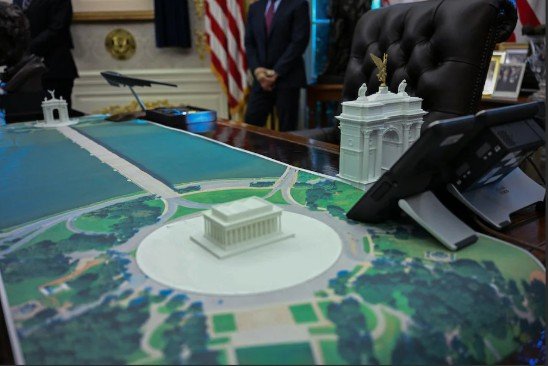
WASHINGTON: The Trump Triumphal Arch proposal Washington marked a significant procedural step forward after the U.S. Commission of Fine Arts conducted its first review of the ambitious project. The plan, championed by Donald Trump, is part of a broader vision to reshape symbolic and architectural landmarks in the U.S. capital.
The commission granted initial approval to the conceptual design of three major initiatives: the towering triumphal arch, a controversial repainting plan for the Eisenhower Executive Office Building, and the construction of an underground visitor screening facility near the White House. While this approval does not finalize the projects, it allows them to proceed to the next phase of design revisions and future evaluation.
Monumental Vision Faces Design Pushback
At the heart of the proposal is a 250-foot-high arch intended for Columbia Island, a federal site managed by the National Park Service. The structure would feature a gilded figure resembling the Statue of Liberty holding a torch at its peak, flanked by two eagles, while four sculpted lions guard its base.
The monument would also bear inscriptions such as “One Nation Under God” and “Liberty and Justice for All,” with a public observation deck offering panoramic views of Washington.
However, the scale and symbolism of the arch have sparked concerns. At 250 feet, the structure would dwarf the Lincoln Memorial and stand at nearly half the height of the Washington Monument. Critics argue that such proportions could disrupt the visual balance of the capital’s historic landscape.
Within the commission itself, Vice Chairman James McCrery II suggested removing the statue and eagles, which would significantly reduce the monument’s height. He also questioned the inclusion of lions, noting their lack of relevance to North American wildlife.
Public Opposition and Legal Challenges
Public reaction to the Trump Triumphal Arch proposal Washington has been overwhelmingly negative. According to commission officials, nearly 1,000 written submissions opposed the project, and most speakers during public comments raised concerns about its size, design, and impact on historic sightlines.
A coalition of veterans and historians has already filed a lawsuit, arguing that the arch would interfere with the historic alignment between the Lincoln Memorial and Arlington House at Arlington National Cemetery. The legal challenge adds another layer of uncertainty to the project’s future.
Broader Plan to Reshape Washington
The arch is one of several high-profile initiatives being pursued by the administration. Interior Secretary Doug Burgum defended the proposal, stating that earlier plans had envisioned a monument on Columbia Island, which today remains underutilized.
He described the site as a neglected space that could benefit from a defining structure, adding that Washington lacks a grand triumphal arch comparable to those in other major global capitals.
Controversy Over Historic Building Makeover
Alongside the arch, the administration is pushing to repaint the Eisenhower Executive Office Building, a National Historic Landmark known for its French Second Empire architectural style. Officials have proposed either a full white repaint or a partial approach that preserves some of the original granite.
The idea has drawn unanimous public opposition, with critics warning that painting the historic stone façade could cause irreversible damage and diminish its architectural integrity. Despite this, administration officials argue that the building’s exterior is deteriorating and that repainting could improve its appearance and align it visually with the White House.
Underground Visitor Center Plan Advances
The commission also reviewed plans for a 33,000-square-foot underground screening facility beneath Sherman Park, near the White House. The project, supported by the U.S. Secret Service and other agencies, aims to modernize security procedures for visitors.
The facility would include advanced screening technology and multiple processing lanes to reduce wait times for tourists and guests. Authorities are targeting completion by mid-2028, positioning it as a key upgrade to White House visitor infrastructure.
Next Steps in Approval Process
The Commission of Fine Arts emphasized that its current approval applies only to initial design concepts. Revised plans incorporating feedback must be submitted for further review before any final decisions are made.
As the Trump Triumphal Arch proposal Washington progresses, it continues to generate intense debate over architecture, heritage, and the future visual identity of the nation’s capital.

