


IMF Chief Kristalina Georgieva Cautions of “Much Worse Outcome” if War Extends Into 2027
Global inflation risks rise as conflict continues
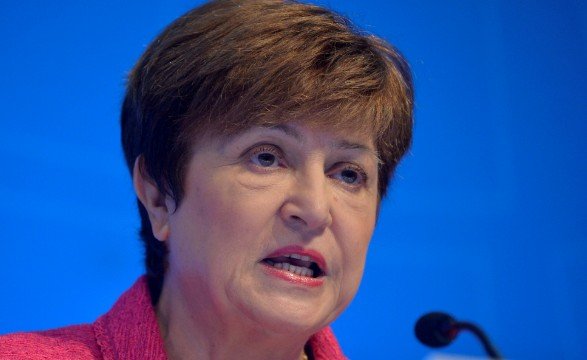
Washington: International Monetary Fund Managing Director Kristalina Georgieva on Monday issued a stark warning over the worsening economic consequences of the ongoing Middle East conflict, saying the global economy could face severe instability if the war stretches into 2027 and crude oil prices surge to nearly $125 per barrel.
Speaking at a conference hosted by the Milken Institute in Washington, Georgieva said rising inflationary pressures were already becoming visible worldwide and that the IMF’s earlier projections based on a short-term conflict were no longer realistic.
According to her, the IMF’s original “reference scenario” had expected only a modest slowdown in global economic growth, forecasting expansion at 3.1 percent alongside inflation near 4.4 percent. However, with the conflict continuing and oil prices remaining elevated, those assumptions have effectively collapsed.
“This scenario, with every day that passes, is moving further into the rear-view mirror,” Georgieva remarked while discussing the rapidly changing economic outlook.
Inflation Pressures Intensify Worldwide
The IMF chief noted that the institution’s “adverse scenario” was already unfolding as energy markets reacted sharply to the prolonged geopolitical crisis. Oil prices hovering around or above $100 per barrel, coupled with supply disruptions and growing uncertainty, were creating stronger inflationary trends across global markets.
Although long-term inflation expectations remain relatively stable for now, Georgieva warned that the situation could deteriorate rapidly if the conflict drags on for another year.
“If this continues into 2027 and oil reaches around $125 per barrel, we are looking at a much worse outcome,” she said. “Inflation would rise significantly, and expectations could become unanchored, creating broader economic instability.”
The IMF had earlier outlined three possible economic scenarios for 2026 and 2027 in response to the war. Its adverse projection predicted global growth slowing to 2.5 percent with inflation climbing to 5.4 percent, while the severe scenario forecast economic growth dropping to just 2 percent alongside inflation nearing 5.8 percent.
Energy Supply Crisis Raises Alarm
Concerns over energy security have also intensified due to disruptions around the strategically critical Strait of Hormuz, through which nearly one-fifth of the world’s crude oil supply previously passed.
Chevron Corporation Chairman and CEO Mike Wirth, who spoke alongside Georgieva during the discussion, warned that prolonged closure or disruption of the shipping route would begin causing real physical shortages in oil supply across several regions.
Wirth stated that Asian economies could be among the first to experience economic contraction as energy demand adjusts to limited supply during the ongoing conflict involving the United States, Israel and Iran.
He added that the longer the strait remains inaccessible, the greater the pressure on industrial production, transportation and manufacturing sectors globally.
Food Prices Could Rise Further
Apart from energy concerns, the IMF is also monitoring the impact of the conflict on international supply chains and agricultural markets.
Georgieva said fertilizer costs had already risen between 30 percent and 40 percent, a development expected to push global food prices higher by roughly 3 percent to 6 percent in the coming months.
She cautioned that disruptions in trade routes and production chains could spread into other industries as well, creating wider inflationary pressures beyond fuel and food.
“What I want to stress is that this is really serious,” she said, expressing concern that many governments still appeared to believe the crisis would end quickly.
According to Georgieva, some policymakers are continuing to introduce measures aimed at protecting consumers and businesses from rising energy costs, which in turn is sustaining strong oil demand despite shrinking supply.
“Don’t throw gasoline on fire,” she warned. “If supply shrinks, demand has to follow.”
The IMF chief’s remarks come amid growing fears among economists and financial markets that a prolonged Middle East conflict could reshape global trade flows, intensify inflation, and weaken economic recovery prospects across both developed and emerging economies.

