


Rajnath Singh Highlights Importance of Surprise Tactics in Modern Warfare
Defence minister highlights importance of surprise attacks in modern combat
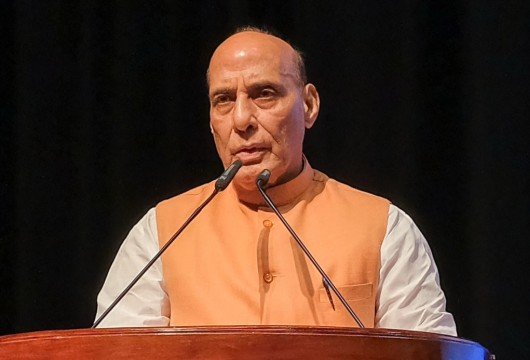
Prayagraj, May 5: Rajnath Singh on Monday stressed that the rapidly evolving nature of global conflicts demands greater preparedness, technological advancement and the ability to surprise adversaries during warfare. Addressing the inaugural session of the three day North Tech Symposium in Prayagraj, Uttar Pradesh, the defence minister said nations that adapt swiftly to technological transformation will gain a decisive advantage in future conflicts.
The symposium was jointly organised by the Indian Army’s Northern and Central Commands along with the Society of Indian Defence Manufacturers and brought together defence officials, industry leaders, innovators, start-ups and academic institutions.
Surprise Tactics Essential in Modern Warfare
Highlighting the strategic importance of unpredictability in military operations, Rajnath Singh said history has repeatedly shown that victory often belongs to the side capable of achieving tactical surprise.
He stated that India’s armed forces are already working towards enhancing such capabilities, but stressed the need for greater proactivity and preparedness. According to him, the country must continue building systems and operational strength that would allow it to respond decisively and unexpectedly whenever required.
The defence minister noted that warfare is changing at an unprecedented speed, driven by technological innovation and evolving global threats.
Technology Reshaping Global Conflicts
Referring to the ongoing Russia-Ukraine War, Rajnath Singh observed that military engagements have transformed dramatically within just a few years. Traditional systems such as tanks and missiles are increasingly being supplemented or replaced by advanced drones, sensors and intelligent surveillance systems.
He also pointed to incidents in Lebanon and Syria involving pager attacks, saying that even ordinary consumer devices can now be weaponised in modern conflict scenarios. Such developments, he warned, underline the urgency for India to remain technologically prepared and adaptable.
According to the minister, future battlefields will rely heavily on innovation, automation and rapid decision-making systems powered by emerging technologies.
Research and Innovation at the Core
Emphasising the importance of scientific research, Rajnath Singh said that future wars are effectively being shaped inside laboratories today. He stated that there is no alternative to research and development in ensuring national security.
The minister highlighted the government’s efforts to strengthen indigenous defence capabilities through the Defence Research and Development Organisation. He noted that DRDO has introduced policies allowing Indian industries free access to several of its patents, a move aimed at improving domestic innovation and enhancing competitiveness in the global defence market.
He urged industries and start-ups to intensify their work in advanced sectors such as Directed Energy Weapons, Hypersonic Weapons, Underwater Domain Awareness, Space Situational Awareness, Quantum Technologies, Artificial Intelligence and Machine Learning.
Operation Sindoor Reflects Preparedness
Praising India’s defence ecosystem, Rajnath Singh said the armed forces and domestic industries have shown the ability to assess changing security environments effectively. He described Operation Sindoor as a notable example of India’s preparedness and technological readiness in handling modern warfare situations.
The defence minister appreciated the collaborative efforts of military establishments, private companies and innovators in strengthening indigenous defence production and operational capabilities.
Military Leadership Highlights Indigenous Solutions
During the symposium, Lieutenant General Anindya Sengupta, General Officer Commanding-in-Chief of the Central Command, said the event offers a vital platform for collaboration between the armed forces, industries, start-ups and academia to develop indigenous technological solutions for operational challenges.
Meanwhile, Lieutenant General Pratik Sharma, General Officer Commanding in Chief of the Northern Command, stated that the primary objective of the symposium is to transform innovative ideas and technological expertise into deployable military capabilities.
An extensive exhibition was also organised as part of the event, featuring indigenous innovations from MSMEs, defence technology firms, start-ups and military innovators. A total of 284 companies participated by setting up stalls showcasing cutting edge defence technologies and solutions aimed at strengthening India’s self-reliance in defence manufacturing.

