


7.8 Quake Strikes Southern Philippines, Tsunami Warnings Raised for Coastal Areas
Power outages reported in parts of Mindanao as authorities urge coastal residents to move to safer locations following the powerful undersea tremor.
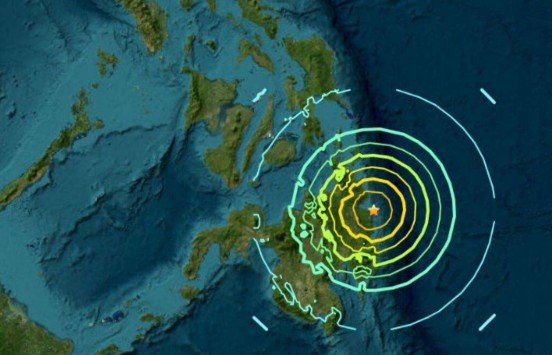
MANILA (Philippines), June 8: A powerful 7.8-magnitude earthquake struck the Mindanao region in southern Philippines early Monday, prompting tsunami warnings across parts of Southeast Asia and triggering precautionary evacuations in vulnerable coastal areas.
According to the Philippine Institute of Volcanology and Seismology, the earthquake occurred at 7:37 a.m. local time. Its epicentre was located about 13 kilometres southwest of General Santos City at a depth of 10 kilometres.
Authorities reported power outages in several areas, while emergency agencies advised residents living near the coast to move to higher ground. There were no immediate reports of casualties or major structural damage.
The Pacific Tsunami Warning Center warned that waves reaching up to three metres could affect certain Philippine coastlines. Smaller waves of up to one metre were forecast for parts of Indonesia and Malaysia.
“We advise people to evacuate to higher grounds or move further inland,” said Teresito Bacolcol, head of the Philippine Institute of Volcanology and Seismology.
Tremors were also felt in Indonesia’s North Sulawesi and North Maluku provinces. The U.S. Geological Survey reported a series of aftershocks, including one measuring 6.1 in magnitude. Initial differences in depth estimates between monitoring agencies were attributed to varying assessment methods commonly used after major seismic events.
Tsunami advisories were also issued for several locations across the western Pacific, including Taiwan, Japan, Guam and Papua New Guinea. Officials, however, confirmed that there was no threat to Hawaii or the mainland United States.
Situated along the Pacific Ring of Fire, the Philippines frequently experiences seismic activity and volcanic eruptions due to the movement of tectonic plates beneath the region. The archipelago is also regularly exposed to tropical storms and typhoons, making it one of the world’s most disaster prone nations.

