


Amit Shah Hails 12 Years of Modi Government as Blend of Development and Cultural Revival
Home Minister says heritage conservation and infrastructure expansion have progressed together under the government's "Vikas Bhi, Virasat Bhi" vision.
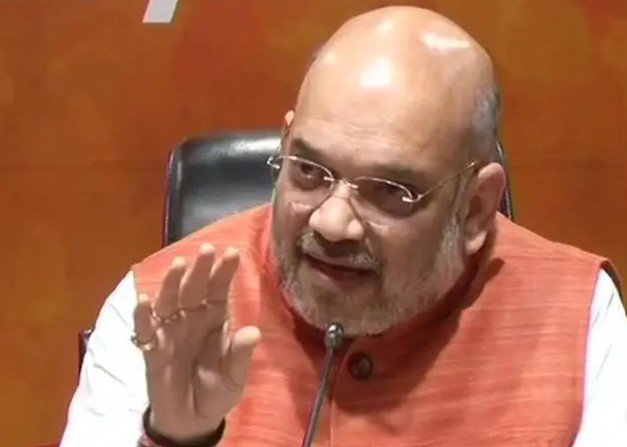
New Delhi, June 18: Union Home Minister Amit Shah on Thursday described the past 12 years of Prime Minister Narendra Modi’s leadership as a period in which economic progress and cultural preservation have advanced hand in hand, creating what he termed a new model of national development.
In a message shared on social media, Shah said the government’s journey since 2014 has been characterized by a unique balance between strengthening India’s civilizational heritage and accelerating modern development. He noted that major religious and cultural projects have been undertaken alongside welfare schemes, infrastructure expansion and manufacturing initiatives aimed at transforming the country’s economic landscape.
The Home Minister pointed to landmark projects such as the Shri Ram Temple in Ayodhya, the Kashi Vishwanath Corridor in Varanasi and the Mahakal Lok development in Ujjain as examples of efforts to restore and showcase India’s cultural and spiritual legacy. According to him, these initiatives have not only enhanced important pilgrimage destinations but have also contributed to tourism, local employment and regional development.
At the same time, Shah highlighted several flagship welfare programmes launched during the past decade. Schemes including Pradhan Mantri Awas Yojana, Ayushman Bharat and food security initiatives have been implemented with the objective of improving living standards and expanding social protection for millions of citizens. He said these measures, coupled with large-scale investments in transport networks and digital infrastructure, have strengthened the foundations of India’s growth story.
The remarks were made as the government showcased achievements completed under the theme “Vikas Bhi, Virasat Bhi,” emphasizing the idea that economic advancement and heritage preservation can complement each other rather than exist as separate policy goals.
According to an official statement, the government has undertaken a wide range of initiatives aimed at protecting and promoting India’s rich cultural assets. These include the digitisation of more than one crore historical records, enabling easier access to valuable archival material and helping preserve important documents for future generations.
The statement also highlighted the successful return of hundreds of ancient artefacts that had been removed from the country over previous decades. Officials said the repatriation of cultural treasures reflects growing international cooperation and India’s increasing efforts to safeguard its historical legacy on the global stage.
Another key area of focus has been the recognition of India’s linguistic and tribal heritage. The government noted that classical language status has been extended to multiple Indian languages, while museums dedicated to tribal freedom fighters have been established in different parts of the country to document and celebrate lesser-known chapters of India’s struggle for independence.
Authorities further pointed to ongoing conservation projects involving temples, monuments and historically significant sites. Restoration work, visitor-friendly infrastructure and heritage city development programmes have been introduced to improve accessibility while protecting cultural landmarks.
The government stated that India’s cultural wealth extends beyond monuments and archaeological sites to include manuscripts, traditional knowledge systems, historical documents and artistic practices. Preserving these assets, it said, is essential for strengthening national identity and ensuring that future generations remain connected to the country’s diverse traditions.
Officials emphasized that heritage development has increasingly been linked with broader economic objectives. Investments in pilgrimage circuits, tourism facilities and heritage destinations have been designed to generate employment opportunities, support local businesses and encourage sustainable regional growth.
The statement also underscored the role of cultural diplomacy in enhancing India’s international profile. Through exhibitions, repatriation efforts and global cultural partnerships, the country has sought to strengthen awareness of its historical contributions and artistic traditions across the world.
Infrastructure development has remained another major pillar of the government’s agenda during the period. Large-scale investments in highways, airports, railway modernization and digital connectivity have been aimed at improving mobility, reducing logistical barriers and supporting economic expansion.
Supporters of the government’s approach argue that integrating cultural preservation with development planning creates a more inclusive model of nation-building. They contend that heritage projects can serve as engines of economic activity while also reinforcing social and cultural continuity.
The government maintains that the combination of welfare initiatives, infrastructure investment and heritage conservation has helped create a comprehensive development framework capable of addressing both contemporary needs and historical responsibilities.
As the administration completes 12 years in office, officials continue to present the “Vikas Bhi, Virasat Bhi” approach as a defining feature of its governance philosophy. The strategy seeks to ensure that modernization and progress move forward without losing sight of India’s cultural roots and civilizational identity.
With ongoing projects in tourism, conservation, digital archiving and public infrastructure, the government says its long-term objective remains the creation of a developed India that draws strength from both innovation and tradition. The initiatives undertaken over the past decade, according to the administration, represent an effort to preserve the country’s heritage while simultaneously building the foundations for future growth.

