


India Rejects China’s Version of Jaishankar-Wang Yi Talks, Issues Strong Rebuttal
MEA rejects Beijing's account of the Manila meeting, reiterates concerns over Chinese occupation, CPEC projects, and the need for peace along the border.
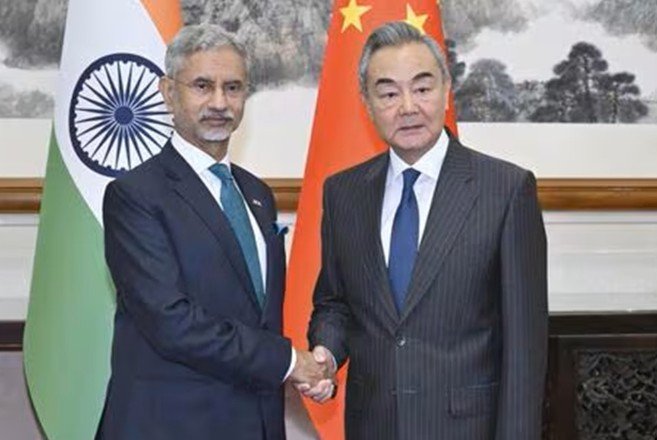
NEW DELHI, Jul 24: India on Friday strongly rejected China’s interpretation of External Affairs Minister S. Jaishankar’s recent meeting with Chinese Foreign Minister Wang Yi, asserting that New Delhi has never violated China’s sovereignty. Instead, the government maintained that Beijing continues to occupy Indian territories in Jammu and Kashmir and Ladakh illegally while carrying out infrastructure projects in disputed areas.
The Ministry of External Affairs (MEA) issued the clarification after China released an official statement regarding the bilateral talks held in Manila on Wednesday. The Chinese readout claimed that Jaishankar had assured Beijing that India respected China’s sovereignty, including on sensitive matters such as Taiwan and Tibet.
However, official sources in New Delhi categorically denied that such assurances were made during the meeting.
Addressing the issue during a weekly media briefing, MEA spokesperson Randhir Jaiswal said the Chinese version of the discussions did not accurately reflect India’s position.
According to Jaiswal, whenever questions related to sovereignty arise, it is India that has legitimate concerns to raise. He emphasized that India has consistently respected China’s territorial integrity, unlike Beijing, which continues to occupy areas that belong to India.
The spokesperson reiterated that China has remained in illegal occupation of parts of Jammu and Kashmir and Ladakh since 1963. He also noted that China’s activities in these territories continue despite India’s repeated objections.
India further criticized Chinese infrastructure and connectivity projects being implemented in Pakistan-occupied Kashmir (PoK) and the Shaksgam Valley, territories that New Delhi considers an integral part of India. Officials stressed that such projects violate India’s sovereignty and have been opposed by successive governments.
The remarks once again brought attention to the China-Pakistan Economic Corridor (CPEC), a flagship component of China’s Belt and Road Initiative. India has consistently objected to the corridor because it passes through Pakistan-occupied Kashmir, arguing that it disregards India’s territorial claims and undermines its sovereignty.
The Jaishankar-Wang meeting took place on the sidelines of the Association of Southeast Asian Nations (ASEAN) ministerial engagements in the Philippine capital, Manila. The discussions formed part of ongoing diplomatic efforts aimed at managing bilateral ties following years of heightened tensions.
During the meeting, Jaishankar underlined that restoring peace and stability along the Line of Actual Control (LAC) remains essential for improving overall relations between the two Asian neighbours. He emphasized that the future of India-China ties should be guided by the principles of mutual respect, mutual interest and mutual sensitivity.
The External Affairs Minister also highlighted several economic concerns affecting bilateral relations. These included limited market access for Indian businesses, the widening trade imbalance between the two countries, and uncertainties surrounding supply chains that continue to affect commerce.
India and China have initiated several confidence-building measures in recent months to stabilize their relationship after the prolonged military standoff in eastern Ladakh that began in 2020. While both sides have made progress through diplomatic and military dialogue, New Delhi has maintained that lasting normalization depends on complete peace along the border and respect for existing agreements.
Friday’s response from the MEA reflects India’s determination to challenge any public narrative that differs from its stated diplomatic position. By firmly rejecting the Chinese readout, New Delhi reaffirmed that sovereignty and territorial integrity remain central to its engagement with Beijing, even as both countries continue efforts to improve bilateral relations through sustained dialogue.

