


CS Launches QR Code-Based Anganwadi Centres in J&K; Reviews ECC&E Initiatives of the Social Welfare Department
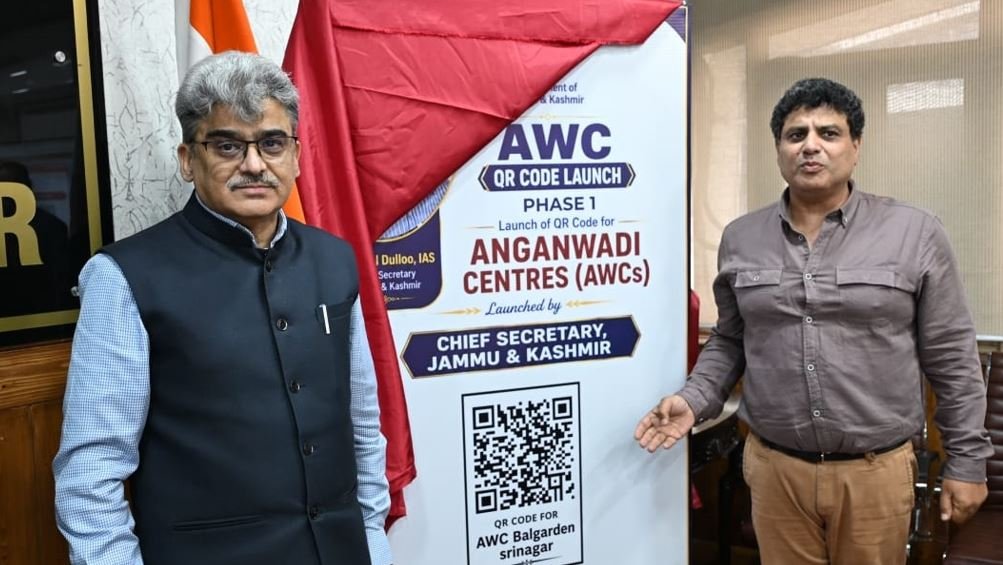
SRINAGAR, JULY 29: In a significant step towards strengthening transparency, digital governance and quality service delivery under Mission POSHAN, the Chief Secretary, Atal Dulloo, today launched the QR Code-based Anganwadi Centre (AWC) initiative in Jammu and Kashmir.
The initiative marks a major milestone in leveraging digital technology to make Anganwadi Centres more accessible, transparent and accountable while empowering citizens with real-time information about services being delivered at the grassroots level.
The launch was held during a review meeting convened by the Chief Secretary to assess the progress achieved by the Social Welfare Department in the implementation of Early Childhood Care and Education (ECCE) across the Union Territory.
The meeting besides Commissioner Secretary, Social Welfare Department was attended by Commissioner Secretary, Planning; Commissioner Secretary, Education; Secretary, RDD; MD, Mission Poshan; Representatives from BISAG-N and other concerned officers.
The Chief Secretary congratulated the Social Welfare Department for embracing digital innovations aimed at improving governance and enhancing public service delivery. He observed that technology should become an effective instrument for improving the quality of services at the grassroots level and ensuring greater citizen engagement.
The Commissioner Secretary, SWD, Sarmad Hafeez while speaking on this occasion revealed that the QR Code initiative has been developed by the Department in collaboration with BISAG and the Information Technology Department. He added that every Anganwadi Centre in the Union Territory has been assigned a unique QR Code, enabling citizens to instantly access comprehensive information regarding the respective Anganwadi Centre.
The platform hosts details relating to Anganwadi Workers and Helpers, beneficiaries, supplementary nutrition, services being delivered, infrastructure available, government schemes, events organised and other important information, thereby promoting greater transparency, accountability and public participation.
Reviewing the implementation of the Early Childhood Care and Education programme, the Chief Secretary emphasised the need for greater digital convergence across departments to create a comprehensive digital profile of every child.
He directed the Social Welfare Department to engage with BISAG-N for integration of APAAR records of the School Education Department, ABHA (Ayushman Bharat Health Account) of the Health Department and U-WIN, the national digital platform for immunisation, with the QR Code-based Anganwadi ecosystem.
He observed that such convergence would enable consolidation of a child’s educational, health, immunisation and other developmental records on a single digital platform, thereby ensuring seamless tracking of the child’s overall growth, facilitating informed interventions and improving inter-departmental coordination.
Highlighting the importance of inclusive and child-centric learning, the Chief Secretary observed that several reputed institutions across the country have developed scientifically designed play-based learning modules for addressing developmental, behavioural, health-related and curriculum-specific challenges faced by children with diverse learning needs.
He advised the Social Welfare Department to study these best practices and explore the possibility of adopting and customising such evidence-based modules to suit the socio-cultural context and specific requirements of children in Jammu and Kashmir.
He said that introducing innovative, play-based pedagogical interventions would further enrich the Early Childhood Care and Education framework and help ensure holistic development of every child, particularly those requiring additional learning and developmental support.
During the meeting, the Managing Director, Mission POSHAN, Sajad Hussain Ganai, gave a comprehensive presentation on the initiatives being undertaken to strengthen Early Childhood Care and Education (ECCE) across Jammu and Kashmir. He highlighted the Mission’s multi-pronged strategy encompassing digital integration, infrastructure development, capacity building of frontline workers, community participation, and convergence of health, nutrition and early learning services.
The Chief Secretary was informed about the successful implementation of digital initiatives, including universal Aadhaar enrolment of beneficiaries, generation of ABHA and APAAR IDs, mapping of all Anganwadi Centres on the Gati Shakti Portal and the development of an advanced Anganwadi Tracking Application.
The presentation also covered the co-location of Anganwadi Centres with schools to ensure a seamless transition to formal education, besides the ongoing upgradation of centres under the Saksham Anganwadi Programme and Bal Vidyalaya Scheme with modern, child-friendly infrastructure.
It was also highlighted that focused interventions for children aged 0–3 years under the Navchetana initiative through structured home visits and early stimulation activities, while children in the 3–6 years age group are being imparted activity-based learning under the Aadharshila curriculum to enhance school readiness.
The Chief Secretary also reviewed the delivery of integrated health and nutrition services through Village Health Sanitation and Nutrition Days (VHSNDs), including immunisation, growth monitoring, maternal care, anaemia screening and nutritional support.
Stressing the need for greater convergence among stakeholder departments, he called upon all concerned to transform every Anganwadi Centre into a vibrant hub of early learning, nutrition, health and community engagement, observing that investment in early childhood development lays the foundation for a healthier, better educated and more productive society.

