


Carbon Credit Financing Seen as Africa’s Key Path to Expanding Clean Cooking
Carbon credit backed funding is helping make induction and cleaner stoves affordable for millions still dependent on charcoal and firewood
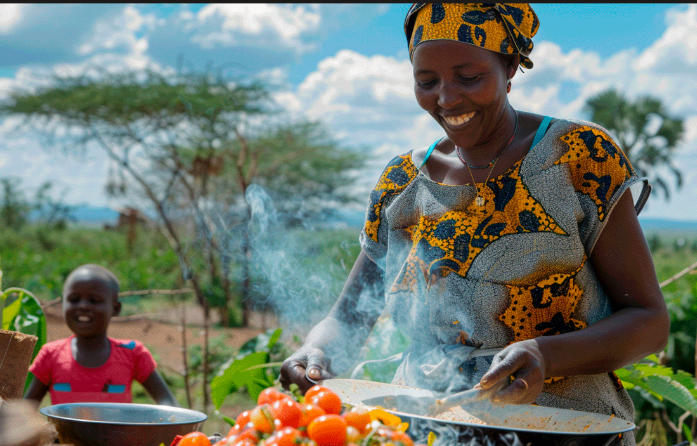
NAIROBI, Sept 7: Carbon credit financing is emerging as a major source of funding for clean cooking solutions across Africa, helping households move away from charcoal and firewood while making cleaner technologies more affordable.
For Nairobi businesswoman Mary Kavutha, the change has brought both financial and health benefits. She now uses an induction cooker to prepare meals for her two young children, replacing a charcoal stove that previously filled her home with smoke.
Kavutha said she can cook several meals using about 80 cents worth of electricity tokens, compared with roughly USD 1.15 that she previously spent on charcoal each day. She also said the electric cooker is faster and safer for her family.
Nearly one billion people across Africa continue to depend on charcoal or firewood for cooking. The International Energy Agency estimates that household air pollution associated with these fuels contributes to around 850,000 deaths each year across the continent.
For many households, however, the decision to adopt cleaner cooking technology is driven less by climate concerns than by affordability.
Carbon credits lower the cost of cleaner stoves
Carbon finance has enabled clean cooking companies to subsidise equipment by raising upfront capital against expected revenues from emission reductions.
Peter Scott, founder and CEO of Nairobi-based clean cooking company BURN, said carbon project financing is crucial if cleaner cooking is to reach millions of African households.
BURN says it has distributed more than 7.3 million cookstoves across 11 African countries. The company uses carbon-credit revenues to reduce the cost of products that would otherwise remain beyond the reach of many low-income families.
An efficient biomass stove that could normally cost about USD 40 may be sold for as little as USD 5 after carbon subsidies. More expensive electric cooking devices, including induction cookers, can also be financed through carbon credits and short-term pay-as-you-go arrangements.
Under the model, investors provide capital to help subsidise and distribute the equipment. They can then receive revenue from carbon credits generated when households reduce their consumption of charcoal, wood and other polluting fuels.
Africa increases investment in clean cooking
Momentum behind the transition has grown in recent years.
The IEA announced in June that Africa had secured USD 900 million in new financial commitments for clean cooking technologies.
More than 30 governments, representing countries where roughly 80 per cent of Africans without access to clean cooking live, have introduced 121 new policies since the 2015 Paris climate summit, according to the agency.
African governments have increasingly recognised access to clean cooking as an essential energy and public-health issue. Tanzania’s President Samia Suluhu has described it as an everyday necessity affecting households across the continent.
The push also follows the African Union’s Dar es Salaam Declaration on Clean Cooking, adopted by 30 governments last year.
Carbon market credibility remains a concern
Despite the growth of carbon-backed financing, the model continues to face scrutiny over the credibility and reliability of carbon credits.
The clean cooking sector has responded by introducing stronger monitoring and verification systems. Companies are increasingly using Bluetooth-enabled devices, digital verification tools and real-time data to track stove usage and calculate emissions reductions.
However, critics caution that carbon finance should complement rather than replace other sources of investment.
George Mwaniki, WRI Kenya representative and head of Air Quality for WRI Africa, said carbon funding generally becomes available only after companies have already invested in manufacturing and distributing equipment.
This creates a financing gap because businesses need substantial upfront capital before households begin generating the emissions reductions that can eventually produce carbon credits.
The collapse of Kenyan clean cooking company Koko Networks in February highlighted some of the risks facing the sector. The company had been widely viewed as an example of Africa’s green transition but shut down after failing to secure government authorisation to sell carbon credits.
Companies tailor solutions to local needs
Clean cooking companies are increasingly adapting their technologies to the energy resources and consumer preferences of individual countries.
BURN says electric cooking is more viable in Kenya and Tanzania, while biomass powered solutions are more popular in countries such as the Democratic Republic of Congo and Madagascar.
Uganda-based Eco Safi operates in Uganda, Kenya and Malawi, providing forced draft pellet stoves and renewable fuel produced from agricultural waste.
In Rwanda, BioMassters manufactures solar-powered pellet stoves and biomass residue fuel, while Kigali-based ENEDOM produces briquettes from agricultural residues.
The variety of approaches reflects the different energy systems, incomes and cooking habits found across Africa.
Affordability remains the biggest driver
For households such as Kavutha’s, the benefits of the transition are immediate: lower cooking costs, less indoor smoke and a safer environment for children.
Her experience illustrates why affordability could prove more important than climate messaging in accelerating adoption.
With carbon financing helping to reduce the initial cost of cleaner cooking equipment, millions of households could gain access to technologies that were previously too expensive.
For Kavutha, the outcome is straightforward: a cleaner kitchen, safer children and lower household expenses.

