


India’s Chess Teams Stay in Medal Hunt After Dramatic Day at Olympiad
India’s men were held by Azerbaijan while Savitha Shri rescued the women’s team against Kazakhstan as both sides remained in contention after Round 8.
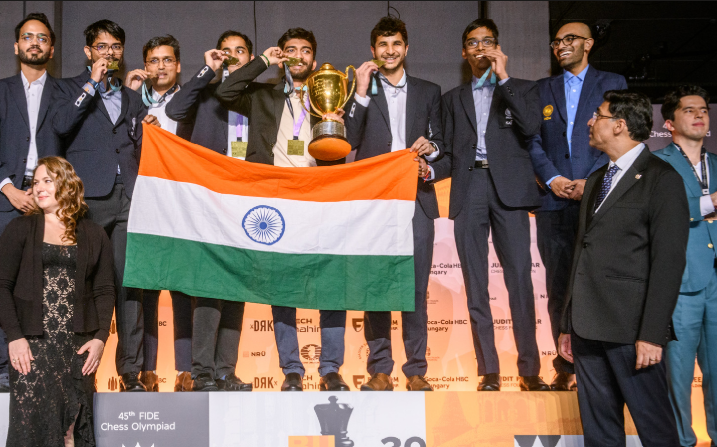
NEW DELHI, Sept 25: India remained firmly in the medal race at the 2026 Chess Olympiad after contrasting results in Round 8, with the men’s team drawing against Azerbaijan and the women’s side being rescued by a decisive performance from Savitha Shri.
The Indian men were unable to take advantage of a major opportunity after leaders Uzbekistan suffered a surprise defeat against Germany. India were held to a 2-2 draw by Azerbaijan, leaving them short of the chance to close the gap at the top of the standings.
The result was frustrating for the Indian team because Azerbaijan presented a difficult but manageable challenge. With Uzbekistan losing, a victory would have significantly improved India’s position in the standings. Instead, the draw meant the race remained open with the later rounds still to come.
India entered the contest aware that every half-point could prove important during the closing stages of the Olympiad. The team has been among the leading contenders throughout the tournament, but the demanding schedule has placed increasing pressure on the players to produce results against strong opposition.
The match against Azerbaijan reflected that competitive balance. Neither side was able to establish enough of an advantage to secure the overall victory, resulting in a 2-2 scoreline.
The missed opportunity came shortly after Germany produced one of the biggest results of the round by defeating Uzbekistan. That outcome created the possibility of India making significant progress in the standings, but the draw prevented the hosts from fully capitalising on the result elsewhere.
India’s women, meanwhile, faced their own tense battle against Kazakhstan. Savitha Shri became the key figure after producing another important individual performance to secure the result for her team.
Savitha’s contribution was particularly valuable because she had remained unbeaten in the tournament and entered the match with a perfect seven points from seven games. Her performance against Kazakhstan once again demonstrated her importance to the Indian lineup.
The women’s contest was finely balanced, but Savitha managed to provide India with the result it needed. Her win ensured the team avoided a setback and kept its campaign alive in a tightly contested field.
The performance has added to Savitha’s growing reputation during the Olympiad. Rather than simply contributing to the team’s score, she has repeatedly delivered at important moments, giving India a reliable source of points as the competition approaches its decisive stages.
India’s strong performances in the women’s event have been supported by a combination of experienced players and emerging talent. The team’s depth has been important during a tournament in which players are required to compete repeatedly over a demanding schedule.
The men’s draw against Azerbaijan also highlighted the difficulty of the final stages of the competition. At this point in the Olympiad, leading teams are facing opponents with strong preparation and little margin for error.
India’s challenge is therefore not limited to winning individual games. The players must also manage the tournament’s overall rhythm, with each round potentially changing the standings at the top.
The defeat of Uzbekistan against Germany provided a reminder of how quickly the table can change. A team that appears secure at the top can lose valuable ground in a single round, while a successful result can dramatically improve the position of another contender.
For India, the next rounds will therefore be crucial. The men’s team needs to convert strong individual performances into match victories, while the women’s side will look to maintain consistency after being kept in contention by Savitha’s latest contribution.
The Olympiad has also highlighted the growing strength of Indian chess across both sections. India has developed a deep pool of elite players, allowing the country to field highly competitive teams while also providing opportunities for younger players to gain experience at the highest level.
Savitha’s run has been one of the notable individual stories of the tournament. Her perfect start through seven rounds placed her among the standout performers, and her ability to deliver against Kazakhstan further strengthened India’s position in the women’s competition.
The men’s team, meanwhile, will need to put the Azerbaijan result behind them quickly. The 2-2 draw was not a defeat, but given the circumstances of the round, it represented a chance missed after Uzbekistan dropped points against Germany.
The competitive nature of the standings means that India cannot afford to rely on results elsewhere. Winning their own matches will remain the clearest route toward staying in the medal race.
The upcoming rounds will also test the ability of the players to maintain concentration. Chess Olympiads are decided over a long sequence of games, and even small errors can have major consequences when teams are separated by narrow margins.
India’s women have shown the value of resilience, with Savitha’s result against Kazakhstan providing an important example. The team will now seek contributions from the entire lineup as it moves toward the final rounds.
For the men’s side, the draw against Azerbaijan means there is still plenty to play for. The result kept India in contention rather than eliminating its medal hopes, but the team will need stronger results in the remaining matches.
The Round 8 results have consequently added another layer of intrigue to India’s campaign. Uzbekistan’s defeat opened the door, Germany took advantage of it, and India’s draw left the standings closely contested.
As the Olympiad enters its decisive phase, India’s focus will turn to securing maximum points in the remaining rounds. The men’s team will look to turn its competitive performances into victories, while the women’s squad will hope Savitha and her teammates can continue their strong run.
The next matches could determine whether India’s teams convert their promising campaigns into podium finishes. For now, both remain in the medal conversation after a dramatic Round 8 that produced contrasting results and reshaped the race at the top.

