


Education Minister Launches Seva First Innovation Challenge 2026 to Encourage Student Innovation
School, ITI, polytechnic, college and university students invited to develop practical solutions for everyday problems.
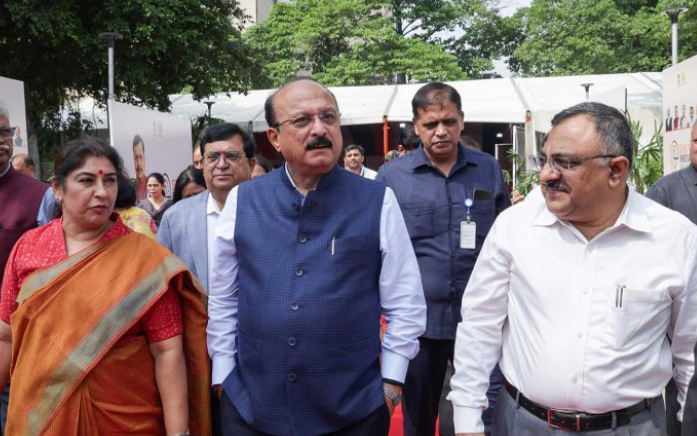
New Delhi, Sep 26 : Union Education Minister Pralhad Joshi on Friday launched the Seva First Innovation Challenge 2026 at the Indian Institute of Science (IISc) in Bengaluru, calling upon young people to identify real life problems and develop practical, affordable solutions that can improve everyday life.
The initiative brings together students from schools, Industrial Training Institutes (ITIs), polytechnics, colleges and universities and seeks to give young innovators an opportunity to move beyond identifying problems and work towards developing solutions that can eventually be implemented.
Speaking at the launch of the South Zone edition of the challenge at IISc Bengaluru on September 25, Joshi said young people can play an important role in finding solutions to challenges faced by communities. He encouraged students to approach innovation from the perspective of public needs and focus on ideas that can have practical applications.
According to the information shared during the launch, participants will be encouraged to identify problems around them and work on innovative responses. The challenge is intended to provide a platform where students can develop their ideas from the initial stage through experimentation and prototyping.
The initiative also aims to connect young innovators with mentors and institutions that can help them strengthen their ideas. Promising concepts are expected to receive continued support through mentoring and incubation, creating a pathway for selected projects to move beyond prototypes towards wider adoption.
The Education Minister also urged startups and industry partners to participate in the process by mentoring young innovators. Such partnerships can provide students with exposure to practical requirements, technical expertise and possible avenues for taking their projects further.
The challenge is being positioned within India’s broader innovation ecosystem, which includes initiatives such as tinkering laboratories, Innovation Councils and the Smart India Hackathon. Joshi highlighted the expansion of startups and patents while stressing the importance of innovation in areas such as renewable energy, green hydrogen and emerging technologies.
The emphasis on practical problem-solving is significant for students because it gives them an opportunity to apply classroom learning to situations outside the traditional academic environment. Instead of limiting innovation to theoretical concepts, participants can examine challenges in their communities and explore how technology, design and scientific knowledge can be combined to address them.
The challenge is open to a broad range of learners. By including school students alongside students from technical and higher education institutions, the initiative seeks to create participation across different stages of education. This also provides younger students with an opportunity to become familiar with innovation and entrepreneurship before entering higher education.
The programme’s organisers are encouraging students to consider problems that affect ordinary people and develop solutions that are practical and affordable. This approach places emphasis not only on technological sophistication but also on whether an idea can address an identifiable need.
During the launch, Joshi interacted with students and took an interest in their ideas and innovations. He encouraged participants to focus on solutions that could contribute to society and said India’s young population has an important role in developing solutions for the country and the wider world.
The registration portal for the Seva First Innovation Challenge 2026 was launched at IISc Bengaluru on September 25. Students interested in participating have been given time to submit their applications, with the application facility scheduled to remain open until October 24, according to education-sector reports.
The initiative comes at a time when educational institutions are increasingly placing emphasis on innovation, entrepreneurship, interdisciplinary learning and practical skills. For students, participation in such programmes can provide experience in identifying a problem, researching possible approaches, developing prototypes and communicating an idea to mentors or industry representatives.
The inclusion of ITI and polytechnic students is also notable because their technical and vocational training can be directly connected with problem-solving and product development. Students from these institutions can contribute practical perspectives in areas where hands-on skills are particularly important.
College and university students, meanwhile, can use their academic and research backgrounds to explore more complex challenges. Bringing these groups together can create opportunities for ideas to emerge from different educational backgrounds.
The programme also reflects an effort to strengthen links between education and the innovation ecosystem. Mentoring and incubation can help students understand the stages that follow the development of an idea, including testing, refinement and potential implementation.
However, the success of individual projects will depend on their development after the initial challenge stage. Moving an idea from a classroom or prototype environment to real-world use generally requires technical validation, resources, mentoring and sustained institutional or industry support.
The Seva First Innovation Challenge therefore provides a platform for students to begin that process. Its focus on practical problems gives participants an opportunity to connect academic knowledge with community needs while gaining experience in innovation.
With registrations now underway, students from eligible educational institutions can use the challenge to present ideas aimed at addressing everyday problems. The initiative’s organisers are expected to support promising concepts through mentoring and incubation, giving selected participants an opportunity to further develop their projects.
The launch at IISc Bengaluru marks the beginning of the 2026 edition of the challenge and places student led innovation at the centre of an education initiative involving multiple levels of learning. The programme will provide participating students with an avenue to experiment with ideas while exploring how innovation can be translated into practical solutions.

