


India Beat Pakistan to Retain Asian Games Cricket Gold
Abhishek Sharma and Tilak Varma power India to 211 before bowlers hold Pakistan to 192 in a thrilling 19-run final victory.
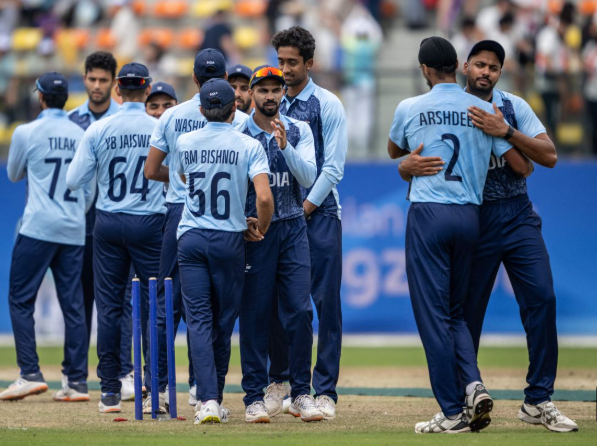
Nisshin, Oct 3: India produced a composed all round performance to defeat Pakistan by 19 runs in the men’s T20 cricket final at the 2026 Asian Games on Saturday, successfully defending the title they won at Hangzhou three years ago.
The high-profile contest at Korogi Sports Park saw India post 211 for six after choosing to bat first, with Abhishek Sharma providing the early momentum before Tilak Varma delivered a spectacular finish. Pakistan, despite a determined chase led by Hasan Nawaz, could manage 192 for six in their 20 overs.
The victory gave India another gold medal at the Aichi-Nagoya Games and added a memorable chapter to the long-running sporting rivalry between the neighbouring countries. It also completed a cricket double for India after the women’s team had earlier secured gold with a commanding victory over Sri Lanka.
India’s decision to bat first immediately paid dividends as Abhishek Sharma attacked the Pakistani bowling from the opening overs. The left-hander scored 61 from only 28 deliveries, striking seven sixes and giving India the kind of rapid start needed to build a substantial total.
His aggressive approach put Pakistan’s bowlers under pressure and allowed India’s middle order to play with greater freedom. Abhishek’s innings was particularly important because India needed to establish a strong platform on a surface where batting conditions could change as the match progressed.
After the opening burst, India continued to score at a healthy rate. Pakistan attempted to slow the scoring through changes in bowling and field placements, but India maintained enough momentum to remain in control.
Tilak Varma then transformed the final stages of the innings with a remarkable display of power hitting. The left-hander remained unbeaten on 51 from just 22 balls, ensuring that India crossed the 200-run mark and finished with the highest total of the men’s competition.
Tilak’s unbeaten half-century was especially significant because it came under enormous pressure. With the innings approaching its conclusion, India needed a substantial final push, and the batter responded with calculated aggression rather than taking unnecessary risks.
His contribution meant Pakistan faced a target of 212, requiring a fast start and sustained scoring throughout the chase.
Pakistan’s response began positively, but India’s bowlers managed to create pressure at important stages. The defending champions understood that wickets would be more valuable than simply restricting boundaries, particularly against a batting line-up capable of producing rapid runs.
Hasan Nawaz emerged as Pakistan’s principal threat. He played an aggressive innings and kept the chase alive deep into the second half of the innings. His 96 gave Pakistan hope that the target could still be reached despite the asking rate continuing to rise.
However, India remained disciplined during the crucial overs. The bowlers avoided allowing Pakistan to build the kind of uninterrupted partnership that could have changed the direction of the match.
Pakistan eventually finished on 192 for six, leaving India 19 runs short of the target.
The result was India’s second consecutive men’s Asian Games cricket gold. The achievement was particularly important because the tournament provided another opportunity for emerging players to perform on a major international stage.
Captain Shreyas Iyer’s leadership also played a significant role. India opted to bat after winning the toss, a decision that allowed the team to put pressure on Pakistan with a sizeable first-innings score.
The match began with an additional layer of tension after Iyer and Pakistan captain Sahibzada Farhan did not shake hands at the toss. The practice has continued during India-Pakistan cricket meetings since last year’s Asia Cup, adding further attention to an already highly watched fixture.
Despite the intense atmosphere, the Indian side maintained its focus once the game began.
For Abhishek, the final represented another statement of his ability to perform in pressure situations. His 61 provided India with a platform from which the rest of the batting line-up could attack.
Tilak’s finishing effort then ensured that Pakistan had little margin for error. His unbeaten 51 from 22 balls gave India the late acceleration required to move beyond the 200-run barrier.
The Pakistan innings, meanwhile, demonstrated considerable resistance. Hasan Nawaz’s 96 was one of the standout individual efforts of the tournament and kept his side in contention until the closing stages.
Pakistan’s inability to convert that individual performance into a winning partnership ultimately proved decisive.
India’s success was part of a strong final-day surge at the Asian Games. The country’s athletes collected several medals across disciplines as the Games approached their conclusion, with cricket and hockey among the most prominent team achievements.
The men’s hockey side also successfully defended its Asian Games title on Saturday, defeating Malaysia 5-1 in the final. The victory secured another gold for India and also earned the team qualification for the 2028 Los Angeles Olympics.
India’s cricket triumph therefore came during a particularly productive closing phase of the continental competition.
The women’s cricket team had already won gold after defeating Sri Lanka by 147 runs, meaning India finished the cricket programme with titles in both men’s and women’s competitions. Sri Lanka secured bronze in the men’s event after defeating Bangladesh.
The Asian Games cricket tournament also offered a glimpse into the depth available to both India and Pakistan. Several players were given the opportunity to perform in a major competition, and the final showed that the next generation of cricketers can handle the pressure associated with one of the sport’s most closely followed rivalries.
For India, the significance of the victory goes beyond the medal. The team successfully defended its previous Asian Games crown, handled the pressure of a final against Pakistan and produced the highest total of the men’s competition.
The combination of Abhishek’s explosive start, Tilak’s remarkable finishing and a disciplined bowling effort ultimately separated the two sides.
Pakistan came close enough to make India work for the title, but the defending champions remained composed when the match entered its decisive phase.
India’s 19-run victory consequently ended the men’s cricket competition with another gold medal for the country and ensured that the Asian Games rivalry between the two sides produced another memorable final.
With the continental Games now concluding, India’s cricket campaign will stand among the major highlights of its 2026 Asian Games performance.

