


Karnataka Plans AI Education From Class 6 in Government Schools
The state government is working to expand artificial intelligence training beyond Class 9 and is also examining plans for a dedicated AI university.
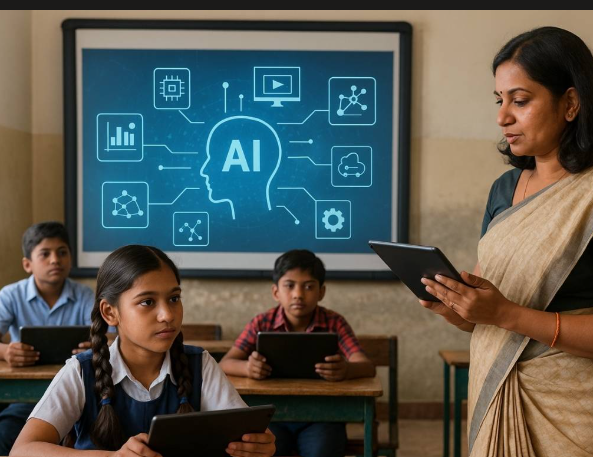
Bengaluru, Oct 6: Karnataka is preparing to expand artificial intelligence education in government schools, with the state government directing officials to explore introducing AI training from Class 6.
The proposal marks an effort to bring emerging technology into school education at an earlier stage and give students greater exposure to artificial intelligence before they reach higher classes. At present, AI training has already begun for Class 9 students in government schools, and the government now wants to examine how the programme can be extended to younger learners.
Deputy Chief Minister D K Shivakumar issued directions to officials regarding the proposed expansion. He also asked authorities to examine initiatives through which technology companies can contribute to AI education and directed them to identify suitable land for establishing an AI university in the state.
The move comes at a time when artificial intelligence is becoming increasingly important across education, employment, research and industry. Introducing students to the subject during their school years could help them develop a basic understanding of AI concepts and encourage them to consider technology-oriented careers.
AI learning to begin earlier
Under the existing arrangement, AI-related training has already reached Class 9 students in Karnataka’s government schools. The proposed extension to Class 6 would bring the subject to students several years earlier.
Officials have been asked to work towards developing an appropriate framework for younger students. Such a programme would need to take into account the age and learning levels of children while ensuring that technology education complements their regular subjects.
At the middle-school level, AI education could focus on basic concepts, digital awareness, problem-solving and responsible use of technology rather than highly technical programming. As students progress to higher classes, the curriculum could gradually introduce more advanced concepts.
The government’s proposal therefore has implications not only for the content taught in classrooms but also for teacher preparation, digital infrastructure and access to suitable learning resources.
Technology industry participation
The state is also looking at collaboration with technology companies to strengthen AI education. According to the reported government statement, Google has expressed interest in providing AI training in schools, and officials have been asked to examine initiatives undertaken by the company in Telangana.
Partnerships with technology organisations could give schools access to specialised training material, instructors and practical learning opportunities. However, implementing such programmes across government schools would require careful planning to ensure that students in different parts of the state receive comparable opportunities.
Teacher training will be another important element. Educators would need sufficient knowledge of AI-related concepts and classroom methods before they can effectively introduce the subject to younger students.
The programme would also have to address differences in digital infrastructure between schools. While some institutions may already have computer laboratories and reliable internet connections, others could require additional facilities.
Proposal for AI university
Alongside school-level training, the government has asked officials to identify land for establishing an AI university in Karnataka.
A specialised institution could create opportunities for advanced education and research in artificial intelligence and related fields. It could potentially support undergraduate and postgraduate programmes, industry collaboration and research projects.
Karnataka already has a substantial technology ecosystem, particularly in Bengaluru. A dedicated AI-focused institution could therefore be positioned within an environment where technology companies, startups and research organisations are active.
The proposed university would also create a possible pathway for students introduced to AI in school to pursue the subject at higher levels.
Changing requirements in education
Artificial intelligence is rapidly influencing professional fields ranging from software development and finance to healthcare, manufacturing, education and communications. This has increased pressure on education systems to prepare students for a workplace in which familiarity with digital technologies is becoming increasingly important.
Introducing AI concepts at school level does not necessarily mean turning every student into a technology specialist. Instead, early exposure can help students understand how automated systems work, how data is used and what responsible technology use means.
For younger learners, the emphasis could be on developing curiosity and analytical thinking. Students could learn through projects, problem-solving activities and age-appropriate digital tools.
As they advance through secondary education, those interested in the subject could receive opportunities to explore coding, machine learning, data analysis and other specialised areas.
Teacher training remains crucial
The proposed expansion will also place greater demands on teachers. A programme introduced from Class 6 would require educators to understand both the technology and the appropriate teaching methods.
Professional development programmes could help teachers become familiar with basic AI concepts and classroom applications. Training would also need to cover issues such as data privacy, online safety and responsible use of AI-generated content.
The quality of implementation will depend substantially on how teachers are supported. Simply adding AI as a topic without adequate training or infrastructure could limit its educational value.
Bridging the digital divide
Another issue will be ensuring that the programme reaches students equally. Government schools serve communities with different levels of access to computers, smartphones and high-speed internet.
A statewide AI education programme would therefore need to account for these variations. Schools with limited infrastructure may require additional equipment, connectivity and technical support.
Providing common learning resources could also help reduce differences between institutions. Offline material and classroom-based activities could complement online tools where connectivity remains limited.
Preparing students for the future
The Karnataka government’s proposal reflects the broader shift towards technology-oriented education. Beginning AI exposure in Class 6 could give students more time to understand the subject and determine whether they want to pursue it further.
The initiative also comes alongside the state’s plan to explore a dedicated university for artificial intelligence. Together, the two proposals point towards an education pipeline stretching from school level awareness to specialised higher education.
The immediate task, however, will be to turn the proposal into a workable curriculum and ensure that teachers and schools have the resources needed to deliver it.
If implemented effectively, early AI education could become an important component of Karnataka’s broader technology and skills strategy. The success of the initiative will ultimately depend on curriculum quality, teacher preparation, infrastructure and equal access for students across the state.

