


Russia Thrash India 8-0 in Women’s Football Friendly in Kolkata
India struggle to contain Russia’s attacking strength as the visitors score five goals before half time and add three more after the break.
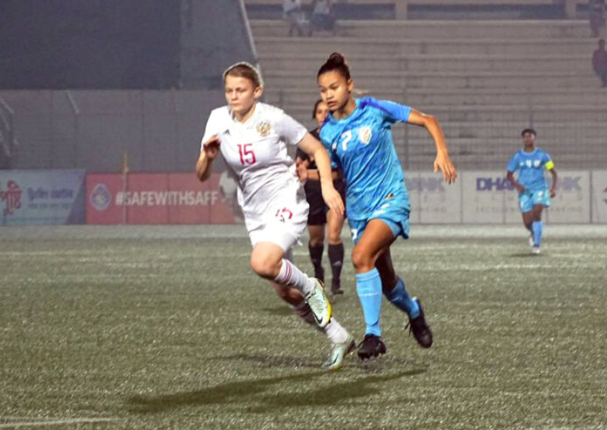
KOLKATA, Oct 12: India suffered a heavy 8-0 defeat against Russia in the second unofficial international friendly at the Kishore Bharati Krirangan in Kolkata on Sunday, as the visitors once again exposed the gap between the two sides in women’s football.
Russia, ranked 27th in the world, dominated the contest after breaking India’s resistance in the 22nd minute. The opening goal triggered a sustained attacking spell, with the visitors scoring five times before the interval and adding three more goals in the second half.
The result followed Russia’s 4-0 victory in the first friendly played on Thursday. Despite making changes to their starting line-up for the return fixture, the visitors maintained their superiority and continued to trouble the Indian defence throughout the encounter.
India head coach Crispin Chettri attempted to respond through tactical adjustments and substitutions, but his team struggled to deal with Russia’s movement, passing and finishing in the attacking third.
The defeat was a difficult outcome for the home side, which had managed to hold its opponents at bay during the opening 21 minutes. However, once Russia found the breakthrough, India’s defensive structure came under increasing pressure.
Early resistance ends with Russia’s opening goal
India began the match with a cautious approach, concentrating on defensive organisation and attempting to restrict the space available to Russia’s attackers.
The hosts spent much of the opening period defending deep in their own half. Their resistance was supported by determined work from defenders, including Ranjana Chanu, who helped prevent the visitors from converting their early possession into goals.
For more than 20 minutes, India managed to withstand the pressure. Russia continued to look for openings through the wide areas, attempting to stretch the Indian defence and create opportunities inside the penalty box.
The breakthrough arrived in the 22nd minute when Ksenia Dolgova delivered a cross from the left. Indian goalkeeper Monalisha Devi Moirangthem was unable to hold the ball, allowing Darina Ishmukhametova to move in and score from close range.
The goal changed the rhythm of the match. Russia became more confident in possession, while India were forced to defend against increasingly frequent attacks.
The visitors capitalised on the opportunity and added four more goals before half-time, leaving the Indian team facing a substantial deficit at the interval.
Russia capitalise on defensive gaps
Marine Acholan scored twice, finding the net in the 25th minute and again in first-half stoppage time. Her goals added to India’s difficulties as Russia continued to exploit gaps in the defensive line.
Diana Kishmakhova also scored in the 30th minute, extending the visitors’ advantage and placing further pressure on the hosts.
Darina completed her brace by converting a penalty in the 42nd minute. The goal highlighted the problems India faced as Russia repeatedly advanced into dangerous positions and forced the defence to react under pressure.
The five-goal first-half performance reflected Russia’s ability to turn territorial dominance into a decisive advantage. Their attackers were effective in using the opportunities created by sustained pressure, while India struggled to regain control after conceding the opener.
For the hosts, the challenge was not limited to preventing goals. They also needed to retain possession for longer periods, move the ball away from their defensive third and create opportunities of their own.
However, Russia’s pressing and quick transitions made it difficult for India to establish a consistent attacking rhythm.
The home side went into the break with the task of reorganising its defence and finding a way to limit further damage.
Second-half substitutions fail to halt the scoring
Chettri made several changes in an effort to improve India’s performance after half-time. Nandini was brought on in goal, while Jasoda Munda entered the midfield and Babysana Devi was paired with Lynda Kom Serto in attack.
The changes were intended to provide fresh energy and improve the team’s ability to move forward. India also showed greater willingness to venture into the Russian half, offering occasional signs of attacking intent.
However, Russia’s substitutes made an immediate impact.
Natalia Mashina, who plays in the Turkish Women’s Super League, entered the match and scored twice in the 49th and 51st minutes. Her quick double extended the lead and dealt another setback to India’s hopes of stabilising the contest.
Mashina’s introduction demonstrated the depth available to the Russian side. Even after making changes, the visitors retained their attacking threat and continued to create opportunities against a defence that had already spent long periods under pressure.
India attempted to respond, but the team found it difficult to sustain attacks or create clear scoring chances. Russia remained organised when defending and moved quickly whenever possession was regained.
Nandini made several important saves after coming on, providing one of the few positive aspects of India’s second-half performance. Her interventions helped prevent the scoreline from becoming even more severe.
Nevertheless, the visitors maintained control and completed an emphatic victory.
A challenging test for the Indian team
The two matches against Russia provided India with an opportunity to assess their level against a strong international opponent. The results, however, revealed several areas that require improvement.
Defensive organisation was a major concern in the second friendly. India initially managed to restrict Russia’s attacks, but the first goal exposed vulnerabilities that the visitors were able to exploit repeatedly.
The inability to recover after conceding also proved costly. Once Russia took the lead, India struggled to slow the tempo or disrupt the visitors’ attacking combinations.
Improving communication between defenders and the goalkeeper will be important, particularly when dealing with crosses and rebounds inside the penalty area. The opening goal illustrated how a moment of uncertainty can quickly change the direction of a match.
India will also need to strengthen their ability to retain possession under pressure. Spending extended periods defending places considerable demands on players and limits the opportunities available to launch counterattacks.
Better ball control and quicker passing could help the team move into advanced positions more frequently, reducing the pressure on the back line.
The coaching staff will have to examine the defensive shape, midfield support and coordination between the forward players as they prepare for future international assignments.
Positive signs despite the disappointing result
Although the scoreline was one-sided, the match offered India several lessons that can be used in future preparations.
The opening period showed that disciplined defending could restrict Russia for a limited period. Ranjana Chanu’s efforts and Nandini’s saves also provided examples of individual contributions under difficult circumstances.
India’s willingness to make changes and attempt to move forward after the break was another aspect to build upon. The next challenge will be turning those efforts into sustained periods of possession and meaningful attacking opportunities.
International friendlies can help teams identify weaknesses that might not be as evident against familiar opposition. Facing a side with greater experience and attacking quality can provide valuable information about the standards required at the international level.
For Russia, the result continued a successful series of friendlies in Kolkata. Their 4-0 win in the first match and the subsequent 8-0 triumph demonstrated the effectiveness of their attacking approach and their ability to maintain pressure across both fixtures.
For India, the priority will be to review the performances constructively rather than focus only on the margin of defeat. Improvements in defensive coordination, possession and decision-making will be necessary if the team is to compete more effectively against stronger opponents.
The second friendly ended with a clear victory for Russia, but the experience also provided India’s coaching staff with a detailed assessment of the work required to improve the team’s international competitiveness.

