


Nearly Half of Karnataka Schools Lack Internet Access Despite Push for AI Education
UDISE+ data for 2025–26 reveals that around 30,520 government managed schools in Karnataka lack connectivity, raising concerns over equitable access to coding, artificial intelligence and digital learning.
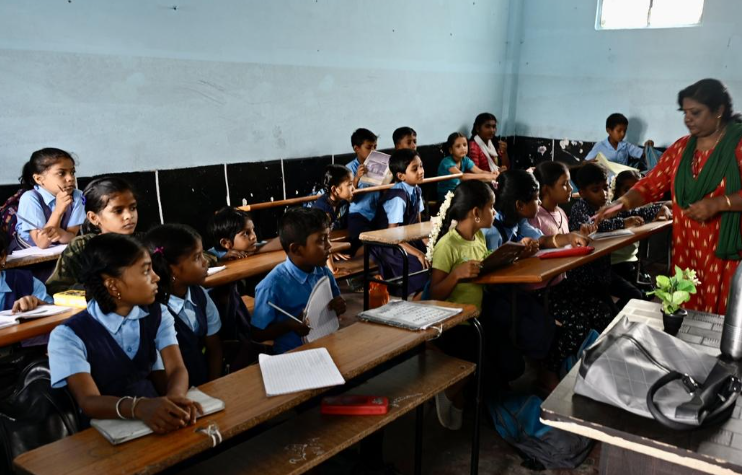
Bengaluru, Oct. 14: Karnataka’s ambition to introduce artificial intelligence (AI) education and coding in schools faces a major infrastructure challenge, with nearly half of the state’s educational institutions lacking internet connectivity, according to the latest Unified District Information System for Education Plus (UDISE+) data.
The report for 2025–26, released by the Union Ministry of Education, shows that only around 51.7 per cent of Karnataka’s 74,578 schools have internet access. This leaves approximately 48 per cent without the facility, putting the state behind several other southern states and below the national connectivity average.
The figures have raised concerns about how effectively the state can introduce technology-based learning when thousands of schools lack the basic infrastructure required to access online educational resources.
The challenge is particularly significant for government institutions, which serve large numbers of students who may have limited access to computers, broadband connections and other digital learning facilities at home.
Government schools face the biggest connectivity gap
Of Karnataka’s 48,527 government-managed schools, only 18,007 have internet facilities. This means approximately 30,520 government schools, or nearly 63 per cent of the total, operate without reported connectivity.
The figures highlight a considerable gap between the state’s technology-focused educational ambitions and the facilities available across its school network.
Connectivity is an important requirement for many modern learning activities, including online research, digital assignments, virtual lessons, educational software and AI-based learning applications.
Without reliable internet access, students may struggle to participate in technology-driven classroom activities or use resources that are increasingly becoming part of contemporary education.
Schools without connectivity may still be able to teach aspects of coding and computing through offline methods, textbooks and practical exercises. However, the absence of a dependable connection can restrict access to updated content, online platforms and collaborative learning opportunities.
The challenge also extends beyond the installation of internet connections. Educational institutions need functioning computers, suitable software, electricity, maintenance support and teachers trained to use digital tools effectively.
As a result, improving connectivity alone would not resolve every infrastructure problem, although it would be an important step towards making digital education more accessible.
AI Akshara Abhiyana and Coding Gurukula face implementation challenges
The connectivity figures have emerged as Karnataka expands its plans to introduce emerging technologies into school education.
Chief Minister D K Shivakumar announced the AI Akshara Abhiyana and Coding Gurukula initiatives during his Independence Day address, with the aim of introducing artificial intelligence education in schools from Class 6.
The initiatives are intended to familiarise students with coding and AI-related concepts at an early stage, allowing them to develop digital knowledge alongside conventional academic subjects.
The chief minister subsequently indicated that AI training had begun for Class 9 students in government schools. Officials were also directed to explore extending the programme to younger students, with support from the state’s information technology department and private organisations.
Introducing these subjects could help students understand computational thinking, problem-solving and the practical applications of emerging technologies.
Early exposure may also help learners become more familiar with digital tools before they enter higher education or pursue careers in technology-related fields.
However, the scale of the connectivity gap raises questions about whether students across the state will receive comparable opportunities to participate.
Schools with established computer laboratories and dependable internet connections are better placed to deliver technology-oriented lessons. Institutions without these facilities may find it difficult to offer the same learning experience unless alternative arrangements are introduced.
The challenge is therefore not simply to announce new courses but to ensure that schools have the resources required to deliver them consistently.
Karnataka trails other southern states
The UDISE+ figures show a substantial difference between Karnataka and several neighbouring states in terms of school connectivity.
Andhra Pradesh has internet access in 99.2 per cent of its 60,843 schools, while Tamil Nadu reports coverage of 99 per cent across 57,566 institutions.
Kerala has connectivity in 92.6 per cent of its 15,750 schools. Telangana, meanwhile, reports internet access in 76.5 per cent of its 41,762 schools.
Karnataka’s coverage of approximately 51.7 per cent is the lowest among the southern states listed in the report.
The comparison is notable because Karnataka is home to Bengaluru, a major information technology and innovation centre. Its technology industry has helped establish the state as an important destination for software development, digital services and technology investment.
However, the presence of a large technology sector does not automatically translate into equal access to digital infrastructure across schools.
The difference between urban technology hubs and institutions in less-connected areas illustrates the importance of directing infrastructure investment towards the places where access remains limited.
The figures also indicate that the issue is not unique to Karnataka. Nationwide, approximately 4.77 lakh of India’s 14.67 lakh schools lack internet access.
The national connectivity rate stands at around 67 per cent, meaning that nearly one-third of schools across the country remain without the facility.
Karnataka accounts for roughly 7.5 per cent of the country’s total school connectivity deficit, according to the reported figures.
These numbers demonstrate the scale of the challenge facing education authorities as they seek to expand technology-based learning while ensuring that students from different regions are not left behind.
Digital learning requires more than internet access
Education experts and school-management representatives have pointed out that AI education requires a combination of infrastructure, teacher preparation and appropriate learning materials.
D Shashi Kumar, general secretary of the Associated Managements of Primary and Secondary Schools in Karnataka, said that the digital divide could be wider if authorities examined only the number of schools reporting internet access rather than the number with functional connections.
A school may be recorded as connected but still face difficulties if its service is unreliable, equipment is outdated or the available connection cannot support classroom activities.
This distinction is important for programmes that depend on regular access to online platforms.
For example, students learning coding may need to use development environments, access tutorials or work with digital learning resources. AI-related instruction can require suitable devices, software and opportunities to practise with relevant applications.
Teachers also need training to explain these subjects in ways that are appropriate for students’ age groups and existing knowledge.
If these requirements are not addressed together, the introduction of new subjects may remain uneven, with some schools offering practical learning while others are restricted to theoretical lessons.
The state will therefore need to assess not only whether schools have internet connections but also whether those connections are reliable and supported by adequate equipment.
Government funding and private partnerships
The Karnataka government has indicated that the information technology department and private organisations could support the expansion of technology education.
Corporate social responsibility initiatives may help schools obtain computers, digital equipment, training resources and other facilities. Partnerships with technology companies could also provide teachers with access to expertise and learning materials.
However, relying on private contributions alone may not be sufficient to address a gap affecting tens of thousands of institutions.
The scale of the requirement calls for a clear assessment of costs, infrastructure needs and long-term maintenance responsibilities.
Internet connections require recurring payments, while computers and related equipment need repairs, software updates and eventual replacement. Schools may also require technical staff or access to support services when equipment stops working.
A sustainable programme would need to account for these expenses rather than focus exclusively on the initial installation of facilities.
Government funding could be directed towards schools with the greatest infrastructure shortages, while partnerships could supplement public investment through equipment, technical assistance and teacher development.
Transparent implementation targets would also help authorities track progress and determine whether the programme is reaching schools that need support the most.
Bridging the gap between urban and rural learners
The connectivity deficit has implications for educational equality.
Students attending well-equipped schools may gain early experience with digital tools, online research and emerging technologies. Those studying in schools without basic facilities could have fewer opportunities to develop similar skills.
This difference may become increasingly important as digital literacy influences higher education, vocational training and employment opportunities.
A technology-focused curriculum should therefore be designed to accommodate schools operating under different conditions.
Where internet access is unavailable, teachers could initially use offline coding exercises, locally stored educational content, printed materials and shared computer laboratories. Mobile digital learning facilities and scheduled access to nearby connected institutions could provide additional support where practical.
These measures would not replace the need for reliable school connectivity, but they could help students continue learning while infrastructure improvements are undertaken.
Teacher training would also be essential. Educators need practical guidance on integrating digital subjects into classroom teaching, identifying age-appropriate applications and helping students use technology responsibly.
Need for measurable progress
The latest figures provide a baseline against which Karnataka’s digital education plans can be assessed.
Authorities could begin by identifying schools without connectivity, mapping the condition of existing equipment and prioritising institutions that face multiple infrastructure shortages.
Subsequent monitoring could measure the number of schools receiving functional connections, the reliability of internet services, the availability of devices and the proportion of teachers receiving relevant training.
Such indicators would offer a clearer picture of whether infrastructure investment is translating into improved classroom opportunities.
The government would also need to ensure that students are taught to use AI and digital platforms critically, with attention to data privacy, online safety and responsible use of technology.
The introduction of AI education offers an opportunity to expand students’ understanding of emerging technologies. Yet its success will depend on the quality and reach of implementation rather than the curriculum announcement alone.
Karnataka’s challenge is to align its ambitions for coding and artificial intelligence with the practical requirements of schools across the state. Closing the connectivity gap, improving equipment and strengthening teacher preparation will be crucial to ensuring that technological progress benefits students from different social and economic backgrounds.
The latest UDISE+ findings underline a central issue for education policy: digital learning can become inclusive only when the necessary facilities are available to the students expected to benefit from it.

