


Rajnath Singh Accuses Congress, Allies of Seeking Bangladesh-Style Regime Change in India
The Defence Minister criticises opposition protests over electoral roll revision, alleging that political leaders are encouraging youth-led unrest and undermining constitutional institutions.
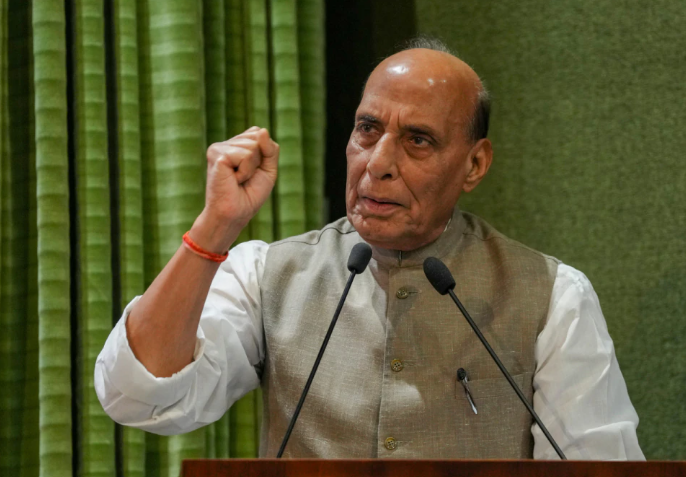
LUCKNOW, Oct. 16: Defence Minister Rajnath Singh on Friday accused the Congress and its allies of attempting to bring about a change of government in India along the lines of Bangladesh, alleging that they were using young people to intensify political confrontation and create disorder.
Addressing a press conference in Lucknow, Singh said democratic rights did not provide any political party with the freedom to disrupt public order or damage the credibility of constitutional institutions.
He alleged that the Congress and opposition groups were directing the energy of young people towards political confrontation instead of encouraging their participation in constructive activities and nation-building.
According to Singh, the youth were being drawn into what he described as a politics of anarchy. He argued that political mobilisation should be directed towards development and public welfare rather than confrontation.
The minister further claimed that statements made by opposition leaders about drawing inspiration from Bangladesh demonstrated their intention to pursue regime change in India. He referred to the 2024 uprising in Bangladesh, which led to the fall of the government headed by Sheikh Hasina.
Singh maintained that the opposition’s campaign extended beyond demands for electoral reforms and had become an attempt to challenge the existing government and democratic institutions.
His remarks came amid protests in New Delhi by opposition parties and civil society groups seeking the resignation of Chief Election Commissioner Gyanesh Kumar over alleged irregularities in the Special Intensive Revision (SIR) of electoral rolls.
Opposition leaders have questioned the transparency of the revision exercise and expressed concerns that eligible voters could be excluded. They have demanded accountability from the Election Commission over the process.
Singh, however, argued that the use of expressions such as “regime change” raised questions about the opposition’s objectives. He urged Congress leader Rahul Gandhi and other opposition figures to recognise the importance of maintaining constitutional order while pursuing political demands.
Referring to observations made by the Supreme Court on Thursday, the defence minister said democratic participation must remain within the framework of the law. He stressed that constitutional institutions should not become targets of political campaigns driven by individual or party interests.
Singh also accused the opposition of relying on allegations, anger and attempts to discredit institutions, claiming that such tactics would not derail India’s development.
He called on Gandhi to respect the public mandate and reconsider his political approach, arguing that democratic disagreements should be addressed through dialogue and established constitutional mechanisms.
Emphasising the responsibility shared by political parties, Singh said the country needed cooperation and constructive engagement rather than prolonged confrontation.
The opposition’s demonstrations have brought renewed attention to the electoral roll revision process and the Election Commission’s role in ensuring transparency. While opposition groups have raised concerns about voter inclusion, Singh’s remarks focused on what he described as the broader political implications of their agitation.
The controversy highlights the continuing disagreement between the government and opposition over electoral administration, institutional accountability and the limits of political protest.
Singh concluded by urging political leaders to prioritise national development and democratic stability, maintaining that public dissent and political competition should not come at the expense of constitutional principles.

