


Jagsher Singh Khangurra Wins Bronze at World Junior Badminton Championships in Cairo
The 17 year old from Punjab fights back to win a game in the semifinal before Indonesia's Radithya Bayu Wardhana secures victory, giving India another podium finish at the global junior event.
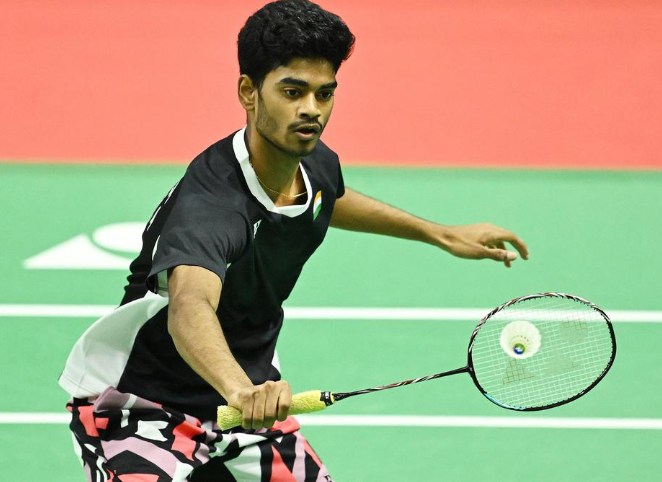
CAIRO, Oct 16: India’s Jagsher Singh Khangurra secured a bronze medal in the boys’ singles competition at the 2026 BWF World Junior Badminton Championships after losing his semifinal against Indonesia’s Radithya Bayu Wardhana in Cairo on Friday.
The Indian shuttler put up a determined fight, recovering from a disappointing opening game to take the second before eventually going down 6-15, 15-13, 3-15 in a contest lasting 49 minutes.
Although Khangurra missed the opportunity to compete for the gold medal, his performance marked an important milestone in his developing career. The result also added to India’s record at the junior world championships, taking the country’s tally in the individual events to 13 medals, comprising one gold, five silver and seven bronze medals. For Khangurra, the medal represented the reward for a strong campaign against international opposition. His progress through the tournament demonstrated his defensive ability, patience during long rallies and capacity to recover when a match begins to move away from him.
A difficult opening against the Indonesian
The semifinal presented Khangurra with a challenging opponent in Wardhana, whose attacking style eventually proved decisive.
The Indonesian started strongly and took the opening game 15-6. Khangurra struggled to match his opponent’s early intensity, allowing Wardhana to establish control of the rallies and build a substantial advantage.
However, the Indian did not allow the opening setback to determine the outcome of the contest. He adjusted his approach in the second game, worked to extend rallies and looked for opportunities to move his opponent around the court.
The change brought results. Khangurra improved his placement and defensive response, making it more difficult for Wardhana to finish rallies quickly. The Indian also showed greater patience when dealing with attacking shots, forcing his opponent to work harder for points.
Khangurra eventually took the second game 15-13, levelling the match and raising the possibility of a comeback.
The decisive third game, however, followed a different pattern. Wardhana regained his attacking rhythm and put Khangurra under immediate pressure. The Indian found it increasingly difficult to maintain the same defensive intensity, while the Indonesian exploited openings with powerful and well-directed shots.
Wardhana won the final game 15-3 to book his place in the championship final. Khangurra’s campaign ended in the semifinals, but reaching the last four guaranteed him a bronze medal.
A quarterfinal comeback paved the way
Khangurra’s medal journey had already included a notable comeback in the quarterfinals.
He faced Chinese Taipei’s Yuan-Syue Jhuang in a match that began unfavourably for the Indian. Jhuang took the opening game 15-6, leaving Khangurra with little room for error.
The Indian responded by improving his defensive positioning and becoming more selective in his attacking shots. Rather than trying to win points too quickly, he focused on keeping rallies alive and making his opponent work for every opening.
The adjustment helped him take the second game 17-15 in a close finish. With the match level, Khangurra carried his momentum into the decider and secured the third game 15-12.
The victory earned him a place in the semifinals and guaranteed India a medal in the boys’ singles category.
His ability to recover after losing the opening game in consecutive knockout matches underlined an important aspect of his performance: he remained competitive even when opponents gained an early advantage.
Such resilience is valuable in badminton, where the momentum of a match can change quickly. Players must make technical and tactical adjustments without allowing frustration to affect their decision-making.
Khangurra’s quarterfinal performance also showed that he could handle close finishes against opponents from established badminton systems.
A defensive style built around control
Khangurra’s game has been shaped by a methodical approach that places emphasis on placement, defensive recovery and constructing rallies.
Rather than relying exclusively on powerful smashes, he often looks to move opponents out of position and create openings through accurate shots. His backhand defence and ability to return difficult deliveries were particularly useful during the tournament.
That style can be effective against aggressive opponents because it forces them to maintain precision over extended exchanges. However, the semifinal also highlighted the limitations of a defensive approach when facing a player who can sustain attacking pressure and finish points efficiently.
Wardhana’s performance showed how attacking variation can disrupt a player who relies on keeping the shuttle in play. Once the Indonesian regained control in the third game, Khangurra struggled to create the same opportunities that had helped him win the second.
The experience provides a clear area for development. Improving the transition from defence to attack could allow Khangurra to take greater control of rallies rather than waiting for opponents to make mistakes.
A more effective attacking game would also help him respond when defensive exchanges become physically demanding.
Stamina emerges as an important lesson
After the semifinal, Khangurra acknowledged that stamina had been a decisive factor. He said Wardhana had stronger endurance and better attacking execution, adding that he began to run out of energy after the opening points of the third game.
The Indian also identified patience and the need for a stronger start as areas requiring attention. His assessment indicated that the defeat was not simply a matter of shot selection, but also of maintaining physical intensity throughout a demanding match.
At the highest levels of junior badminton, players must repeatedly accelerate, change direction and recover between explosive movements. Long rallies can place considerable demands on the legs and cardiovascular system, particularly when opponents use varied angles to move them around the court.
Improved endurance could help Khangurra maintain the quality of his movement during decisive phases. It would also allow him to continue applying pressure when a match reaches its final game.
Technical development will remain equally important. Better attacking placement, more variation in pace and the ability to turn defensive situations into offensive opportunities could help him become a more complete singles player.
The semifinal defeat therefore offered both a significant achievement and a practical learning experience.
From Nabha to the international stage
Khangurra hails from Nabha in Punjab and has emerged through India’s junior badminton structure. He is a former under-17 national champion and has also earned recognition at the Asian junior level.
His development reflects the role of organised coaching and competitive opportunities in preparing young players for international tournaments. Regular exposure to strong opponents helps athletes understand the demands of global competition and identify the areas that require further improvement.
Khangurra has trained under coach Sagar Chopra and has drawn inspiration from Indian badminton players, including Olympic medallist Lakshya Sen.
His journey also illustrates the importance of maintaining a long-term approach to development. A medal at a world junior championship is a significant accomplishment, but the transition to senior international badminton requires continued progress in fitness, tactical awareness and consistency.
The bronze medal gives Khangurra an international result on which to build. With further training and exposure, he will have opportunities to test his progress against players with different styles and levels of experience.
Significance for Indian junior badminton
India’s presence on the podium in Cairo offers encouragement for the country’s junior badminton programme. The World Junior Championships provide a platform for emerging players to measure themselves against competitors from nations with established traditions in the sport.
Success at this level can help young athletes gain confidence and attract greater attention, but sustained development requires more than a single tournament result.
Players need access to high-quality coaching, strength and conditioning programmes, medical support and a competitive calendar that allows them to progress gradually.
Khangurra’s performance demonstrates the importance of combining technical ability with mental resilience. His comeback against Jhuang showed that he could adapt during a match, while the semifinal highlighted the need to improve stamina and attacking consistency.
These lessons can be incorporated into his preparation for future tournaments.
For Indian badminton, the broader objective is to develop players who can move from junior success into the senior circuit. That transition is demanding, as opponents become stronger and tactical differences more pronounced.
Khangurra’s bronze medal provides a positive foundation, but the next phase of his career will depend on how effectively he addresses the shortcomings identified in Cairo.
Looking ahead
The Indian shuttler leaves the championship with a medal and a clearer understanding of the demands of elite junior competition.
His route to the semifinals included a significant recovery against Jhuang, demonstrating composure and the ability to adjust under pressure. Against Wardhana, however, the physical and attacking demands of the match proved more difficult to manage.
The experience should help him focus his training on endurance, stronger openings and a more proactive attacking strategy.
For now, the bronze medal stands as an important achievement for the Punjab youngster and another podium finish for India at the World Junior Championships.
The result also serves as a reminder that progress in badminton is built through a combination of resilience, preparation and the willingness to learn from difficult matches. Khangurra has demonstrated the first two qualities during his campaign; continued work on the third could prove decisive in his future development.

