


Indian Students Turn to AI for Speed but Prefer Traditional Notes for Better Retention
HP Futures 2026 survey finds 82 per cent of Indian respondents concerned about deeper learning, while 78 per cent expect artificial intelligence to create more employment opportunities.
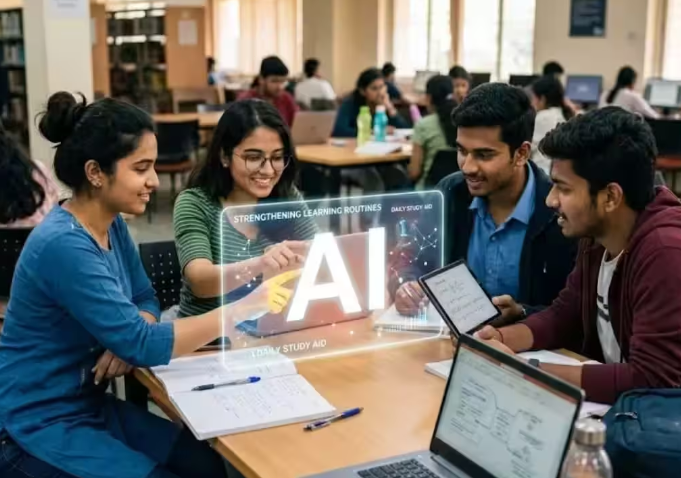
NEW DELHI, Oct 22: Indian students are increasingly recognising the benefits of artificial intelligence in education while expressing concerns that faster completion of academic tasks may not necessarily translate into deeper understanding, according to the HP Futures 2026 global survey.
The survey covered more than 6,000 students worldwide, including 758 respondents from India. Its findings highlight a growing debate within education: how institutions can incorporate AI into teaching and learning without weakening students’ ability to think independently, retain information and apply knowledge.
According to the report, 82 per cent of Indian respondents expressed concern that AI could help them finish assignments more quickly without necessarily improving their understanding or retention of the material.
The findings suggest that students are distinguishing between using technology to save time and developing the knowledge required to succeed academically. While AI tools can provide summaries, explain unfamiliar concepts and organise information, students remain conscious of the importance of engaging directly with what they study.
Traditional learning methods continue to play a role in their study routines. The survey found that many respondents preferred handwritten or printed notes when their objective was to remember information. Reported findings indicated that 42 per cent favoured these conventional methods, compared with 17 per cent who preferred AI-generated summaries for retention.
The results do not establish that one learning method is universally superior. Rather, they reflect students’ perceptions of how different approaches support their academic work and the challenges they associate with relying heavily on automated assistance.
AI adoption raises questions about learning quality
Artificial intelligence has become increasingly accessible to students through applications that can summarise lengthy readings, explain difficult topics, generate practice questions and help organise research.
These functions can be useful when students encounter unfamiliar terminology or need an alternative explanation of a complex concept. AI tools may also help learners identify areas requiring additional revision and prepare preliminary outlines for assignments.
However, the convenience of receiving an immediate answer can create a risk if students accept generated material without checking its accuracy or attempting to understand the underlying reasoning.
For example, a student preparing for a science examination may obtain a concise explanation of a biological process within seconds. Yet remembering the sequence, understanding the mechanisms involved and applying that knowledge to an unfamiliar question require further engagement.
Similarly, a student using AI to prepare an essay may receive a structured draft without necessarily developing the research, interpretation and writing skills the assignment is intended to assess.
The survey draws attention to this distinction between producing academic work and learning through the process of completing it.
Students remain optimistic about future careers
Despite concerns about academic depth, Indian respondents expressed considerable confidence in AI’s potential role in employment.
Around 78 per cent believed the technology would generate more career opportunities than it would eliminate. Another 87 per cent said they were confident about using AI tools effectively and responsibly in their future professional lives.
The survey also found that 92 per cent believed their education was preparing them for the workplace.
These findings indicate that students are not necessarily rejecting AI. Instead, many appear to regard it as a technology they will need to understand and use while continuing to develop skills that cannot be reduced to operating software.
AI is expected to influence a wide range of occupations, including information technology, healthcare, business, research and communications. Workers in these fields may increasingly encounter automated systems that assist with information processing, analysis and routine tasks.
For graduates entering such environments, the ability to assess AI-generated output critically could be as important as familiarity with the tools themselves.
Students will need to recognise when a system produces incomplete information, identify unsupported claims and understand the limitations of automated recommendations. These abilities depend on subject knowledge and sound judgement, not merely technical proficiency.
Report calls for stronger foundational skills
The HP Futures 2026 initiative, led by HP in collaboration with the Global Learning Council and the Education Leaders Forum, brought together 58 leaders from education, policymaking and the future-of-work sector.
The report calls for greater attention to skills such as critical thinking, creativity, communication and collaboration. It recommends that these abilities be integrated into mainstream education rather than treated only as extracurricular additions.
The report also stresses the continued importance of literacy, numeracy and foundational learning. These skills provide the basis for interpreting information, solving problems and evaluating new ideas.
For schools and colleges, the challenge is to introduce emerging technology without allowing it to displace essential educational objectives. Digital tools can support classroom instruction, but students still need opportunities to practise reasoning, explain their answers and demonstrate independent understanding.
Teachers could, for instance, ask students to compare an AI-generated explanation with a textbook account, identify errors and defend their conclusions using evidence. Such exercises would allow learners to benefit from technology while developing the ability to question its output.
Another approach would involve asking students to solve a problem independently before using AI to review their reasoning. Comparing the two responses could help identify gaps in understanding and encourage students to take greater responsibility for their learning.
Assessment methods may need greater emphasis on understanding
The findings also have implications for how educational institutions assess students.
Assignments that can be completed largely through automated text generation may provide limited evidence of an individual’s understanding unless the process also requires students to explain, verify or apply what they have produced.
Educators may therefore consider combining written work with oral explanations, classroom exercises, practical projects and problem-solving activities. These methods can help establish whether students understand the concepts they present.
Such changes would not necessarily require schools and universities to abandon conventional examinations. Instead, institutions could use a mixture of assessment formats to evaluate both subject knowledge and the ability to apply it.
Clear guidelines on acceptable AI use are also important. Students should understand when assistance is permitted, how generated information must be verified and when work must reflect their own independent effort.
Institutions can support responsible use by teaching students how to check sources, protect personal information and acknowledge technological assistance where required by academic rules.
Balancing efficiency with independent thinking
The survey’s findings point towards a practical challenge for education policymakers. Students are preparing for workplaces in which AI may become increasingly common, but they also need a firm grasp of the subjects they study.
A balanced approach would allow technology to support repetitive or time-consuming tasks while preserving opportunities for students to reason, experiment, read extensively and develop their own ideas.
The effectiveness of such an approach will depend on how AI is incorporated into lessons, how teachers are trained and whether students have equitable access to appropriate digital resources.
Schools and colleges will also need to consider the reliability of AI-generated information, data privacy and the possibility that students with different levels of access to technology may experience unequal learning opportunities.
The HP Futures 2026 findings provide a snapshot of student attitudes rather than a direct measurement of academic performance. They do not prove that AI use necessarily reduces learning or that traditional note-taking always produces better results.
Nevertheless, the responses underline the importance of designing educational practices around understanding rather than speed alone.
As AI becomes more integrated into academic life, the central question for educators will be how to ensure that students emerge not only as efficient users of technology but also as independent thinkers capable of evaluating information, solving unfamiliar problems and making informed decisions.

