


Ramayana’s Judi Jodi Song Draws Attention as Fans Debate Shreya Ghoshal and Chinmayi’s Renditions
A.R. Rahman's new composition celebrating Rama and Sita's wedding draws mixed reactions, while listeners compare Shreya Ghoshal's studio recording with Chinmayi's live performance.
Mumbai, October 30: The upcoming mythological epic Ramayana: Rise of a Legend continues to generate discussion ahead of its theatrical release, with its latest song, Judi Jodi, attracting attention from music lovers and film audiences.
Released on October 29 on the occasion of Karwa Chauth, the song celebrates the wedding of Lord Rama and Goddess Sita, portrayed by Ranbir Kapoor and Sai Pallavi in Nitesh Tiwari’s ambitious cinematic adaptation of the Indian epic.
Composed by Oscar-winning music director A.R. Rahman, with lyrics written by Dr Kumar Vishwas, the track presents the sacred union of Rama and Sita through a musical sequence centred on their wedding celebrations.
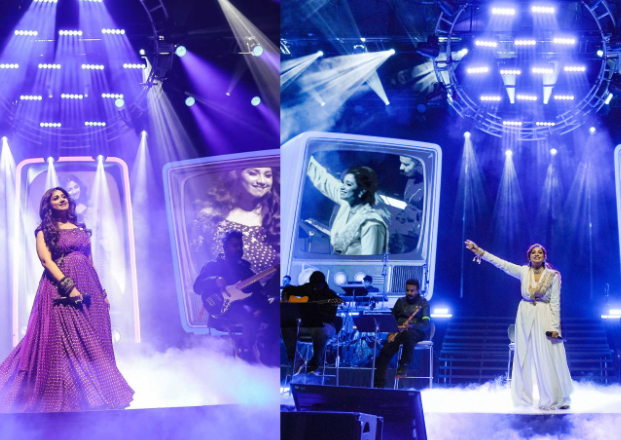
However, the song has also generated a discussion among listeners over two different renditions associated with Shreya Ghoshal and Chinmayi Sripaada. While Ghoshal’s studio recording features in the Hindi version, Chinmayi’s live performance at an event has also received appreciation online.
The discussion has divided sections of the audience, with some preferring the emotional quality of Chinmayi’s live rendition and others praising Ghoshal’s established vocal style.
A musical celebration of Rama and Sita’s wedding
The release of Judi Jodi comes at an important stage in the promotional campaign for Ramayana, which is scheduled to reach cinemas on November 5.
The song captures the wedding celebrations of Rama and Sita, including the varmala ceremony, and presents a glimpse of the relationship between the two central characters.
The makers chose Karwa Chauth for its release, linking the song’s theme of companionship and commitment with a festival associated with marital relationships.
The track has been made available in five languages: Hindi, Tamil, Telugu, Malayalam and Kannada. This multilingual approach is intended to connect the film with audiences across different parts of India.
Shreya Ghoshal has sung the Hindi version, while Heer has performed the Tamil rendition. Sireesha Bhagavatula has lent her voice to the Telugu version, Amritha Sureshh has sung the Malayalam version and Pooja Vaidyanath has recorded the Kannada version.
The lyrics have been written by Kumar Vishwas, with regional adaptations by different lyricists for the respective language versions.
The composition is another important addition to the film’s soundtrack, which has been attracting attention because of Rahman’s involvement and the scale of the production.
Shreya Ghoshal and Chinmayi’s performances become a talking point
Soon after the release, social media users began discussing the differences between Ghoshal’s studio version and Chinmayi’s live rendition.
Some listeners felt that Chinmayi’s performance carried greater emotional depth, particularly because of its spontaneous quality. They appreciated the texture and simplicity of her voice and argued that the live rendition brought a different interpretation to the composition.
Other listeners defended Ghoshal’s recording, describing her vocals as expressive and technically polished. Several fans said her singing gave the song its emotional character and praised the way she handled the composition.
The discussion also led to requests for the makers to release Chinmayi’s rendition officially, allowing audiences to listen to both versions.
Chinmayi subsequently clarified her role in the performance, explaining that she had stepped in as a stand-in and learnt the song at short notice. She also credited Ghoshal as the original singer and praised her contribution.
Her clarification helped establish the distinction between the official Hindi recording and the live performance that had attracted attention.
The debate highlights how audiences increasingly engage with film music beyond simply listening to officially released tracks. Live performances, promotional appearances and short video clips can create additional conversations around a film’s soundtrack.
A.R. Rahman’s music remains under scrutiny
The latest discussion surrounding Judi Jodi comes after another song from the film, Mangal Rang, generated mixed reactions among listeners.
The earlier track, featuring Arijit Singh and Shreya Ghoshal, faced criticism from some sections of the audience over its musical style and perceived influences. The response led to discussions about the direction of the film’s music and the expectations attached to a project of this scale.
Rahman, however, has maintained that his approach is centred on the creative process rather than immediate online reactions.
In an interview with Hindustan Times, the composer discussed the extensive work involved in developing the soundtrack, including experimentation, refinement and repeated revisions.
He indicated that the amount of time spent on the creative process leaves little energy to continuously follow public feedback.
Rahman has also described Ramayana as one of the most ambitious projects of his career. The soundtrack reportedly took approximately three and a half years to develop.
The music project also brings together Rahman and internationally acclaimed composer Hans Zimmer, a collaboration that has attracted interest beyond the Indian film industry.
The involvement of two prominent composers has raised expectations about the film’s musical scale and its ability to appeal to audiences in international markets.
The soundtrack is expected to play an important role in establishing the film’s emotional atmosphere, particularly because the story is based on one of India’s most widely recognised epics.
Ranbir Kapoor and Sai Pallavi lead the film
Directed by Nitesh Tiwari, Ramayana: Rise of a Legend features an extensive cast led by Ranbir Kapoor as Lord Rama and Sai Pallavi as Goddess Sita.
Yash portrays Ravana, while Sunny Deol plays Lord Hanuman and Ravi Dubey appears as Lakshman.
The film also features several other performers in important roles, including Lara Dutta, Rakul Preet Singh and Kajal Aggarwal.
The casting has been a major part of the film’s promotional campaign, with audiences particularly interested in seeing how the actors interpret characters that have been represented in Indian literature, television and cinema for generations.
Ranbir Kapoor’s portrayal of Lord Rama is among the most closely watched aspects of the production. Sai Pallavi’s casting as Sita has also attracted considerable attention, given the importance of the character within the epic.
Yash’s portrayal of Ravana represents another major element of the film, with the actor taking on a character central to the conflict in the Ramayana.
The project is planned as a two-part cinematic adaptation, with the first instalment scheduled for worldwide theatrical release on November 5, 2026. The second part is planned for Diwali 2027.
A major production targeting international audiences
The film is produced by Namit Malhotra’s Prime Focus Studios in collaboration with DNEG and Yash’s Monster Mind Creations.
Its production scale, visual effects and international distribution arrangements have positioned it as one of the major Indian cinematic projects of the year.
The makers are planning releases in Hindi, Tamil, Telugu, Kannada and Malayalam, while international distribution is expected to introduce the film to audiences outside India.
The involvement of DNEG, a major visual effects company, is also significant because the epic requires the creation of large-scale environments, elaborate settings and visually demanding sequences.
The production is expected to rely heavily on visual storytelling to bring the world of the Ramayana to the big screen.
The collaboration with international partners, including Hans Zimmer’s association with the music project, also reflects the ambition to present the film to a wider global audience.
Social media attention adds to pre-release momentum
With the release date approaching, the film’s promotional activities have increasingly become a subject of online discussion.
The debate surrounding Judi Jodi demonstrates the attention being paid to even individual elements of the soundtrack. While some listeners have focused on the composition and lyrics, others have concentrated on the differences between vocal performances.
The discussion over the earlier song Mangal Rang has also contributed to the broader conversation about the musical direction of the project.
At the same time, the makers have continued releasing promotional material to introduce audiences to the film’s characters, music and visual presentation.
The response illustrates the challenges of presenting a new cinematic interpretation of a familiar epic. Audiences approach the material with established cultural and emotional expectations, making every major creative decision open to discussion.
For Rahman, the latest reactions add another chapter to the public conversation surrounding the soundtrack. For the film’s cast and production team, the growing attention provides an opportunity to keep the project in public focus before its theatrical opening.
As Ramayana: Rise of a Legend prepares for its November 5 release, the interest surrounding Judi Jodi suggests that its music will remain an important part of the film’s pre-release conversation.

