


Manisha Bhanwala Creates History as India’s First Women’s Wrestling World Champion
The Indian wrestler overcomes a six point deficit to defeat American Abigail Nette 8-6 in the 59kg final at the World Championships in Astana.
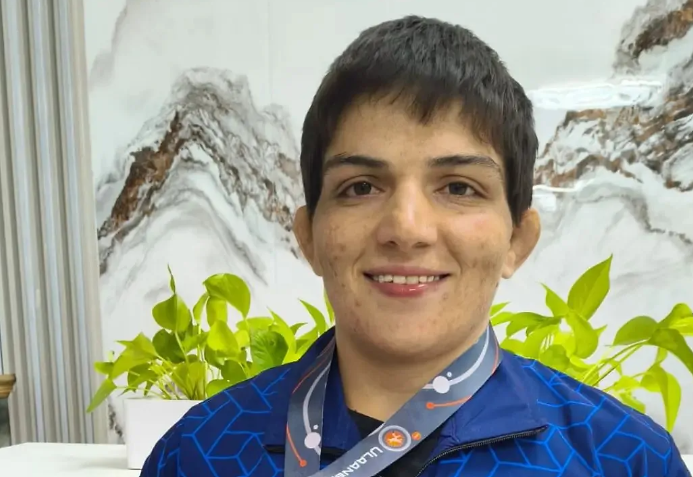
ASTANA, Oct 31: Indian wrestler Manisha Bhanwala has created history by becoming the country’s first-ever women’s world champion after producing a remarkable comeback victory in the 59kg freestyle final at the 2026 World Wrestling Championships in Astana, Kazakhstan.
The 29 year old defeated American wrestler Abigail Nette 8-6 after recovering from a six-point deficit, delivering one of the most memorable performances of India’s campaign at the global competition.
Manisha’s achievement marks a historic breakthrough for Indian women’s wrestling, which had previously come close to securing a world championship title but had never produced a gold medallist in the women’s category.
Her victory on Friday, October 30, was widely celebrated across the Indian sporting community, with reports and reactions continuing on Saturday.
The gold medal also made Manisha only the second Indian wrestler to win a senior world championship title. Two-time Olympic medallist Sushil Kumar had previously achieved the distinction by winning the men’s 66kg freestyle gold at the 2010 World Championships.
For Manisha, the victory represented the fulfilment of a long-standing ambition after several years of competing at the highest level without securing a senior world medal.
Her triumph also completed an impressive performance by the Indian women’s wrestling contingent, which finished the championships with four medals, including one gold, two silver and one bronze.
United World Wrestling+2
Dramatic Comeback Against American Opponent
The final against Nette began on a difficult note for the Indian wrestler, as the American immediately adopted an aggressive approach and secured an early advantage.
Nette executed a powerful attack that earned her four points. India’s corner challenged the decision, but the challenge was unsuccessful, resulting in an additional point for the American.
Manisha subsequently received a caution, allowing Nette to extend her advantage to 6-0.
With the Indian wrestler trailing significantly, the contest appeared to be moving towards an American victory. However, Manisha managed to score a step-out point before the interval, reducing the deficit to 6-1.
The second period completely changed the direction of the contest.
Manisha returned to the mat with renewed determination and began applying pressure through a series of well-planned attacks. She secured a takedown, reducing the gap, before another successful move brought her closer to the American.
Nette’s corner challenged one of the decisions, arguing that the referee had already stopped the action. However, the challenge was unsuccessful, allowing Manisha to collect another point.
The Indian wrestler then used a gut-wrench technique to turn her opponent and level the score at 6-6.
With the contest reaching its decisive moments, Manisha continued attacking rather than allowing Nette to regain control.
She eventually executed another pressure takedown to move ahead 8-6. The American attempted to recover, but Manisha defended her advantage during the remaining seconds.
Nette could not find a way through the Indian wrestler’s defence, and the final whistle confirmed Manisha’s historic victory.
The result reflected her physical endurance, tactical awareness and ability to remain composed under considerable pressure.
United World Wrestling described the victory as a landmark moment for India, noting that Manisha had become the country’s first women’s world champion.
United World Wrestling+1
Strong Campaign Before the Final
Manisha’s gold-medal performance was supported by an impressive run through the earlier rounds of the competition.
She began her campaign against Canada’s Laurence Beauregard, a four-time Pan American champion and 2025 world bronze medallist.
The Indian wrestler secured victory by fall, making a confident start to her campaign.
In the quarter-finals, she faced Mongolia’s Bolortuya Khurelkhuu and produced another commanding performance, winning the contest 6-0.
The semi-final presented a different challenge, as Manisha faced Kazakhstan’s Altyn Shagayeva in front of the home crowd.
However, the Indian wrestler showed no signs of pressure. She established a 3-0 advantage in the opening period before increasing her lead to 10-0 and securing victory by fall.
The performance booked her place in the final and provided India with another opportunity to claim its first women’s wrestling world title.
Manisha’s progress was particularly significant because she had participated in three previous senior World Championships without winning a medal.
She had reached the bronze-medal contest in the non-Olympic 65kg category in Tirana in 2024 but lost to Japan’s Miwa Morikawa.
The latest achievement therefore marked a major turning point in her international career.
India’s Medal Tally Reaches Four
Manisha’s gold medal helped India finish the championships with four medals in women’s freestyle wrestling.
Neelam Sirohi secured silver in the 50kg category, while Kajal Dhochak finished runner-up in the 76kg division.
Tanu Sharma added a bronze medal in the 72kg category, completing India’s medal collection.
Neelam and Kajal had both reached their respective finals earlier in the competition but were unable to convert their opportunities into gold medals.
Their silver-medal performances nevertheless demonstrated the growing competitiveness of Indian women wrestlers at the international level.
Manisha’s victory eventually provided the breakthrough that the Indian contingent had been seeking.
The men’s freestyle campaign, meanwhile, proved more challenging, with several Indian wrestlers exiting the competition before the medal rounds.
Nikhil fought back from an 0-8 deficit against Iran’s Ahmad Masoud Mohammadnezhadjavan in the 61kg category and briefly moved ahead 9-8 before losing 9-10.
Pushpender Dalal won his opening two bouts in the 86kg category but subsequently lost to Azerbaijan’s Arsenii Dzhioev.
Jaspooran Singh and Vishal Kaliraman also failed to progress further in their respective categories.
Vicky Hooda’s campaign ended in the 97kg repechage after he suffered a defeat against Iranian wrestler Hassan Yazdani.
Despite the difficulties in the men’s competition, the women’s team’s four-medal performance gave India a historic finish.
UNI India+1
A Dream Connected to Her Father
Beyond the sporting achievement, Manisha’s victory carried a deeply personal meaning.
Her father, Suresh Bhanwala, played a significant role in introducing her to wrestling and encouraging her to pursue the sport.
He had supported her ambitions from an early age and wanted to see his daughter win a major international title for India.
However, he passed away in 2022 and could not witness the fulfilment of that dream.
Following her victory in Astana, Manisha paid tribute to her late father by displaying a T-shirt bearing his photograph.
The gesture became one of the emotional highlights of her championship triumph.
She had also carried his photograph with her during the competition, reflecting the importance of his support throughout her wrestling journey.
Manisha has previously spoken about the influence her father had on her career and how his encouragement helped her continue pursuing her ambitions during difficult periods.
Her world title was therefore not merely a personal sporting milestone but also a tribute to the person who had encouraged her to take up wrestling.
The achievement was particularly meaningful after the disappointment of the 2026 Asian Games, where she competed in the 57kg category but lost in the quarter-finals against Japan’s Akari Fujinami.
Rather than allowing that setback to affect her confidence, she returned to training with renewed determination and focused on improving her performance.
United World Wrestling+1
Focus Shifts to Future International Competitions
Manisha’s victory is expected to provide considerable encouragement to India’s next generation of women wrestlers.
She has expressed her ambition to defend her world title at the next championships and compete in the 57kg Olympic weight category.
The 59kg division in which she won gold is a non-Olympic category, making her future performances in Olympic weight classes an important part of her sporting ambitions.
Her achievement could also help younger wrestlers approach major international finals with greater confidence.
For several years, Indian women’s wrestling has produced talented athletes capable of challenging the world’s leading competitors. However, winning the senior world championship title had remained an elusive objective.
Anshu Malik had reached the women’s final in 2021, becoming the first Indian woman to achieve that distinction, but had to settle for silver.
The performances of Neelam Sirohi and Kajal Dhochak in the 2026 competition further demonstrated India’s ability to produce finalists at the highest level.
Manisha has now taken that progress a step further by winning the gold medal.
The triumph also highlights the importance of endurance, preparation and tactical planning in wrestling, where a contest can change dramatically within a few moments.
Her recovery from a 6-0 deficit against Nette demonstrated the importance of maintaining concentration even when the opponent appears to have established control.
India’s historic achievement in Astana will consequently be remembered as an important milestone for the country’s wrestling programme.
For Manisha, the world championship gold represents years of hard work, personal sacrifice and determination.
Her victory has not only brought international recognition but has also opened a new chapter for Indian women’s wrestling, giving aspiring athletes a landmark achievement to aim for in future competitions.

