


NEET-PG 2027 Likely to Adopt Rank-Based Admission System, Centre Tells Supreme Court
A 12 member expert panel has recommended replacing the percentile based eligibility system with rank-based merit, while advising against lowering qualifying standards to fill vacant postgraduate medical seats.
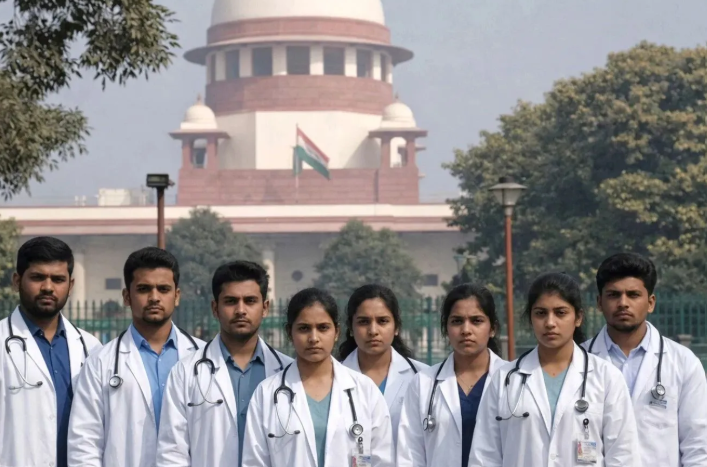
NEW DELHI, Nov. 4: The postgraduate medical admission process in India could undergo a significant change from 2027, with the Centre informing the Supreme Court that an expert committee has recommended replacing the existing percentile-based qualifying system for NEET-PG and NEET-SS examinations with a rank based merit system.
The recommendation is aimed at addressing recurring concerns over reductions in qualifying cut-offs, vacant postgraduate medical seats and delays in the counselling process. The proposed changes are also intended to ensure that admissions are conducted through a more consistent merit-based mechanism without compromising the standards of medical education.
A 12-member expert committee constituted by the Centre submitted its report to the Supreme Court on November 3. The panel examined the existing admission framework and suggested that candidates should be considered for postgraduate medical courses according to their ranks rather than relying primarily on the current percentile-based eligibility criteria.
The National Medical Commission (NMC) has given in-principle approval to the proposal, with implementation being considered from the 2027 admission cycle. However, the final regulations, detailed eligibility conditions and operational arrangements are yet to be announced.
The development comes after repeated controversies surrounding reductions in the NEET-PG qualifying cut-off to accommodate candidates for vacant medical seats. The practice had raised concerns among medical aspirants and other stakeholders about the balance between filling available seats and maintaining minimum academic standards.
Repeated cut-off reductions trigger concerns
The existing percentile-based system has faced criticism following several instances in which qualifying requirements were substantially reduced during postgraduate medical counselling.
In 2023, the qualifying percentile was brought down to zero across all categories, making even candidates with negative marks eligible to participate in counselling. The decision attracted attention because it raised questions about the purpose of minimum qualifying requirements in a highly competitive professional examination.
A similar situation emerged during the NEET-PG 2024 admission cycle. In January 2025, the qualifying percentile was reduced to the 15th percentile for candidates belonging to the General and Economically Weaker Section categories and to the 10th percentile for reserved categories.
The qualifying requirements were subsequently lowered further in February 2025.
The issue resurfaced during the 2025-26 admission cycle when the National Board of Examinations in Medical Sciences announced another major reduction in the qualifying cut-off for the third round of NEET-PG counselling on January 13, 2026.
Under the revised criteria, the qualifying percentile for General and EWS candidates was reduced from 50 to seven. For General Persons with Disabilities candidates, it was lowered from 45 to five.
For candidates belonging to the Scheduled Caste, Scheduled Tribe and Other Backward Classes categories, the qualifying percentile was reduced from 40 to zero.
The revised requirements also allowed candidates with negative marks to become eligible for counselling.
The decision was taken amid concerns over a substantial number of unfilled postgraduate medical seats. Figures presented before the Supreme Court indicated that the reduction in qualifying requirements made an additional 95,913 candidates eligible to participate in the counselling process.
While the move was intended to increase participation and facilitate the filling of vacant seats, it also prompted questions about whether repeated relaxation of examination standards was an appropriate long-term solution.
Petitioners approached the Supreme Court, raising concerns about the possible implications of lowering eligibility requirements on the quality of postgraduate medical education.
Supreme Court seeks permanent solution
The Supreme Court has been examining the issue and has emphasised the need for a sustainable mechanism to address recurring problems in postgraduate medical admissions.
In May 2026, a Bench comprising Justices P S Narasimha and Alok Aradhe called for a permanent solution to the repeated reduction of NEET-PG qualifying cut-offs.
The court observed that the matter had repeatedly arisen during successive admission cycles, creating uncertainty among medical aspirants and contributing to difficulties in filling available seats.
The judicial intervention also highlighted the importance of maintaining appropriate standards in postgraduate medical education while addressing the problem of vacant seats.
Following the proceedings, the Centre informed the court in August 2026 that it had constituted a 12-member expert committee on July 23. The panel was headed by the Director General of Health Services and was assigned the responsibility of examining the existing admission framework.
The committee was expected to identify shortcomings in the current system and suggest measures to improve the admission process.
After reviewing the matter, the panel recommended moving towards a rank-based system for NEET-PG and NEET-SS. Its report was submitted to the Supreme Court on November 3.
The latest recommendation represents an effort to establish a more stable admission framework rather than relying on repeated changes to qualifying percentiles during counselling.
Why rank-based admissions matter
Under the existing percentile-based arrangement, candidates must meet the prescribed qualifying percentile to become eligible for the admission process. The qualifying requirement can be revised by the authorities during counselling, particularly when a large number of postgraduate seats remain vacant.
The proposed rank-based approach would place greater emphasis on candidates’ relative merit and their positions in the examination.
Such a system could provide a more clearly defined basis for preparing merit lists and conducting admissions. It may also reduce the need for repeated changes to qualifying thresholds simply to increase the number of eligible candidates.
However, the precise structure of the proposed mechanism remains unclear. Authorities have not yet released detailed information about how ranks will be used, what minimum eligibility conditions will apply or how category-wise admission requirements will be incorporated.
The final framework will be important in determining how the new arrangement affects candidates from different categories and whether it can address the problems associated with the existing process.
The committee has also recommended that minimum qualifying standards should not be lowered merely to fill vacant postgraduate medical seats. This recommendation reflects concerns that admission requirements should continue to serve as an important measure of academic preparedness.
Panel suggests measures to address vacant seats
Apart from recommending changes to the examination system, the expert committee has proposed several measures to deal with the recurring problem of unfilled postgraduate medical seats.
One of its suggestions involves reducing fees for non-clinical postgraduate courses. The recommendation is intended to make such programmes more attractive to medical graduates and encourage greater participation.
Non-clinical and para-clinical disciplines play an important role in medical education, research, diagnostics and healthcare administration. However, vacancies in certain postgraduate programmes have remained a concern during counselling rounds.
The panel has also suggested exempting students pursuing pre-clinical and para-clinical subjects from service bonds.
Service bond conditions have been part of medical education and recruitment policies in different states and institutions. The committee’s recommendation seeks to examine whether such requirements create additional barriers for students considering particular postgraduate disciplines.
Other proposals focus on reducing counselling delays and improving the overall allocation process. Timely counselling is important because prolonged admission procedures can create uncertainty for candidates and institutions, while also affecting the academic calendar.
A more efficient process could help ensure that available seats are allocated within a reasonable period and that medical colleges can begin their academic sessions without unnecessary delays.
Final decision and implementation awaited
Although the NMC has approved the proposed shift in principle, the rank-based arrangement has not yet become a formally implemented admission policy.
The recommendations will require further consideration and the formulation of detailed regulations before they can be applied to future examinations.
The Supreme Court has also allowed the petitioners time to submit their responses to the expert committee’s report and adjourned the matter.
The next steps are therefore expected to involve consideration of the committee’s recommendations, further judicial proceedings and decisions by the concerned medical education authorities.
For candidates preparing for NEET-PG 2027, the proposed changes could have important implications for admission planning. Aspirants will need to follow official notifications to understand the final eligibility conditions, merit-list arrangements and counselling procedures.
Medical colleges and universities will also have to prepare for any changes introduced under the revised framework.
The issue has wider significance for India’s medical education system, where the demand for postgraduate specialisation remains high and the availability of seats varies across disciplines and institutions.
A transparent and predictable admission process is important not only for candidates but also for maintaining confidence in the country’s medical education standards.
The proposed reform seeks to address two major concerns simultaneously: the persistent problem of vacant postgraduate seats and the need to maintain appropriate academic standards.
Whether the rank based mechanism can achieve both objectives will depend on its final design and implementation. For now, the expert committee’s recommendations have placed the proposed reform at the centre of discussions on the future of postgraduate medical admissions in India.

