


India Defeat New Zealand by Five Wickets in Rain Affected First ODI, Take 1-0 Lead
Virat Kohli's explosive 74 and a disciplined bowling performance led by Arshdeep Singh and Anshul Kamboj helped India secure a convincing victory over New Zealand in Auckland.
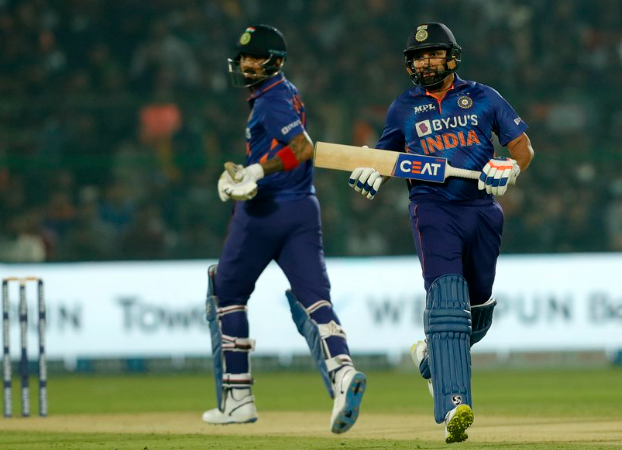
India : India produced a commanding all round performance to defeat New Zealand by five wickets in the opening match of the five game ODI series at Eden Park in Auckland on Wednesday. Virat Kohli led the successful chase with an impressive 74-run innings, while the Indian bowling attack dismantled the home team’s batting order to secure an important victory.
The match was affected by repeated rain interruptions, forcing a revision of India’s target under the Duckworth-Lewis-Stern (DLS) method. Chasing a revised target of 143 runs, India reached the total comfortably, taking an early 1-0 advantage in the series.
The victory was particularly significant for India as several players delivered valuable contributions in challenging conditions. While Kohli provided the experience and stability required during the chase, the young pace attack demonstrated its ability to trouble New Zealand’s batters.
Indian Bowlers Put New Zealand Under Pressure
After winning the toss, Indian captain Shubman Gill elected to bowl first, a decision that proved effective as the visitors consistently troubled New Zealand’s top order.
The hosts struggled to establish partnerships against India’s disciplined fast bowling. Arshdeep Singh led the attack with four wickets for 70 runs, while Gurnoor Brar claimed three wickets for 44 runs.
Anshul Kamboj also delivered an outstanding performance, taking two wickets while conceding only 22 runs in his allotted 10 overs. His accuracy, ability to generate movement and control over line and length made him one of the standout performers of the match.
Kamboj’s performance was particularly encouraging given that it was only his second appearance in ODI cricket. He maintained pressure throughout his spell and prevented New Zealand from building momentum during the middle overs.
India’s bowlers repeatedly used short-pitched deliveries to challenge the opposition batters. The strategy proved successful as New Zealand lost wickets at regular intervals and struggled to recover from their early setbacks.
The home side was eventually dismissed for 185 in 40.2 overs, leaving India with a manageable target under normal circumstances. However, further rain interruptions meant that the revised target became 143 runs.
Virat Kohli Takes Charge of India’s Run Chase
India’s chase received a major boost from Virat Kohli, who produced an attacking innings of 74 runs from just 51 deliveries.
Playing one day before his 38th birthday, Kohli demonstrated that his appetite for scoring runs in international cricket remained strong. His innings included a combination of controlled stroke play, calculated aggression and effective running between the wickets.
The former India captain reached his 80th half-century in ODI cricket during the innings, adding another milestone to his remarkable international career.
Kohli played with confidence against both pace and spin, finding gaps in the field and punishing loose deliveries. His ability to rotate the strike ensured that India maintained control of the required run rate despite interruptions caused by rain.
The experienced batter eventually lost his wicket to Jacob Duffy after attempting an aggressive shot towards deep square leg. However, his contribution had already placed India in a strong position to complete the chase.
Kohli also impressed in the field, taking a spectacular diving catch to dismiss New Zealand all-rounder Nathan Smith off Anshul Kamboj’s bowling. The effort further underlined his importance to the team beyond his batting contributions.
Anshul Kamboj Emerges as a Major Positive
Although Kohli’s batting attracted considerable attention, Kamboj’s performance was another significant takeaway for the Indian team management.
The young fast bowler demonstrated excellent control throughout his 10-over spell, restricting the scoring opportunities available to New Zealand’s batters.
Former India cricketer Irfan Pathan also praised Kamboj’s performance, highlighting his ability to generate movement and maintain consistent lengths.
Kamboj’s contribution was particularly valuable because India are looking to develop additional fast-bowling options ahead of the 2027 ODI World Cup.
The emergence of another dependable pace option could strengthen India’s bowling resources, especially when the team has to manage workloads and injuries during a demanding international calendar.
Gurnoor Brar also made an impression with his three-wicket performance. His pace and ability to trouble the New Zealand batting line-up provided India with another encouraging sign.
Captain Gill praised the collective effort of his bowlers, describing the performance as an important team contribution.
New Zealand Struggle After Losing Early Wickets
New Zealand entered the opening ODI after displaying strong batting form in their previous T20 international outing, but the home side failed to reproduce that performance.
The absence of Devon Conway, who was unavailable after suffering a concussion, also affected the team’s batting combination. Tim Seifert stepped in and top-scored with 38 runs in his first ODI appearance in more than 18 months.
However, New Zealand could not establish the partnerships required to challenge India’s bowling attack.
The middle order faced continued pressure, while India’s fast bowlers ensured that the hosts were unable to accelerate consistently during the innings.
Despite a late contribution that helped the hosts reach 185, the total proved insufficient to put India under sustained pressure.
India Look Ahead to the Second ODI
The opening victory gives India an important advantage as the five-match series moves forward. The second ODI is scheduled to take place in Wellington on Saturday.
The team management will be encouraged by the contributions of both experienced and younger players. Kohli’s form provides stability to the batting line-up, while the performances of Kamboj and Brar offer additional options in the pace department.
India will also look to maintain the discipline demonstrated in Auckland, particularly with the ball, as New Zealand prepare to respond in the next match.
For the hosts, improving their batting performance will be a major priority. They will need stronger partnerships at the top and greater consistency from the middle order to challenge the visitors.
The opening match has given India a positive start to the tour, with the team’s combination of experienced batting and effective fast bowling proving decisive.
Kohli’s impressive half-century, Kamboj’s economical spell and Arshdeep’s four-wicket contribution ensured that India began the ODI series on a winning note. The visitors will now aim to build on that momentum and strengthen their position before the remaining matches.

