


India Defeat Japan 4-1 to Retain Asian Champions Trophy, Clinch Record Sixth Title
India produced a remarkable second-half comeback in Mohali after conceding an early goal, with Shilanand Lakra, Dilpreet Singh, Jugraj Singh and Vivek Sagar Prasad scoring in the final stages.
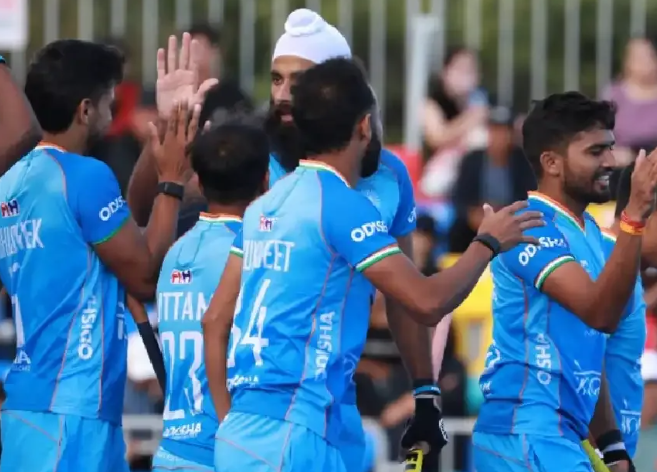
MOHALI, Nov 6: Defending champions India produced a spectacular comeback to defeat Japan 4-1 in the final of the ninth Hero Asian Champions Trophy at the Olympian Balbir Singh Senior International Hockey Stadium in Mohali on Thursday, securing their sixth title in the continental competition.
India, who entered the final as favourites after an impressive unbeaten campaign, were made to work hard by a disciplined Japanese side. An early goal put the hosts under pressure, while Japan’s organised defensive structure prevented the Indian forwards from finding the net for most of the first three quarters.
However, the home team eventually found its rhythm and transformed the contest with four goals in a remarkable spell. Shilanand Lakra brought India level in the 42nd minute, before Dilpreet Singh, Jugraj Singh and Vivek Sagar Prasad scored to complete a convincing victory.
The result extended India’s dominance in the tournament and provided a memorable conclusion to their campaign in front of an enthusiastic home crowd.
The final began with celebrations in the stands, where supporters welcomed the Indian players with music and energetic cheering. India had already defeated Japan by an identical margin during the group stage, and expectations were high that the hosts would repeat their earlier performance.
Japan, however, had different plans.
The visitors made an aggressive start and stunned the home crowd in the third minute when Kazumasa Matsumoto scored with a superb reverse hit effort. The early breakthrough gave Japan confidence and forced India to chase the game from the opening stages.
The Indian players attempted to respond immediately, increasing their attacking pressure and moving forward in search of an equaliser. Abhishek Nain, Dilpreet Singh, Sukhjeet Singh and Hardik Singh created opportunities during the first quarter, but Japan’s defensive organisation and goalkeeper Kisho Kuroda prevented the hosts from converting their chances.
Kuroda proved particularly effective, making important interventions to deny India’s attacking players. Japan maintained a compact defensive formation and used close man to man marking to restrict the movement of Indian forwards inside the circle.
India enjoyed considerable possession and created several promising attacking situations, but the lack of finishing accuracy continued to frustrate the home side.
The second quarter followed a similar pattern. India controlled much of the play and repeatedly attempted to penetrate the Japanese defence, but the visitors remained disciplined and protected their narrow lead.
At half-time, India had enjoyed 52 per cent possession and recorded 11 circle penetrations compared with Japan’s six. The hosts had managed two shots on target, while Japan had one. However, the Japanese side remained ahead on the scoreboard.
Japan also earned two penalty corners during the first half, while India failed to secure any. The statistics reflected India’s territorial advantage but also highlighted Japan’s ability to defend effectively and make the most of its limited opportunities.
The Indian coaching staff needed to find a solution to Japan’s defensive approach. The visitors were marking Indian players closely, leaving little space for the forwards to create clear scoring opportunities.
India gradually began changing their approach during the third quarter. Midfielders Hardik Singh and Nilakanta Sharma played an important role in improving the movement of the team and creating openings through coordinated passing.
Their efforts helped India increase pressure on the Japanese defence. The hosts began finding more space in attacking areas and earned two penalty corners in quick succession.
One of those opportunities eventually resulted in the equaliser.
Indian captain Harmanpreet Singh took the drag-flick, but Japanese goalkeeper Kuroda managed to stop the initial attempt. Aditya Lalage collected the rebound and directed the ball towards Shilanand Lakra, who converted from close range in the 42nd minute.
The goal brought India back into the contest and changed the atmosphere inside the stadium. The players gained renewed confidence, while the supporters responded with louder cheers as the hosts increased their attacking intensity.
Japan challenged the decision surrounding the equalising goal, but the video umpire ruled that Aditya’s aerial pass was not dangerous.
The Japanese team also changed its goalkeeper, replacing Kuroda with Takumi Kitagawa. However, the substitution failed to stop India’s growing momentum.
Once the equaliser was scored, the Indian attack became increasingly dangerous. The hosts began pressing higher up the field, forcing Japan to defend under sustained pressure.
Dilpreet Singh put India ahead six minutes after Lakra’s equaliser. Hardik Singh supplied the pass, and Dilpreet made no mistake in converting the opportunity to give the defending champions a 2-1 advantage.
The goal shifted the pressure entirely onto Japan, which had defended successfully for much of the match but was now struggling to contain India’s attacking movement.
India continued to push forward and earned another opportunity through a penalty corner. Jugraj Singh stepped forward and converted the chance, extending the lead and bringing the home crowd to its feet.
With the momentum firmly on their side, the Indian players maintained their attacking approach rather than settling for a narrow advantage.
Vivek Sagar Prasad completed the scoring with India’s fourth goal, converting a rebound after another effort from Shilanand Lakra. The strike effectively sealed the championship for India and completed an extraordinary turnaround.
The final score of 4-1 reflected India’s dominance during the closing stages, although the match had remained closely contested for much of its duration.
Indian captain Harmanpreet Singh acknowledged that Japan had performed strongly during the opening two quarters. He said the early goal demonstrated that the opposition had arrived with a clear plan to challenge the defending champions.
According to Harmanpreet, India needed to improve its midfield movement and adapt to Japan’s man-to-man marking system. The team eventually relied on zonal marking and increased collective pressure to break through the opposition’s defensive structure.
The captain also emphasised the importance of maintaining belief after conceding the opening goal. He said the players were confident that following their planned structure would eventually create scoring opportunities.
Head coach Craig Fulton was also pleased with the response shown by his players. He explained that the team had previously demonstrated its ability to recover from difficult situations during the tournament, including against Japan and South Korea.
Fulton said India increased its pressing and attacking effort during the final two quarters, which helped the team produce four goals and secure the championship.
The victory was particularly important as India continued preparing for the next phase of its international hockey programme. Fulton noted that the tournament provided valuable experience for both established players and younger members of the squad.
He also pointed towards the importance of developing the team over the coming 18 months ahead of the Los Angeles Olympic Games in 2028.
The championship triumph carried additional significance for midfielder Nilakanta Sharma, who represented India for the final time in international hockey. The title-winning performance therefore marked an emotional farewell for the experienced player, who was part of the Indian side’s successful campaign.
India’s victory also brought celebrations across the country, with the home crowd treating the achievement as a special sporting gift ahead of the festival of Diwali.
Hockey India announced a cash reward of Rs 3 lakh for each member of the playing squad and Rs 1.5 lakh for every member of the support staff in recognition of their achievement.
The tournament’s third-place match also produced an entertaining result, with Malaysia defeating South Korea 5-2 to secure the bronze medal.
For India, the sixth Asian Champions Trophy title further strengthened its position among the leading teams in Asian hockey. The achievement also marked the country’s third consecutive championship victory, underlining its consistency in the continental competition.
The comeback against Japan demonstrated the importance of patience, tactical adjustments and collective effort in high-pressure matches. While the early stages exposed difficulties against Japan’s defensive organisation, India’s response during the final two quarters highlighted the team’s attacking depth and ability to adapt.
The championship will provide the Indian players with confidence as they turn their attention towards future international assignments. With the Los Angeles Olympics approaching in 2028, the coaching staff will also have an opportunity to assess emerging talent and strengthen the team’s overall combination.
India’s performance in Mohali was therefore significant beyond the trophy itself. The victory showcased the team’s ability to overcome adversity, while the emergence of younger contributors alongside experienced players offered encouragement for the road ahead.
After trailing for much of the contest, the defending champions finished in commanding fashion, turning a difficult final into a memorable 4-1 triumph and adding another prestigious title to India’s hockey history.

