


Ranbir Kapoor, Yash and Sai Pallavi’s Ramayana Crosses Rs 500 Crore in India, Nears Rs 1,000 Crore Worldwide
Nitesh Tiwari's mythological epic records Rs 511.10 crore in domestic net collections and Rs 934.55 crore globally after seven days, strengthening its position among the biggest Indian cinematic releases of 2026.
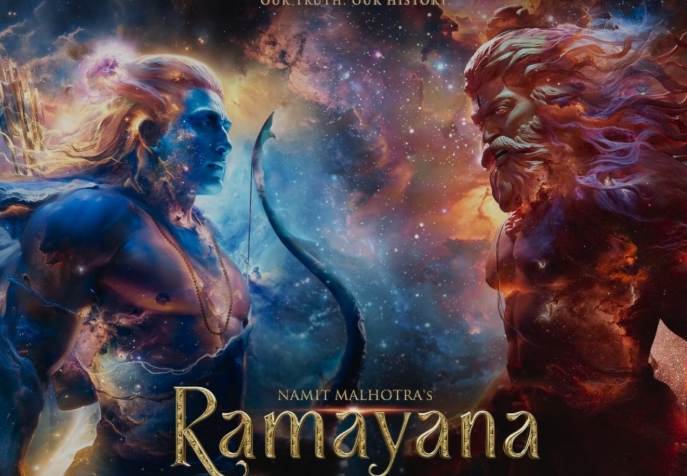
Mumbai , Nov 12 : Nitesh Tiwari’s ambitious mythological film Ramayana: Rise of a Legend has delivered an impressive performance at the box office, crossing the Rs 500 crore mark in domestic net collections within its first seven days in theatres. Featuring Ranbir Kapoor, Yash and Sai Pallavi in leading roles, the film has also moved closer to the Rs 1,000 crore milestone in worldwide earnings.
Released on November 5, the first instalment of the two-part cinematic adaptation has attracted audiences across multiple language markets. According to early estimates reported by trade tracker Sacnilk, the film collected approximately Rs 70.65 crore net in India on Wednesday, November 11, taking its cumulative domestic net earnings to Rs 511.10 crore.
Its India gross collection reached Rs 611.05 crore, while overseas markets contributed another Rs 25 crore on the seventh day. This took its total international gross earnings to Rs 323.50 crore and worldwide collections to approximately Rs 934.55 crore.
The latest figures have strengthened the film’s position among the biggest commercial releases of the year. With only around Rs 65.45 crore separating it from the Rs 1,000 crore worldwide milestone, the production is approaching another major box-office achievement.
Strong Performance Across Multiple Languages
One of the major factors behind the film’s impressive theatrical performance has been its release across several Indian languages.
The Hindi version remained the largest contributor to the overall domestic earnings, generating approximately Rs 58 crore on its seventh day through 19,715 screenings.
The Kannada version added Rs 4.50 crore from 922 shows, while the Malayalam and Telugu versions contributed Rs 2.75 crore each. The Tamil version collected approximately Rs 2.65 crore.
The language-wise figures indicate that the film has managed to attract audiences beyond the traditional Hindi-speaking theatrical market.
Interestingly, the Malayalam version recorded the highest reported occupancy among the five language editions on Wednesday, reaching approximately 68 per cent. The Tamil version registered 55.4 per cent occupancy, followed by Kannada at 47.4 per cent and Hindi at 43.3 per cent. Telugu recorded approximately 25.5 per cent.
These figures highlight the importance of regional markets in the film’s overall commercial performance.
The makers have positioned the production as a large-scale cinematic presentation of an important Indian epic, seeking to connect with audiences across different age groups and linguistic backgrounds.
Its multilingual release strategy has helped expand its theatrical reach, while the involvement of prominent actors from different film industries has increased public interest.
Ranbir Kapoor’s Transformation Into Lord Rama
Ranbir Kapoor plays Lord Rama, the central character of the epic narrative. His casting attracted considerable attention because of the significance of the character in Indian cultural and religious traditions.
The actor’s portrayal represents a major departure from several of his previous screen roles, which have included romantic dramas, intense character studies and contemporary action-oriented films.
The production follows Rama’s journey from his early life and marriage to Sita to his exile from Ayodhya. The narrative subsequently moves towards the abduction of Sita by Ravana, establishing the central conflict that will continue in the second instalment.
Sai Pallavi plays Sita, while Yash appears as Ravana. Ravi Dubey portrays Lakshman, and the supporting cast includes veteran performers Arun Govil as King Dasharath and Lara Dutta as Kaikeyi.
The casting has been an important talking point throughout the film’s promotional campaign. Audiences have shown particular interest in seeing established performers take on characters that have remained deeply familiar through generations of storytelling.
For Ranbir, the project represents one of the most significant productions of his career in terms of scale, subject matter and audience expectations.
Yash’s appearance as Ravana has also contributed substantially to the film’s popularity. The actor, who gained nationwide recognition following the success of the KGF franchise, brings an established action-film following to the production.
Sai Pallavi’s involvement has further increased interest among audiences, particularly in southern India, where she enjoys a strong following because of her performances in regional cinema.
Yash’s Ravana and the Film’s Visual Presentation
Yash’s portrayal of Ravana has emerged as one of the most discussed aspects of the production.
The character is central to the epic’s conflict and requires a portrayal that combines authority, ambition, intelligence and complexity.
The filmmakers have approached the character as an important part of the larger narrative rather than simply presenting him as an antagonist.
The production’s visual scale, costumes, character designs and action sequences have also attracted attention. The makers have attempted to create a cinematic world that reflects the grandeur associated with the epic while presenting the narrative through contemporary filmmaking techniques.
The project has been backed by Namit Malhotra’s Prime Focus Studios in collaboration with DNEG and Yash’s Monster Mind Creations.
The involvement of international technical teams has been an important component of the production’s overall vision.
The film also features music composed by A R Rahman and Hans Zimmer, bringing together two internationally recognised composers for the ambitious project.
Action choreography has been handled by Terry Notary and Guy Norris, adding further international experience to the production team.
The combination of a well-known Indian story, prominent performers and international technical talent has helped establish the film as one of the year’s major theatrical attractions.
Worldwide Collections Approach Rs 1,000 Crore
The film’s overseas performance has played an important role in its rapid progress towards the Rs 1,000 crore milestone.
After collecting approximately Rs 25 crore internationally on its seventh day, the overseas gross total reached Rs 323.50 crore.
Combined with domestic gross earnings of Rs 611.05 crore, the worldwide total stood at Rs 934.55 crore.
The overseas contribution demonstrates the commercial potential of Indian productions that have established narratives and recognisable performers capable of attracting audiences outside the country.
The film’s international distribution strategy has also been an important element of its theatrical campaign.
Industry reports have highlighted plans for a broad international rollout, with Sony Pictures associated with its overseas distribution strategy.
The production’s appeal is not limited to Indian audiences. The Ramayana is a familiar cultural narrative across several countries, particularly in parts of Southeast Asia, where different adaptations and interpretations have existed for generations.
The international response could therefore provide an important indicator of how Indian mythological cinema performs in markets beyond the domestic theatrical circuit.
A Midweek Decline Does Not Slow the Overall Run
Despite its impressive cumulative earnings, the film witnessed a decline in daily collections on its seventh day.
Its Wednesday net collection of Rs 70.65 crore was lower than the approximately Rs 94.10 crore recorded on Tuesday.
The decline reflected the changing pace of weekday theatrical business after the initial holiday-related demand.
However, the film continued to record substantial footfall across thousands of screenings.
The seventh-day collection was also higher than its reported opening-day net earnings of approximately Rs 64.85 crore, demonstrating that the production maintained considerable audience interest during its first week.
Monday had been particularly strong, with collections estimated at Rs 107.50 crore net, benefiting from the festive-period audience response.
Although weekday earnings moderated afterwards, the overall domestic and international totals remained strong.
Trade observers are likely to focus on the film’s second weekend performance to assess whether it can maintain its momentum and move comfortably beyond the Rs 1,000 crore worldwide mark.
The coming days will also provide a clearer indication of its ability to attract repeat viewers and sustain demand against competing releases.
Two-Part Adaptation Expands the Story
The film has been planned as a two-part cinematic project, allowing the filmmakers to explore the epic’s narrative across a broader storytelling framework.
The first instalment focuses on Rama’s early life, his marriage to Sita, the circumstances surrounding his exile and the events leading to her abduction by Ravana.
It concludes with Rama preparing to undertake the mission to rescue Sita, establishing the foundation for the conflict that will drive the second part.
The upcoming instalment is expected to focus on Rama’s efforts to locate and rescue Sita, bringing additional characters and major developments from the epic into the narrative.
Sunny Deol is expected to portray Lord Hanuman in the second part, adding another prominent performer to the cast.
The sequel is scheduled to arrive during Diwali 2028, according to reports surrounding the production.
The decision to divide the story into two films reflects the scale of the source material and the filmmakers’ intention to give important characters and narrative developments sufficient screen time.
It also creates an opportunity to build audience anticipation between the two releases.
A Major Test for Indian Mythological Cinema
The commercial performance of Ramayana: Rise of a Legend has renewed attention on the potential of large-scale mythological productions in the Indian film industry.
Indian cinema has frequently explored historical, religious and legendary subjects, but the scale of contemporary productions has expanded significantly with improvements in visual effects, international collaboration and distribution networks.
The film’s performance demonstrates the strong theatrical interest that can be generated when a familiar story is presented with prominent actors and a large production budget.
At the same time, its long-term commercial success will depend on maintaining audience interest beyond the initial release period.
With domestic collections already above Rs 500 crore and worldwide earnings approaching Rs 1,000 crore, the production has established a significant first-week record.
The coming weekend will be particularly important in determining the next stage of its box-office journey.
For Ranbir Kapoor, Yash and Sai Pallavi, the film represents a major career milestone, while its commercial performance has placed considerable expectations on the upcoming sequel.
As audiences continue visiting theatres, the film’s journey towards the Rs 1,000 crore worldwide milestone remains one of the biggest entertainment developments of November 2026.

