


India and Egypt Set $12 Billion Trade Ambition, Explore Free Trade Agreement
New Delhi and Cairo agree to establish a joint working group to examine a preferential or free trade pact as bilateral commerce expands and more than 300 companies explore investment opportunities.
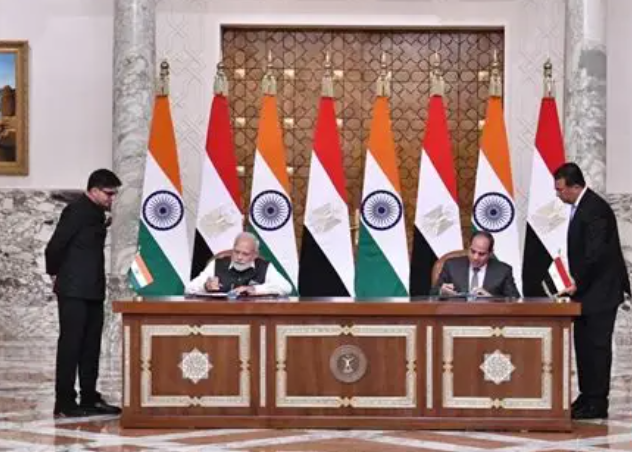
CAIRO, Nov 16: India and Egypt have agreed to strengthen their economic partnership by setting an ambitious target of increasing bilateral trade to USD 12 billion, while exploring the possibility of a Preferential Trade Agreement or Free Trade Agreement to improve market access and encourage investment between the two countries.
The decision was taken during the seventh session of the India-Egypt Joint Trade Committee (JTC), co-chaired by Union Commerce and Industry Minister Piyush Goyal and Egypt’s Minister of Investment and Foreign Trade, Mohamed Farid Saleh, in Egypt’s New Administrative Capital on Monday.
The meeting marked the first time that the bilateral trade mechanism was convened at the ministerial level, highlighting the growing importance both governments attach to expanding commercial relations and strengthening their strategic economic partnership.
As part of the discussions, both countries agreed to establish a Joint Working Group to examine the terms of reference for a proposed preferential or free trade agreement. The initiative is expected to identify opportunities for reducing trade barriers, improving access to domestic markets and developing stronger investment connections.
The proposed arrangement could create a more predictable business environment for companies operating in both countries and encourage exporters to explore new commercial opportunities.
India and Egypt have maintained longstanding economic and diplomatic relations, with cooperation extending across manufacturing, pharmaceuticals, engineering, chemicals, agriculture, energy and infrastructure.
The latest initiative comes at a time when both economies are seeking to diversify international trade relationships, strengthen supply chains and attract greater investment into productive industries.
According to an official statement issued by the Ministry of Commerce and Industry, bilateral trade between the two countries increased by 35 per cent to reach USD 6.5 billion during the financial year 2025-26.
The momentum continued during the first six months of the current financial year. Trade between April and September 2026 increased by 65 per cent to USD 5.04 billion, compared with USD 3.08 billion during the corresponding period of the previous year.
The figures indicate expanding commercial activity and provide a stronger foundation for the two governments to pursue their USD 12 billion trade ambition.
Joint working group to examine trade agreement
The proposed Joint Working Group will examine the framework required for a preferential or comprehensive free trade arrangement.
A preferential trade agreement generally provides selected tariff concessions on specified goods, while a free trade agreement can cover a wider range of products and services, subject to the terms negotiated by participating countries.
For Indian exporters, improved access to the Egyptian market could create opportunities to expand shipments of manufactured goods, pharmaceuticals, engineering products, textiles and agricultural commodities.
Egypt, meanwhile, could benefit from stronger commercial access to India’s large consumer market and expanding industrial economy.
The discussions also focused on practical difficulties faced by companies engaged in cross-border business.
Both governments examined the need to reduce non-tariff barriers, streamline customs procedures, strengthen product standards and improve conformity assessment mechanisms.
Non-tariff barriers include regulatory requirements, product certification procedures, registration conditions and other administrative measures that can increase the cost and time involved in international trade.
Businesses frequently identify such requirements as obstacles even when import duties are relatively low.
The two countries also discussed product registrations and regulatory procedures affecting commercial operations, with the objective of making trade more efficient and predictable.
Improved customs coordination and transparent standards could help businesses reduce delays, manage inventories more effectively and establish dependable supply arrangements.
Business forum attracts more than 300 companies
Alongside the government-level discussions, the India-Egypt Business Forum brought together more than 300 companies from both countries to explore investment, manufacturing and trade opportunities.
The forum provided an important platform for business representatives to identify potential partners, discuss industrial cooperation and develop proposals for joint ventures.
Indian and Egyptian companies examined opportunities across pharmaceuticals, engineering, automobiles, chemicals, textiles, agriculture, food processing, renewable energy, infrastructure and digital services.
The participation of a large business delegation reflected growing interest in translating diplomatic engagement into commercial agreements and long-term industrial partnerships.
Goyal emphasised the importance of moving beyond discussions and ensuring that proposed cooperation results in concrete business outcomes.
He also highlighted the need to address trade-related difficulties within a defined timeframe, encourage investments in industrial clusters and create opportunities for smaller businesses through partnerships with larger companies.
The discussions included strengthening connections between suppliers, manufacturers and investors to improve the participation of small and medium enterprises in bilateral trade.
Both sides also considered establishing regular reviews to assess progress and ensure that identified opportunities develop into actual commercial projects.
Such an approach could help businesses receive greater clarity about investment procedures, market access and the regulatory environment in both countries.
Pharmaceuticals and manufacturing emerge as priority sectors
Pharmaceuticals and healthcare were among the important areas identified for expanded cooperation.
India has an established pharmaceutical manufacturing industry, with companies supplying generic medicines and healthcare products to numerous international markets.
Egypt, meanwhile, offers opportunities for investment in pharmaceutical production, medical devices and healthcare infrastructure.
Greater collaboration could support joint manufacturing arrangements, technology exchange and improved availability of affordable medicines.
The two countries also discussed cooperation in engineering and automobile manufacturing.
India’s engineering industry has a broad industrial base covering machinery, electrical equipment, automobile components and specialised manufacturing products.
Egypt could provide opportunities for Indian businesses seeking to establish manufacturing and distribution networks serving regional markets.
Agriculture and food processing were also included among the priority sectors.
Both countries have an interest in strengthening food supply chains, improving agricultural productivity and developing infrastructure for storage, processing and distribution.
The discussions covered opportunities involving fertilisers, irrigation technology, cold-chain facilities and agricultural equipment.
Energy and renewable power were other important areas of potential collaboration.
As countries increasingly focus on energy security and diversification, cooperation in renewable energy, green hydrogen and related industrial technologies could create opportunities for investment and technical partnerships.
The digital economy was also identified as an area where Indian companies could contribute through financial technology, digital platforms and enterprise solutions.
Investment promotion and business facilitation
Apart from merchandise trade, both countries are seeking to strengthen investment relations.
The discussions included improving cooperation between Invest India and Egypt’s General Authority for Investment and Free Zones (GAFI).
The two sides considered strengthening their existing framework and developing a proposed digital platform to facilitate the exchange of investment-related information and support business partnerships.
Such a platform could help companies identify investment opportunities, understand regulatory requirements and establish contact with relevant government agencies.
Improved information sharing is particularly important for businesses considering overseas expansion because investment decisions depend on reliable information about taxation, licensing, land availability, infrastructure and market conditions.
The two governments also discussed ways to encourage Egyptian investment in Indian states and industrial clusters while facilitating greater participation by Indian companies in Egypt.
The objective is to create long-term industrial relationships rather than limiting cooperation to individual export and import transactions.
Growing strategic and economic relationship
The latest trade initiative builds on expanding political and economic engagement between India and Egypt.
The two countries have identified opportunities to strengthen cooperation in manufacturing, logistics, energy, healthcare and emerging technologies.
Their economic engagement has also gained importance as international businesses increasingly seek diversified supply chains and alternative production locations.
For Indian companies, Egypt’s geographical position provides access to markets across North Africa and the wider Middle East. Its location near important maritime trade routes also makes it relevant for businesses involved in international shipping and distribution.
For Egyptian companies, India represents a large market with significant demand for industrial goods, agricultural products, chemicals and consumer products.
The proposed trade agreement could help create a more favourable environment for businesses looking to establish a stronger presence in both economies.
However, the USD 12 billion objective will require sustained growth in exports and imports, effective removal of trade barriers and stronger participation from private-sector companies.
The two countries will also need to examine the technical and legal aspects of any proposed agreement before deciding on its final scope.
The seventh Joint Trade Committee meeting has therefore provided an important starting point for the next phase of economic cooperation.
The next session of the committee is scheduled to take place in New Delhi in 2028 or earlier by mutual agreement.
In the meantime, the proposed Joint Working Group is expected to examine the possible trade agreement framework and identify areas where improvements can be introduced.
The growing volume of bilateral commerce and participation of hundreds of companies indicate that India and Egypt are seeking to establish a broader economic partnership.
If the proposed measures are implemented effectively, the initiative could strengthen export opportunities, attract fresh investment and create new industrial connections between the two countries.

