


Marques Ackerman Slams Maiden Test Century as South Africa Fight Back Against Bangladesh
The South African opener struck a brilliant 157 off 164 deliveries, sharing a decisive 202 run partnership with Zubayr Hamza to help the hosts reach 287 for four on the second day of the opening Test in Johannesburg.
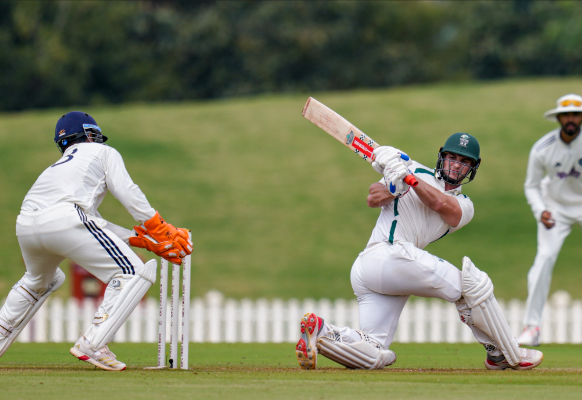
JOHANNESBURG, Nov 16: South Africa opener Marques Ackerman produced a remarkable batting performance to register his maiden Test century, guiding the hosts towards recovery against Bangladesh on the second day of the opening Test at the Wanderers Stadium on Monday.
Ackerman scored an impressive 157 runs from 164 deliveries, helping South Africa reach 287 for four at stumps in reply to Bangladesh’s first-innings total of 400. His innings included 21 boundaries and a six, providing the home side with a strong platform after an early setback.
The 25-year-old batter was supported by Zubayr Hamza, who contributed 83 runs from 129 balls. The pair shared a crucial 202-run partnership for the second wicket, preventing Bangladesh from gaining complete control of the match.
South Africa ended the day 113 runs behind Bangladesh’s first-innings score, with six wickets remaining and captain Temba Bavuma unbeaten on 19. Ryan Rickelton was also at the crease on seven when the day’s play concluded.
Ackerman’s performance became the defining moment of the day’s action, particularly because he had previously come close to registering a Test hundred during his earlier appearances.
The opener demonstrated patience during the initial stages before increasing the scoring rate as he became more comfortable at the crease. His innings combined disciplined defence with aggressive stroke play, putting considerable pressure on Bangladesh’s bowling attack.
Bangladesh had entered the second day in a relatively strong position after finishing the opening day’s play at 327 for six. Their batters had built a substantial total, and the visitors were hoping to extend their advantage by adding further runs during the morning session.
Wicketkeeper-batter Litton Das resumed his innings on 89 and quickly moved towards his century. He eventually reached the milestone with a boundary, completing his eighth Test hundred in 154 deliveries.
Das continued batting aggressively after reaching three figures and finished with 120 runs from 154 balls, an innings featuring 14 fours and a six.
His contribution was particularly important because it helped Bangladesh move beyond the 350-run mark and establish a competitive first-innings total.
However, South African fast bowler Dane Paterson prevented the visitors from extending their innings much further. He produced an excellent spell during the morning session, taking four wickets to restrict Bangladesh to 400.
Paterson’s intervention proved crucial for the home side, as Bangladesh had looked capable of reaching a significantly higher total when play resumed.
The visitors were eventually dismissed after adding 73 runs to their overnight score. Paterson finished with four wickets for 92 runs, providing South Africa with an opportunity to begin their reply without facing an excessively large deficit.
Bangladesh’s total of 400 was nevertheless a significant achievement, representing their highest Test score on South African soil.
The innings also featured an important contribution from Towhid Hridoy, who had scored 137 earlier in the match. Along with Das, he helped Bangladesh establish a strong batting foundation.
It was the first time two Bangladesh batters had registered centuries in the same Test innings against South Africa.
The visitors therefore had plenty of reasons to be satisfied with their batting effort, although Paterson’s late strikes prevented them from achieving an even more commanding position.
South Africa’s response began poorly when opener Aiden Markram was dismissed in the second over.
Bangladesh fast bowler Hasan Mahmud produced an effective delivery that drew a tentative response from Markram, who edged the ball behind after scoring only five runs.
The early breakthrough gave Bangladesh renewed confidence, but Ackerman and Hamza responded with a determined partnership that changed the direction of the contest.
Both batters initially concentrated on building a stable foundation, carefully negotiating the movement generated by Bangladesh’s fast bowlers.
Hasan Mahmud and Taskin Ahmed attempted to maintain pressure through disciplined lines and lengths, but the South African pair gradually became more comfortable against the attack.
Ackerman began finding gaps in the field with increasing regularity, while Hamza concentrated on rotating the strike and punishing loose deliveries.
The partnership grew steadily as the two batters demonstrated good understanding and patience.
Hamza reached his half-century from 82 deliveries, using a mixture of controlled drives and well-timed shots to maintain the scoring rate.
Ackerman, meanwhile, completed his third consecutive fifty in Test cricket after 68 balls. He brought up the milestone by striking Mehidy Hasan Miraz through deep midwicket for four.
The South African opener continued to attack the bowling whenever opportunities appeared, while avoiding unnecessary risks against deliveries that demanded a defensive response.
Bangladesh attempted several changes in their bowling approach but struggled to break the partnership.
Taskin Ahmed came particularly close to dismissing Hamza when the batter was struck in front of the wickets. However, the delivery was declared a no-ball because the bowler had overstepped the crease, allowing Hamza to continue his innings.
The missed opportunity proved costly for Bangladesh as the partnership continued to grow.
After the lunch interval, Ackerman and Hamza maintained their concentration and gradually brought South Africa back into the contest.
Their 202-run stand represented a major turning point in the innings, particularly after Markram’s early dismissal had threatened to expose the middle order.
Bangladesh captain Najmul Hossain Shanto eventually turned to left-arm spinner Mominul Haque in an attempt to break the partnership.
The decision produced the desired result when Mominul dismissed Hamza for 83.
Hamza attempted to continue his positive approach but edged a delivery behind to wicketkeeper Litton Das, ending an innings that had played an important role in South Africa’s recovery.
His departure brought Ackerman and captain Temba Bavuma together at the crease.
Ackerman, however, remained determined to complete his first Test century.
He continued playing confidently against the Bangladesh attack and reached the landmark in 125 deliveries, bringing up his hundred with a single off Taskin Ahmed.
The achievement marked an important personal milestone for the opener, who had missed an earlier opportunity to score a Test century during his second appearance at the highest level.
His maiden hundred demonstrated how effectively he had adjusted to the demands of Test cricket and how much his batting had developed since his previous opportunities.
Rather than slowing down after reaching three figures, Ackerman continued to put pressure on the bowlers.
He increased the tempo of his innings, finding boundaries regularly and forcing Bangladesh to make frequent adjustments to their field placements.
His aggressive approach also helped South Africa reduce the first-innings deficit at a faster rate.
Ackerman eventually departed for 157 after facing 164 balls. Hasan Mahmud dismissed him with Taskin Ahmed completing the catch at backward square leg.
The dismissal ended a superb innings and broke a 61-run partnership between Ackerman and Bavuma.
Hasan continued to make an impact by removing Matthew Breetzke for two shortly afterwards, preventing South Africa from taking complete control of the contest.
Bangladesh also had an opportunity to dismiss Ryan Rickelton when the batter edged a delivery behind, but wicketkeeper Litton Das was unable to hold the catch.
At the close of play, Bavuma remained unbeaten on 19, while Rickelton was not out on seven.
The match therefore remained finely balanced, with South Africa still requiring another 113 runs to draw level with Bangladesh’s first-innings total.
For the hosts, the third day will be important in determining whether they can secure a first-innings lead or whether Bangladesh’s bowlers can regain control.
Bavuma’s presence at the crease provides South Africa with an experienced batter capable of guiding the lower middle order. Rickelton will also be expected to make a meaningful contribution after surviving the late opportunity offered to Bangladesh.
The visitors, meanwhile, will look towards Hasan Mahmud and Taskin Ahmed to make early breakthroughs.
Hasan’s performance on the second day was particularly encouraging, as he removed Markram, Ackerman and Breetzke to finish with three important wickets during South Africa’s reply.
Mominul’s dismissal of Hamza also demonstrated that Bangladesh could find success through spin after struggling to contain the South African partnership.
The bowling side will need to maintain discipline and take advantage of any opportunities during the next session.
Ackerman’s century has nevertheless changed the complexion of the match. His innings ensured that South Africa remained firmly in contention despite Bangladesh’s substantial first-innings total.
The opening Test has also provided several individual highlights, including centuries from Litton Das and Towhid Hridoy for Bangladesh and a maiden Test hundred for Ackerman.
For the South African opener, the 157-run innings represents a major breakthrough in his international career. Scoring a first Test century against a competitive bowling attack will provide considerable confidence for future assignments.
His performance also reinforces the importance of partnerships in the longest format, where patience and concentration can transform the direction of a match.
South Africa will now aim to build on the foundation created by Ackerman and Hamza as they attempt to overcome Bangladesh’s first-innings advantage.
With six wickets still available at the end of the second day, the contest remains open, and the next phase of the match could prove decisive in determining which team gains the upper hand.

