India’s Electronics Exports Set to Cross $60 Billion in FY27 Amid Manufacturing Boom
Electronics shipments have already reached $38.4 billion in the first seven months of the financial year, with mobile phones and non-smartphone products driving growth as the government focuses on strengthening domestic supply chains.
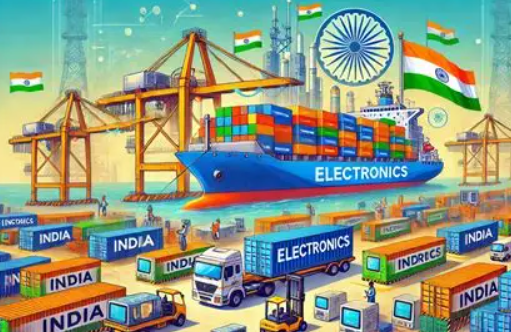
New Delhi, Nov 26: India’s electronics exports are expected to surpass $60 billion during the financial year 2026-27, reflecting the rapid expansion of domestic manufacturing and the country’s growing presence in global electronics supply chains.
A senior official from the Ministry of Electronics and Information Technology (MeitY) said on Wednesday that merchandise shipments from the sector had already crossed $38.4 billion during the first seven months of the current financial year, putting India on course to achieve a new export milestone.
Speaking at the Confederation of Indian Industry (CII) Electronics Summit, Joint Secretary Sushil Pal expressed confidence that exports would exceed the government’s expectations, supported by strong demand for mobile phones and other electronic products.
According to the official, mobile phones accounted for approximately $20 billion of the cumulative exports, while non-smartphone electronics contributed around $18 billion.
The figures indicate that India’s export growth is gradually extending beyond smartphones, with several other categories of electronic products gaining importance in international markets.
Pal noted that October recorded particularly strong export performance, although the November figures were still being compiled at the time of his remarks.
He said non-smartphone electronics exports had already reached the level recorded during the entire previous financial year within the first seven months of FY27.
The development is significant for India’s manufacturing ambitions because it suggests that the country’s electronics industry is expanding into a wider range of products rather than relying predominantly on mobile phone assembly.
Strong Performance Across Electronics Categories
India’s electronics industry has witnessed substantial growth over the past few years, supported by government incentives, rising manufacturing investment and the expansion of production facilities operated by domestic and international companies.
During FY26, electronics production in India exceeded $116 billion, while exports reached approximately $48 billion.
The projected $60-billion export target for FY27 would represent a considerable increase over the previous financial year’s performance.
The government’s export strategy has increasingly focused on strengthening domestic production capabilities, improving component availability and encouraging manufacturers to establish deeper supply chains within the country.
Smartphones continue to remain the largest category in India’s electronics export basket. However, the expansion of non-smartphone shipments is emerging as an important indicator of diversification.
These products include electronic components, printed circuit boards, communication equipment, memory-related products and storage devices.
Official trade figures released earlier by the government showed that electronic goods exports increased by 44 per cent to $31.97 billion during April-September 2026-27, compared with $22.20 billion in the corresponding period of the previous financial year.
Smartphone exports rose 35.8 per cent to $18.17 billion, while non-smartphone electronic goods recorded stronger growth of 56.5 per cent, reaching $13.79 billion.
The faster expansion of the latter category indicates that India’s manufacturing ecosystem is gradually developing capabilities across multiple segments of the electronics value chain.
It also provides opportunities for component manufacturers, technology suppliers and specialised industrial units to participate in the sector’s expansion.
Press Information Bureau+2
Non-Smartphone Products Gain Importance
The growing contribution of non-smartphone electronics is particularly important for India’s long-term manufacturing strategy.
For several years, smartphones have been the principal driver of the country’s electronics export expansion. Large-scale manufacturing operations and international supply-chain partnerships have helped India become an increasingly important production destination.
However, a sustainable electronics manufacturing ecosystem requires capabilities beyond final product assembly.
Components such as printed circuit boards, semiconductor-related products, electronic substrates, memory devices and communication equipment are essential for producing a broad range of consumer and industrial electronics.
Greater domestic manufacturing of these products can reduce dependence on imported inputs and improve the ability of Indian companies to respond to changes in international demand.
The latest export performance suggests that this diversification is gradually taking place.
The government’s official figures also indicate that non-smartphone products are increasing their share of overall electronic goods exports.
During the first six months of FY27, these products accounted for 43.2 per cent of total electronics exports, reflecting their growing contribution to the sector.
The expansion is particularly relevant as international companies increasingly seek diversified manufacturing locations and alternative sourcing arrangements.
India’s large domestic market, skilled workforce and expanding industrial infrastructure provide opportunities for manufacturers looking to establish or enlarge their production operations.
Supply Chain Challenges Remain
Despite the strong export performance, the industry continues to face challenges related to the availability of critical components.
Pal pointed out that manufacturers were experiencing shortages not only of semiconductor chips but also of several non-semiconductor inputs.
These include substrates and printed circuit boards, which are essential for manufacturing electronic products.
The issue highlights the complexity of developing a complete electronics manufacturing ecosystem.
Even when companies have sufficient assembly capacity, shortages of specialised components can disrupt production schedules and affect delivery commitments.
Semiconductors have traditionally received significant attention because of their importance in computers, smartphones, automobiles and advanced electronic devices.
However, the availability of other components is equally important for maintaining uninterrupted production.
Printed circuit boards, for example, connect electronic components and allow devices to perform their intended functions. Substrates are also important in advanced packaging and electronic manufacturing processes.
A shortage in any of these inputs can affect the production of finished goods.
The government has been pursuing targeted policies to strengthen domestic semiconductor capabilities and improve the availability of critical manufacturing inputs.
The broader objective is to encourage investment across different stages of the electronics value chain, rather than concentrating only on final assembly operations.
Industry participants have increasingly highlighted the need for a coordinated approach involving component manufacturers, semiconductor companies, technology developers and equipment suppliers.
Government’s Manufacturing Push
The expansion of electronics exports is closely connected with India’s efforts to establish itself as a major global manufacturing destination.
The government has introduced several initiatives aimed at increasing domestic production, encouraging investment and improving the competitiveness of Indian manufacturers.
Production-linked incentive programmes have played an important role in attracting companies to the country, particularly in the mobile phone manufacturing segment.
The policy approach has also focused on creating opportunities for domestic businesses to participate in international supply chains.
Manufacturers are being encouraged to expand their production capabilities, improve product quality and develop stronger research and engineering operations.
The electronics industry has also benefited from growing demand for digital devices, communication equipment, computers and other technology products.
As businesses and households increasingly depend on electronic equipment, the demand for reliable manufacturing and supply-chain networks has become more important.
India’s growing domestic consumption provides manufacturers with an additional market alongside their export operations.
This combination of domestic demand and international opportunities could support further investment in production facilities.
Global Trade Opportunities
The global electronics industry is undergoing significant changes as companies reassess their manufacturing locations and sourcing strategies.
International businesses are seeking greater supply-chain resilience, particularly after disruptions caused by geopolitical tensions, trade restrictions and logistical challenges.
India is attempting to benefit from this shift by strengthening its manufacturing infrastructure and encouraging foreign investment.
The country’s expanding electronics exports could help it become a more important supplier to markets across Asia, Europe and North America.
However, increasing international market share will require Indian manufacturers to maintain competitive prices and meet strict quality and delivery standards.
Companies will also need to invest in automation, product development and advanced manufacturing technologies.
The availability of specialised components and skilled technical personnel will remain important for sustaining growth.
Industry experts have also emphasised that building domestic capabilities in electronics manufacturing requires long-term investment rather than depending exclusively on short-term incentives.
The development of component suppliers, testing facilities and technology partnerships will be essential for improving the industry’s competitiveness.
Outlook for FY27
With exports already exceeding $38 billion during the first seven months of the financial year, the government remains optimistic about achieving the $60-billion milestone.
The remaining months will be important in determining whether the industry can maintain its current momentum.
Strong smartphone shipments, improved performance in non-smartphone categories and rising international demand are expected to support further growth.
At the same time, component shortages and external market uncertainties could influence production and shipment schedules.
The government’s focus on semiconductor manufacturing and supply-chain development is expected to remain central to the industry’s expansion.
If the current growth trend continues, FY27 could become an important year for India’s electronics manufacturing sector.
Beyond the immediate export target, the larger objective is to develop a diversified manufacturing ecosystem capable of producing a wider range of electronic products and components.
Such a transformation could improve India’s position in global trade, attract additional investment and create employment opportunities across manufacturing and technology-related industries.
The expected achievement of $60 billion in electronics exports would therefore represent not just an increase in shipment value but also a sign of the country’s evolving industrial capabilities.