


Supreme Court’s Verdict Reserved: Apex Court Weighs Constitutional Validity of Article 370 Revocation, 16-Day Marathon Hearing Concludes
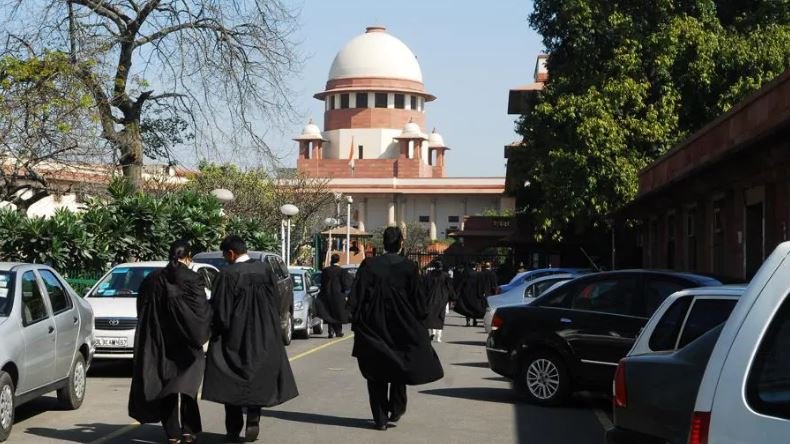
05-09-2023 : The Supreme Court of India has reached a momentous juncture as it concludes its extensive deliberations and hearings surrounding a pivotal legal matter. Today, the apex court has reserved its much-anticipated verdict on a cluster of petitions that challenge the momentous abrogation of Article 370 of the Indian Constitution, an article that had bestowed distinct and unique status upon the erstwhile state of Jammu and Kashmir.
This landmark decision comes after an exhaustive and marathon 16-day hearing conducted by a distinguished five-judge bench, presided over by Chief Justice DY Chandrachud. Comprising the eminent jurists Justices Sanjay Kishan Kaul, Sanjiv Khanna, BR Gavai, and Surya Kant, this bench meticulously considered the arguments presented by senior advocates Kapil Sibal, Gopal Subramanium, Rajeev Dhavan, Zaffar Shah, Dushyant Dave, and others on the final day of the hearings.
In a gesture of procedural transparency and fairness, the Supreme Court has extended an opportunity to lawyers representing both petitioners and respondents to submit written submissions over the next three days. These submissions, however, are to be concise, not exceeding two pages in length.
Throughout the comprehensive hearings that spanned the course of 16 days, the court had the privilege of hearing arguments from Attorney General R Venkataramani, Solicitor General Tushar Mehta, as well as senior advocates such as Harish Salve, Rakesh Dwivedi, and V Giri, all representing the interests of the Central government and intervenors who ardently defended the abrogation of Article 370.
The proceedings encompassed a multifaceted examination of various legal issues, including the constitutional validity of the Central government’s decision to revoke Article 370 on August 5, 2019. Additionally, the validity of the Jammu and Kashmir Reorganisation Act, a pivotal legislation that led to the bifurcation of the erstwhile state into two Union Territories – Jammu and Kashmir and Ladakh – was subject to rigorous scrutiny. Other matters of concern included challenges to the imposition of the Governor’s rule in Jammu and Kashmir on June 20, 2018, and the imposition of the President’s rule in the region on December 19, 2018, along with its subsequent extension on July 3, 2019.
It is worth noting that several petitions challenging the abrogation of Article 370 and the enactment of the Jammu and Kashmir Reorganisation Act, 2019 were consolidated and referred to a Constitution bench in 2019. This consolidation was a testament to the significance and complexity of the legal issues at hand.
Meanwhile, amidst this pivotal legal saga, Mohd Akbar Lone, a prominent leader of the National Conference, took a significant step by filing an affidavit in the Supreme Court. In this affidavit, he reiterates his unwavering commitment to uphold the provisions of the Indian Constitution and protect the territorial integrity of the country. This action was taken in response to a directive from the apex court, which had required Lone to declare his allegiance to the Constitution of India and unequivocally acknowledge the sovereignty of the nation. This directive was issued following allegations that he had raised the controversial slogan “Pakistan zindabad” (Long live Pakistan) in the Jammu & Kashmir Assembly in 2018, a matter that stirred significant controversy during the Constitution bench’s hearings on the abrogation of Article 370.
As the legal proceedings drew to a close, senior advocate Kapil Sibal, representing Mohd Akbar Lone, presented the affidavit to the five-judge Constitution bench, led by Chief Justice DY Chandrachud, for their examination. However, Solicitor General Tushar Mehta, representing the Central government, raised objections to the contents of the affidavit, emphasizing that it lacked any expression of remorse for the alleged conduct in question.
Notably, Mohd Akbar Lone is the lead petitioner challenging the abrogation of Article 370, a constitutional amendment that had accorded special status to the erstwhile State of Jammu and Kashmir. As the nation awaits the Supreme Court’s verdict, this legal saga stands as a pivotal moment in the annals of Indian jurisprudence, with far-reaching implications for the nation’s constitutional and political landscape.

