


Akhilesh Yadav Challenges Yogi Govt to Publish District Wise Details of 64,000 Acres of Recovered Land
SP chief questions Yogi Adityanath’s figures on reclaimed land, links demand for transparency to wider concerns over accountability in Uttar Pradesh
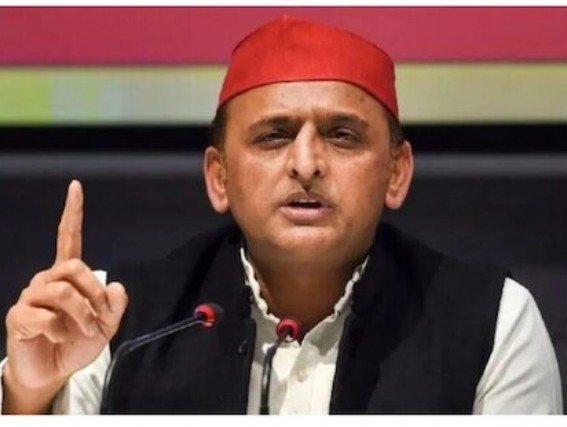
Lucknow, July 10: Samajwadi Party president Akhilesh Yadav on Thursday sharpened his attack on the Uttar Pradesh government, asking Chief Minister Yogi Adityanath to place in the public domain district wise details of the “64,000 acres” of land that the BJP government says it has freed from illegal encroachments since coming to power in 2017.
In a strongly worded post on X, the former chief minister said the state government should publish a full district by district record, including the area recovered and the relevant land documents, if it wants the public to trust the claim. Yadav said such disclosure was necessary to establish the credibility of the figures being cited by the ruling dispensation.
The Samajwadi Party leader’s remarks came a day after Adityanath, while addressing a public programme in Chitrakoot, said his government had reclaimed around 64,000 acres of land that had allegedly been under illegal occupation when the BJP assumed office in the state. The chief minister made the statement while inaugurating and laying foundation stones for 124 development projects worth Rs 951 crore.
Escalating the political confrontation, Yadav argued that the government’s assurances no longer carry unquestioned credibility in the public sphere. He said the administration must release the exact district-wise breakup of the land it claims to have recovered, along with official records, rather than relying on broad public assertions.
Yadav also used the opportunity to renew his criticism of the BJP government over its handling of allegations linked to the Ayodhya Ram temple donation embezzlement controversy. He alleged that the Special Investigation Team constituted by the state government to probe the matter lacked credibility and was designed to shield those responsible rather than uncover the truth.
Referring to that episode, the SP chief said public confidence had been eroded by what he described as selective investigations and inconsistent official claims. He further alleged that previous controversies had already raised doubts about the reliability of government statements, and said citizens were justified in seeking documentary proof rather than political rhetoric.
In his social media post, Yadav framed the issue as one of accountability and public trust. He asked how people should decide what to believe when there is a mismatch between figures stated in speeches and figures available in official records. The question, he suggested, was not merely about land recovery but about the broader credibility of the government’s governance narrative.
The latest exchange adds another layer to the continuing political battle between the ruling BJP and the opposition Samajwadi Party ahead of future electoral contests in Uttar Pradesh. Land, law and order, corruption allegations, and governance claims have repeatedly emerged as central themes in the confrontation between the two parties.
Adityanath, in his Chitrakoot address, had used the land recovery claim to mount a sharp attack on previous SP governments. He alleged that before 2017, large tracts of government land, as well as land belonging to traders and poor citizens, were under illegal occupation. The chief minister claimed that the current government launched a sustained campaign against encroachments and succeeded in reclaiming thousands of acres.
He also accused “Samajwadi Party goons” of grabbing public land in the past by using political patronage and intimidation, alleging that party flags were planted on occupied plots to protect illegal possession. According to Adityanath, the recovered land is now being repurposed for public use, including the establishment of universities, medical colleges and investment driven projects aimed at creating jobs.
The BJP has repeatedly projected anti-encroachment drives as evidence of its commitment to rule of law and administrative discipline in Uttar Pradesh. The state government has over the years highlighted bulldozer led crackdowns, removal of illegal occupations and action against what it describes as land mafias as major pillars of its governance model.
For the Samajwadi Party, however, the government’s narrative offers an opening to question both the scale of the claims and the transparency of the process. By demanding district-wise documentation, Yadav has sought to shift the debate from headline numbers to verifiable records, forcing the BJP to defend not only the policy but also the data behind it.
Political observers say the significance of the demand lies in its attempt to test the official narrative on administrative performance. If the government releases detailed district-level data, the opposition is likely to scrutinise whether the land was indeed public property under illegal occupation, whether due legal procedure was followed, and how much of the reclaimed land has actually been put to public use. If no such detailed disclosure is made, the opposition will continue to question the claim as exaggerated or politically convenient.
The dispute also reflects the larger contest over political messaging in Uttar Pradesh. The BJP has consistently framed its tenure as one marked by stronger law enforcement, infrastructure growth and a crackdown on criminality and encroachment. The SP, on the other hand, has sought to challenge that image by alleging selective action, inflated claims and a pattern of governance driven by publicity rather than institutional transparency.
Yadav’s latest intervention is therefore not just a response to a number cited by the chief minister; it is part of a broader effort to undermine the BJP’s governance pitch. By tying the land recovery issue to controversies such as the Ayodhya donation allegations and disputed official claims in other matters, he is attempting to build a larger argument that the state government’s statements cannot be accepted without documentary scrutiny.
For Adityanath and the BJP, the challenge will be to maintain the momentum of a narrative that portrays the government as having cleaned up years of alleged disorder under previous administrations. The chief minister’s speech in Chitrakoot was designed to showcase both development spending and administrative resolve, linking reclaimed land to institutions, investment and employment generation. The opposition’s counterattack now seeks to puncture that claim by demanding evidence at the district level.
As the war of words intensifies, the controversy over the 64,000-acre figure is likely to remain a political flashpoint in Uttar Pradesh. Whether the government responds with a detailed public record, and whether that data withstands scrutiny, may determine how the issue evolves in the days ahead. For now, Akhilesh Yadav has turned a headline claim into a demand for verifiable proof, placing the burden back on the state government to substantiate one of its most prominent assertions on governance and land reform.

