


Akhilesh Yadav Slams UP Government Over Lucknow Scam Call Centre Bust, Minister Hits Back With NCRB Figures
After Lucknow Police arrested 119 suspects in an alleged international cyber fraud racket operating from Gomti Nagar, Samajwadi Party chief Akhilesh Yadav accused the Uttar Pradesh government of failing to rein in cybercrime, while minister Asim Arun defended the state’s record citing NCRB figures.
Lucknow, Jul 2: A major police crackdown on an alleged international cyber fraud racket in Lucknow has triggered a fresh political confrontation in Uttar Pradesh, with Samajwadi Party president Akhilesh Yadav accusing the BJP government of failing to control cybercrime and state minister Asim Arun hitting back with NCRB data to defend the administration.
The political exchange came a day after Lucknow Police busted an alleged scam call centre operating out of a commercial building in the Gomti Nagar area and arrested 119 people said to be linked to an international cyber fraud network. According to the police, the racket primarily targeted foreign nationals, especially citizens in the United States, and was allegedly run through a fake call centre model designed to dupe victims online.
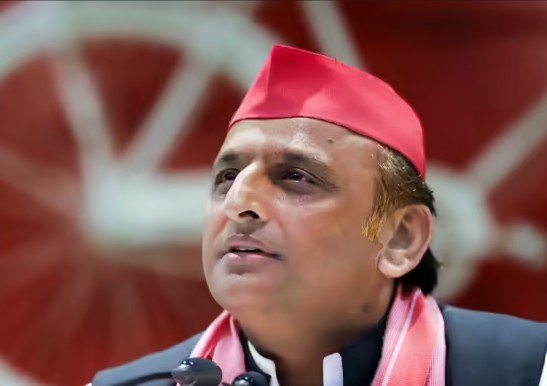
Addressing a press conference at the Samajwadi Party office in Lucknow on Thursday, Akhilesh Yadav used the case to launch a broad attack on the Yogi Adityanath-led government, claiming the development exposed serious lapses in policing, monitoring and digital security in the state capital itself.
Questioning the government’s handling of cybercrime, the former chief minister said it had taken nearly a decade for the administration to uncover such a large operation in Lucknow, despite repeated claims of strong governance and improved law and order. He alleged that if a detailed and honest probe were carried out across the state, many more such rackets would come to light.
Yadav argued that the discovery of the alleged scam centre in a prominent locality was evidence that the government either remained unaware of what was happening under its watch or failed to act in time. He said the bust should not be seen as an isolated criminal case, but as a sign of a wider and more worrying pattern of cyber-related offences growing in Uttar Pradesh.
In a sharp political swipe, the Samajwadi Party chief also linked the issue to broader concerns about governance and accountability under the BJP regime. Referring to allegations surrounding theft of donation money at the Ram Mandir in Ayodhya, Yadav claimed CCTV cameras had been switched off and footage deleted, suggesting that the state government had failed to ensure transparency even in highly sensitive matters.
He further alleged that Uttar Pradesh was among the leading states in cyber fraud and cybercrime, while also claiming that a significant number of such incidents never get formally registered. According to him, the actual scale of digital fraud may be far bigger than official data suggests because many victims either do not report the crime or their complaints are not recorded effectively.
Yadav said the nature of crime in India was changing rapidly and governments needed to adapt to the new reality. He argued that criminals no longer needed to rely only on conventional street crime when money could be siphoned away through online fraud, impersonation and digital deception. In that context, he asked what concrete steps the Uttar Pradesh government had taken to improve cyber policing, strengthen digital surveillance and protect ordinary people from online scams.
He also targeted the BJP politically, alleging that those involved in “looting” had found shelter under the ruling party. Continuing his attack, Yadav said the Centre and the state government had spoken extensively about Digital India and online governance, but had failed to invest equal seriousness in digital safety, cyber awareness and institutional preparedness against online fraud.
The Samajwadi Party leader also questioned whether Chief Minister Yogi Adityanath fully understood the seriousness of cybercrime and the speed at which digital fraud networks were evolving. He suggested that the government’s response remained rooted in traditional law-and-order optics, while cybercriminals were operating through sophisticated and transnational systems that required a more specialised strategy.
The remarks prompted a swift response from Uttar Pradesh Minister of State (Independent Charge) for Social Welfare Asim Arun, who rejected the allegations and accused Akhilesh Yadav of making politically motivated statements that were not supported by official crime data.
In a social media post, Arun said the Samajwadi Party chief’s claim that Uttar Pradesh was leading the country in cybercrime was contrary to the figures published by the National Crime Records Bureau. Addressing Yadav directly, the minister said that if he had read the NCRB report carefully, he would not have made such a statement.
Arun, a former IPS officer, cited the NCRB’s 2024 data and said Telangana had recorded the highest number of cybercrime cases in the country, not Uttar Pradesh. He argued that the opposition was trying to create a misleading impression about the law-and-order situation in the state by selectively using a single incident to attack the government.
The minister also defended the broader framework put in place to tackle cyber offences, crediting the Narendra Modi government for strengthening the institutional response to online fraud. He pointed to the National Cyber Crime Reporting Portal and the 1930 helpline, saying these systems allow victims to directly lodge complaints related to financial fraud and cyber deception.
According to Arun, the complaint mechanism is designed in a way that registrations are made directly by citizens and victims, not manipulated by state governments or local police units. By highlighting this point, he sought to counter the opposition’s charge that cybercrime figures were being underreported or hidden by the administration.
Even as the political blame game intensified, the Lucknow Police continued to project the case as a major breakthrough in dismantling a suspected international fraud operation. Police Commissioner Amrendra Kumar Sengar said the arrests followed an extensive operation and that the accused were allegedly linked to a network that targeted foreign nationals through fake calls, deceptive messaging and other fraudulent means.
Officials indicated that the call centre had been functioning from a commercial premises in Gomti Nagar, one of Lucknow’s best-known business and residential zones. The use of such a location has added to the seriousness of the case, as it raised questions about how such a large operation could allegedly function for an extended period without attracting earlier attention.
While the police have not publicly disclosed every operational detail of the racket, initial findings suggest that the accused were part of a system used to deceive victims abroad by posing as service providers, technical support agents or officials. Such fraud models have become increasingly common in transnational cybercrime investigations, with scammers often relying on fake identities, scripted conversations and pressure tactics to extract money or confidential financial information.
The arrest of 119 people in one operation makes the Lucknow bust one of the more significant cybercrime crackdowns in recent months in Uttar Pradesh. It has also highlighted how scam call centres, once viewed largely as isolated urban fraud setups, may in some cases be part of wider networks with links extending beyond state and national borders.
The political controversy surrounding the case reflects a larger debate over how cybercrime should be measured, reported and addressed. Opposition parties often argue that official crime statistics do not fully capture the ground reality because underreporting remains a major challenge. Governments, on the other hand, tend to point to institutional reforms, technological platforms and formal complaint systems as evidence of stronger action.
In Uttar Pradesh, the issue is particularly sensitive because law and order remains a central political theme for the ruling BJP as well as the opposition. For the Yogi Adityanath government, every high-profile crime case becomes a test of its claim that policing has improved and criminal networks are being dealt with firmly. For the Samajwadi Party, such incidents offer an opportunity to question the government’s governance record and challenge its narrative of control and security.
Cybercrime adds another layer to that debate because it is often less visible than conventional offences, yet potentially more damaging in financial and reputational terms. Unlike street crime, digital fraud can be committed from a hidden location, target victims across states or countries, and leave behind complex electronic trails that require specialised investigation. This makes both prevention and prosecution more difficult, and also complicates public understanding of how widespread the problem actually is.
The Lucknow bust has therefore become more than just a police case. It has opened up questions about surveillance, digital awareness, regulatory oversight of commercial spaces, and the capacity of law enforcement agencies to track and shut down sophisticated fraud networks before they expand. It has also sparked a fresh political argument over whether Uttar Pradesh is doing enough to prepare for a new era of crime that increasingly operates through phones, computers and online payment systems rather than physical violence on the streets.
For now, the immediate focus remains on the police investigation and the legal proceedings against those arrested. Authorities are expected to examine the seized devices, communication records, financial trails and possible international links of the alleged network. Investigators will also likely look into how the operation was structured, who financed it, how recruits were brought in, and whether similar centres are operating elsewhere under different fronts.
As the investigation progresses, the case is likely to remain politically charged. Akhilesh Yadav has sought to use the bust to question the BJP’s governance model and cybercrime preparedness, while the government has tried to turn the debate toward official data and institutional mechanisms. With both sides framing the incident to suit their political narrative, the Lucknow cyber fraud bust has quickly moved beyond a law enforcement action and into the centre of Uttar Pradesh’s political discourse.

