


Amira Kadal Bridge, Where Past Walks Present
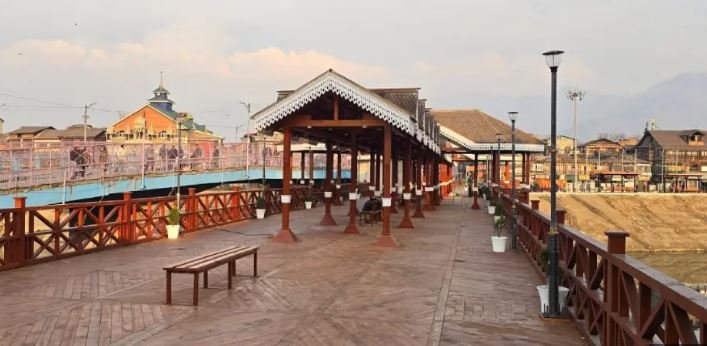
Amira Kadal Bridge stands as one of Srinagar’s most enduring urban landmarks, quietly carrying the weight of history while remaining firmly embedded in the city’s everyday life. Built in the early twentieth century during the Dogra period, the bridge was conceived to improve connectivity between the old city and emerging commercial quarters. Over time, it evolved into far more than a passage across the Jhelum River. Surrounded by bustling markets and constant pedestrian movement, it became a shared civic space where commerce, culture, and routine human interaction naturally converged.
Bridges such as Amira Kadal are not merely physical structures. They shape how a city breathes and moves. They link neighborhoods, sustain livelihoods, and anchor collective memory. In historic cities like Srinagar, these crossings become symbols of continuity, carrying generations across time as much as across water. Preserving them is therefore not only about maintaining mobility but also about safeguarding the living narrative of the city itself. The recent redevelopment of Amira Kadal offers an instructive example of how urban renewal can proceed without erasing identity. At a time when development is often associated with speed and scale, this project reflects a more thoughtful approach. It recognizes that progress does not require the abandonment of history and that preservation and modernization can work in quiet harmony when guided by care and purpose. Srinagar’s urban character has been shaped over centuries by trade, travel, and everyday life unfolding along its bridges and riverbanks. Amira Kadal has long functioned as a meeting point of these forces. Its redevelopment, therefore, carried responsibilities beyond technical execution. The task was to enhance safety, accessibility, and durability while retaining the bridge’s familiar presence and emotional connection with residents who have walked across it for decades. What distinguishes this intervention is its people-centered design philosophy. Attention to pedestrian comfort, inclusivity, and safety has been combined with respect for traditional form and material. This approach acknowledges that infrastructure is not something citizens merely observe but something they experience daily. When urban spaces respond to how people move, pause, and interact, they directly influence the quality of urban life. The project also reinforces a broader understanding of smart cities. Technology and modern systems play an important role, but they cannot substitute cultural continuity. A city becomes truly smart when development enhances daily living without disconnecting people from their surroundings and shared past. By placing heritage at the core of renewal, Srinagar’s urban planning demonstrates that wisdom in development lies as much in restraint as in innovation. Urban identity is particularly vulnerable during periods of rapid change. Many historic cities struggle to balance growth with memory. Projects like the Amira Kadal redevelopment show that infrastructure renewal can itself become a form of cultural preservation. Retaining familiar spatial rhythms and visual cues allows communities to feel rooted even as their city adapts to new needs. There is also a clear economic and social dimension to such efforts. Improved pedestrian infrastructure enhances accessibility for shoppers, workers, and visitors. Increased footfall supports local businesses, while visitors experience the city in a more authentic and welcoming way. When heritage spaces are restored rather than replaced, they continue to serve as engines of social interaction and economic vitality. Policy direction remains central to achieving such outcomes. Heritage sensitive redevelopment demands coordination between planners, engineers, conservation specialists, and local stakeholders. It requires patience and dialogue, as balancing safety, modern use, and preservation is rarely straightforward. Yet projects shaped by consultation and care tend to earn wider public trust and lasting acceptance. Srinagar’s recent urban initiatives suggest a growing recognition that regeneration must be inclusive. Infrastructure should serve not only vehicles and utilities but also pedestrians, traders, elders, and children. The renewed emphasis on walkability and public spaces points toward cities that are easier to navigate and more humane in scale.
Amira Kadal thus emerges as more than a redeveloped bridge. It becomes a symbol of an urban philosophy that values memory alongside movement and sees heritage as a resource rather than a constraint. As Srinagar continues to evolve, the success of such heritage-led renewal will depend on consistency and sensitivity. When cities listen to their own histories while planning for the future, they move forward with confidence, dignity, and shared pride.

