


Bhalla sounds alarm over rising public distress in J&K
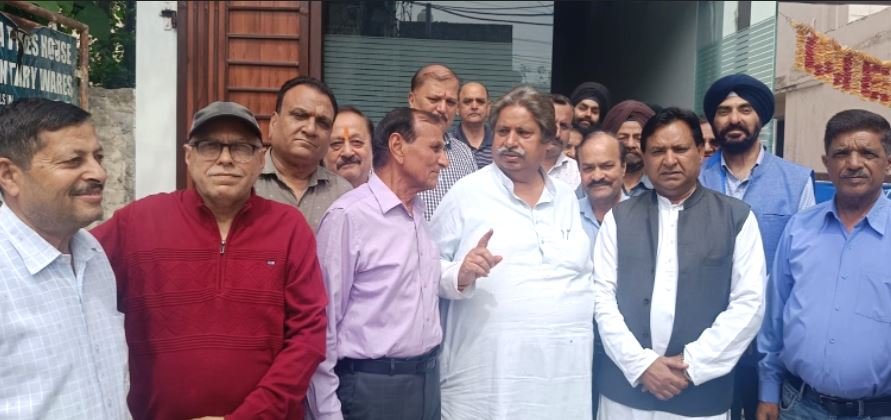
Jammu, March 27 : Mass contact programme amplifies voices of unemployed youth, flood victims, and neglected workers.In a significant outreach aimed at giving voice to the growing public discontent across the Union Territory, Raman Bhalla, Working President of the Jammu and Kashmir Pradesh Congress Committee (JKPCC), today intensified his mass contact programme by visiting Gandhi Nagar Block, where he held extensive interactions with local residents, party workers, and representatives of various social and professional groups.
Accompanied by prominent party functionaries including Dawarka Choudhary, Pardeep Bhalla, Bushan Kumar (Block President), Satpal Sapolia, Vipan Sharma, Kirpa Singh, S. Attar Singh, Sanjeev Vaid, Chanjit Chib, Parveen Gupta, Ashwani Sethi, Subash Choudhary, Kulwant Singh and others, Bhalla’s visit turned into a platform for the aggrieved public to openly express their concerns over what they described as administrative inertia and unfulfilled promises.
During the interaction, a consistent pattern of grievances emerged, cutting across sectors and communities. From unemployed youth to distressed farmers, from daily wagers to women frontline workers, people narrated their struggles, underscoring a widening gap between government claims and ground realities in Jammu and Kashmir.
Bhalla, while addressing the gathering, expressed deep concern over what he termed as a “systemic failure” to respond to people’s pressing needs despite the presence of an elected majority government. He asserted that the prevailing situation reflects not just policy paralysis but also a lack of political will to address the hardships of the common people.
Highlighting unemployment as the most pressing crisis, Bhalla said that the youth of Jammu and Kashmir are facing an uncertain future due to the absence of a coherent employment policy. He criticized the government for failing to attract new investments or establish industries that could generate sustainable jobs.
“The neglect of existing industrial units and absence of new industrial initiatives have compounded the problem, pushing educated youth towards frustration and despair,” he remarked, adding that employment generation must be treated as a top priority rather than a rhetorical promise.
Bhalla also voiced serious concern over the plight of families affected by recent monsoon rains, flash floods, and other natural calamities. He noted that many victims who lost homes, crops, and essential belongings are still waiting for compensation.He described the delay in relief measures as “unacceptable and insensitive,” stating that such administrative apathy not only deepens the suffering of victims but also erodes public trust in governance.
Drawing attention to basic civic amenities, Bhalla said that people are grappling with acute shortages of electricity and drinking water, even as they are being burdened with hefty utility bills.Calling it a “double injustice,” he said, “The common man is paying more but receiving less. This mismatch between billing and service delivery is unacceptable and demands immediate corrective action.”
Taking up the issue of employment security, Bhalla criticized the government for its failure to frame a clear and time-bound policy for the regularization of daily wagers, contractual, and ad hoc employees.He emphasized that thousands of such workers have been left in a state of prolonged uncertainty, with no clarity about their future despite years of service. “Their patience is wearing thin, and their grievances can no longer be ignored,” he warned.
Bhalla also highlighted what he described as the government’s indifference towards key social justice issues, including reservation for ST-2 categories and long-pending demands of POJK displaced persons.He further pointed out that Anganwadi workers, ASHA workers, and Self Help Groups (SHGs)—who form the backbone of grassroots service delivery—continue to be underpaid and under-recognized. He called for immediate enhancement of their honorarium in recognition of their vital contributions.
Expressing concern over declining public services, Bhalla said that the failure to fill vacancies in hospitals and educational institutions is severely affecting healthcare and education. He noted that the shortage of doctors, paramedical staff, teachers, and lecturers is placing an undue burden on existing staff and compromising service quality, particularly in rural and underserved areas.
In a strong appeal, Bhalla urged all legislators, cutting across party lines, to raise these pressing issues in the remaining part of the Budget Session and ensure that people’s concerns are addressed on priority.“Public welfare must rise above political considerations. This is not the time for silence but for collective action,” he asserted.
Reiterating the party’s commitment to the welfare of the people, Bhalla said that the mass contact programme will continue across all regions to ensure that the voices of the marginalized and distressed are heard at every level. He assured that the Congress party will continue to act as a strong voice of the people, raising their issues vigorously and holding the government accountable until tangible solutions are delivered.

