


Chidambaram Takes a Swipe at Amit Shah Over Women’s Reservation, Questions His Memory
The Congress leader says the 2023 constitutional amendment already provides for 33 per cent reservation and argues that removing Article 334A could enable its early implementation.
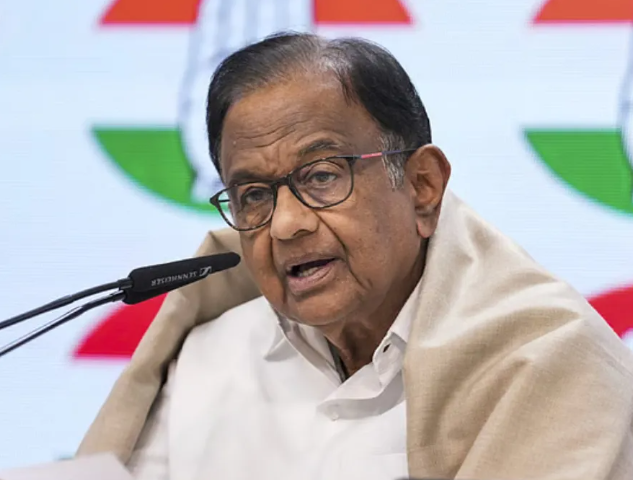
NEW DELHI, Nov 27: Senior Congress leader P Chidambaram on Friday criticised Union Home Minister Amit Shah over the implementation of 33 per cent reservation for women in the Lok Sabha and state legislative assemblies, accusing him of overlooking the Congress’s position on the issue.
The former Union finance minister said Shah was either suffering from “amnesia” or being economical with the truth while targeting the Congress over the women’s reservation legislation.
In a post on X, Chidambaram maintained that his party had supported the passage of the women’s reservation legislation in Parliament and continued to demand its immediate implementation.
“Home Minister Amit Shah either has amnesia or is economical with the truth. He claims that the Congress cannot stop the implementation of the promise to reserve 1/3 of the seats for women in the Lok Sabha and the State Legislatures. The Constitution (106th) Amendment Act, 2023 has already been enacted,” he said.
Chidambaram recalled that Parliament had passed the Constitution (106th Amendment) Bill in September 2023, with the Lok Sabha approving it on September 20 and the Rajya Sabha clearing it the following day.
Questioning the government’s delay in implementing the legislation, he asked why the existing constitutional provision had not been put into effect and why another bill was being considered.
He explained that the 106th Constitutional Amendment inserted Article 334A, linking the implementation of women’s reservation to a delimitation exercise following the next Census.
According to Chidambaram, the Congress and several other Opposition parties had objected to this provision during parliamentary discussions, arguing that it unnecessarily made women’s representation dependent on two conditions: the completion of the Census and the subsequent delimitation exercise.
“Read the debates in Parliament. Congress and other Opposition parties opposed the insertion of Article 334A which, unnecessarily, created two hurdles: Census and Delimitation after the Census,” he said.
Accusing the BJP of deliberately retaining the provision, Chidambaram added that the ruling party had been adamant about including Article 334A in the legislation.
He argued that the government could resolve the delay by introducing a proposal to remove Article 334A from the Constitution.
“Once Article 334A is deleted, women’s reservation can be implemented immediately,” the Congress leader said, maintaining that the existing constitutional framework could be amended to ensure earlier implementation.
The remarks have brought renewed attention to the political disagreement surrounding the timeline and conditions for introducing greater women’s representation in India’s legislatures.
The Constitution (106th Amendment) Act, commonly known as the Nari Shakti Vandan Adhiniyam, provides for reserving one-third of the seats in the Lok Sabha, state legislative assemblies and the Delhi Legislative Assembly for women. The legislation also includes provisions relating to reserved seats for women belonging to Scheduled Castes and Scheduled Tribes.
However, its implementation is linked to the publication of relevant figures following the first Census conducted after the commencement of the amendment and the subsequent delimitation exercise.
Chidambaram’s criticism came a day after Shah accused Congress leader Rahul Gandhi of using the Constitution as a political instrument while questioning constitutional institutions and electoral processes.
Addressing a ‘Samvidhan Gaurav Divas’ programme in New Delhi, the Home Minister said carrying a copy of the Constitution or displaying it publicly did not, by itself, demonstrate respect for the country’s founding document.
Shah also reiterated the BJP’s commitment to providing 33 per cent reservation for women in the Lok Sabha and state legislative assemblies.
The exchange has intensified the political debate between the ruling BJP and the Congress over women’s representation, with both parties seeking to establish their positions on the implementation of the landmark constitutional amendment.
While the BJP has maintained that it supports greater participation of women in legislative institutions, the Congress has questioned the conditions attached to the legislation, arguing that the reservation should not be delayed by linking it to future administrative exercises.
The disagreement highlights a wider political challenge surrounding the implementation of women’s reservation, particularly the relationship between constitutional provisions, population-based representation and the delimitation process.

