


Electric Vehicle Demand Outpaces Production in India, Puts Pressure on Automakers
Rising bookings and limited dealer inventories push Tata Motors, Ather Energy, Hero MotoCorp and Bajaj Auto to expand manufacturing capacity amid component shortages and festive-season demand.
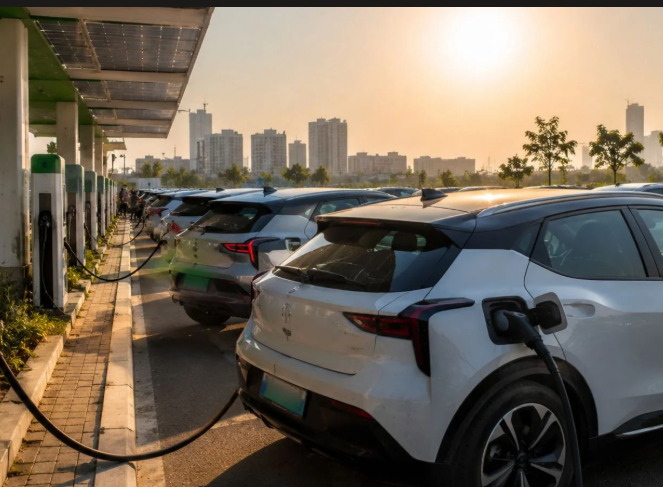
NEW DELHI, Oct 17: India’s electric vehicle industry is facing a growing supply challenge as consumer demand rises faster than manufacturers can increase production, prompting major automakers to accelerate capacity expansion and strengthen their supplier networks.
Electric vehicle penetration across vehicle categories has reached 10.7 per cent, according to Vahan registration data cited in industry reports. The growing adoption of electric cars, scooters and three-wheelers is creating fresh opportunities for manufacturers, but limited component availability and production constraints are delaying deliveries in several segments.
The pressure is particularly significant ahead of the festive season, when vehicle purchases traditionally increase. Manufacturers are attempting to meet customer requirements while managing lean inventories, higher input costs and uncertainty over the availability of critical components.
Tata Motors Passenger Vehicles, Ather Energy, Hero MotoCorp and Bajaj Auto are among the companies increasing production capacity to respond to the expanding market.
The latest developments indicate that India’s electric mobility industry is moving into a new phase in which production efficiency, supplier reliability and manufacturing scale could become as important as product launches and customer incentives.
Electric mobility gains ground across vehicle categories
Electric vehicles are gaining popularity as consumers consider running costs, fuel-price volatility and the availability of new models.
Registration figures indicate that electric cars accounted for 8.5 per cent of passenger vehicle registrations in September, while electric two-wheelers represented 11.6 per cent. Adoption was considerably higher in the three-wheeler category, where electric models accounted for 64.9 per cent of registrations.
The difference between vehicle categories reflects variations in usage patterns and operating economics. Electric three-wheelers are widely used for commercial passenger transport and goods movement, where frequent daily usage can make lower running costs particularly attractive.
Electric two-wheelers appeal to commuters seeking alternatives to petrol-powered scooters and motorcycles. Passenger electric cars, meanwhile, are gaining attention as manufacturers introduce models across different price points and vehicle sizes.
However, growing interest does not automatically translate into immediate sales. Customers may face waiting periods, limited dealership stocks or delays in receiving particular models and configurations.
For manufacturers, the ability to convert bookings into completed deliveries is becoming a key measure of operational performance.
Tata Motors increases electric car production
Tata Motors Passenger Vehicles, one of India’s leading electric passenger vehicle manufacturers, has recorded a sharp increase in demand for its electric cars, particularly the Punch.ev and Nexon.ev.
Bookings have risen to nearly 2.5 times their levels before February 2026, according to company information cited in recent reporting.
The company increased electric vehicle production by nearly 40 per cent in the second quarter compared with the first quarter. Quarterly wholesale volumes exceeded 47,000 units, almost double the level recorded a year earlier.
Despite the expansion, demand continues to exceed available supplies.
Amit Kamat, chief commercial officer at Tata Motors Passenger Vehicles, said the company was working closely with subsystem suppliers to improve availability and support deliveries during the festive period.
The company has more than doubled its monthly electric vehicle production capacity to over 16,000 units, compared with approximately 7,500–8,000 units last year.
However, increasing factory capacity alone cannot eliminate delivery delays if suppliers are unable to provide the required components in sufficient quantities.
The availability of batteries, motors, electronic systems and other specialised parts can determine how quickly an automaker converts production capacity into finished vehicles.
Any interruption in the supply of one critical component can delay the assembly of an entire vehicle, even when other parts and manufacturing facilities are available.
Electric scooter makers accelerate expansion
The supply challenge is also affecting electric two-wheeler manufacturers, which are attempting to increase production to meet demand from individual customers and commercial users.
Ather Energy plans to raise its annual manufacturing capacity from 420,000 units to 920,000 units through the commissioning of its AURIC facility in Maharashtra.
The planned expansion is intended to improve the company’s ability to meet future demand and support a larger sales network.
Nevertheless, waiting periods have extended to two months or more in some states, while dealer inventory has fallen to less than a week, compared with around 15 days previously.
Limited availability can affect customer satisfaction and create opportunities for competitors that have vehicles ready for immediate delivery.
For dealers, low stock levels make it harder to serve buyers who want to compare variants, choose specific colours or complete purchases quickly.
The expansion of manufacturing facilities may improve availability over time, but the outcome will also depend on the reliability of suppliers and the pace at which production systems reach their intended output.
Hero MotoCorp is also increasing its electric vehicle manufacturing capacity. The company aims to raise monthly output from 30,000 units in early August to 45,000 units by the end of the 2026–27 financial year. It began the financial year with capacity of approximately 15,000 units a month.
Bajaj Auto, meanwhile, intends to increase its electric two-wheeler production capacity from 50,000 units to 60,000 units monthly through productivity improvements and higher output from vendors.
These plans reflect growing competition among manufacturers seeking to strengthen their positions in India’s expanding electric mobility market.
Component shortages complicate expansion
The industry’s supply problems extend beyond factory space and assembly-line capacity.
Manufacturers have raised concerns about restrictions affecting critical components, including rare-earth materials used in electric motors. Geopolitical tensions in West Asia have also contributed to higher costs and delays affecting certain supply chains.
Rare-earth materials are important for several motor technologies because of their magnetic properties and performance characteristics. Restrictions or disruptions affecting their availability can increase procurement costs and complicate production planning.
Automakers must therefore manage both domestic manufacturing requirements and international supply risks.
Companies that depend heavily on imported components can face longer delivery schedules, currency-related cost fluctuations and uncertainty about future availability.
One response is to diversify suppliers and develop stronger relationships with component manufacturers. Another is to increase domestic sourcing where technically and commercially feasible.
However, localisation takes time. Suppliers need investment, specialised equipment, technical expertise and sufficient production volumes to manufacture components at competitive costs.
Quality control is equally important. A rapid increase in output must not compromise vehicle safety, durability or reliability.
For manufacturers, the challenge is to expand capacity while ensuring that suppliers can maintain consistent quality and delivery schedules.
Automakers invest in larger facilities
Several manufacturers are making longer-term investments to prepare for continued growth in electric mobility.
Maruti Suzuki has commissioned a dedicated facility with annual capacity for 250,000 units of its e Vitara electric SUV. TVS Motor has also outlined broader manufacturing expansion plans.
Such investments can help companies prepare for higher future demand, improve production flexibility and develop a stronger position in the electric vehicle market.
However, new capacity involves substantial capital expenditure. Manufacturers must account for land, machinery, equipment, labour, logistics and the cost of maintaining production lines before facilities reach optimal utilisation.
If demand grows more slowly than expected, underused capacity can put pressure on profitability. If demand remains stronger than supply, companies may need to expand further or improve productivity at existing plants.
Automakers must therefore balance immediate shortages against long-term expectations for market growth.
Festive demand raises the stakes
The festive season is an important period for India’s automotive industry because customers often bring forward purchases during major shopping occasions.
Higher demand can benefit manufacturers, dealerships, lenders and vehicle-component suppliers. However, companies with limited inventories may struggle to convert customer interest into revenue within the expected period.
Waiting periods can also influence buyer behaviour. Some customers may postpone purchases, select alternative models or switch to a competing manufacturer with better availability.
For dealerships, the priority is to communicate delivery timelines accurately and avoid creating unrealistic expectations.
Automakers may also need to allocate vehicles carefully across regions, prioritising markets where demand is strongest and logistics permit timely deliveries.
The festive period will consequently test the ability of manufacturers to coordinate production, component procurement and distribution.
Price competition and profitability
As electric vehicle adoption increases, manufacturers are likely to face continued pressure to offer competitive prices while improving vehicle performance and range.
Battery systems and other specialised components remain important cost factors. Supply shortages can make procurement more expensive, while increased manufacturing volumes may eventually improve economies of scale.
Companies that achieve higher production efficiency could gain an advantage through lower unit costs and better delivery performance.
However, rapid expansion can also increase expenditure on facilities, inventory and supplier development. The effect on profitability will depend on the balance between sales growth, pricing, input costs and capital investment.
Manufacturers must also continue investing in research and development to improve battery performance, charging convenience, software features and vehicle safety.
Customer confidence will depend not only on the initial purchase price but also on the availability of service centres, replacement parts and dependable after-sales support.
Outlook for India’s EV industry
India’s electric vehicle market has significant growth potential, but the latest supply constraints demonstrate that consumer adoption must be supported by a dependable manufacturing ecosystem.
The increase in electric vehicle penetration across cars, two-wheelers and three-wheelers indicates that electrification is expanding beyond a limited group of early adopters.
The next stage will require manufacturers to coordinate capacity additions with component availability, distribution networks and customer service.
Automakers that strengthen supplier partnerships, improve productivity and maintain consistent delivery schedules may be better positioned to capture demand during the festive season and beyond.
For the wider industry, the key challenge is to ensure that production growth keeps pace with consumer interest without creating excessive costs or compromising product quality.
The performance of manufacturers over the coming quarters will show whether capacity expansion can ease waiting periods and establish a more reliable supply base for India’s electric mobility transition.

