


Gold Demand Slumps Despite Price Drop, Jewellery Sales Decline 70%
Gold prices have fallen nearly ₹50,000 from record highs, but weak consumer sentiment, higher import duty and global economic uncertainty continue to weigh on jewellery purchases across India.
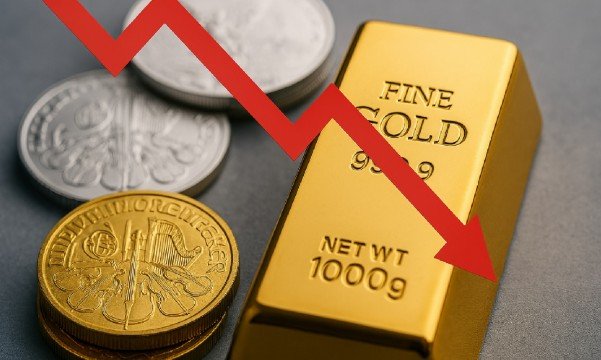
India, July 01 : India’s gold market is witnessing an unusual trend as a steep decline in prices has failed to revive consumer demand. Instead of returning to jewellery stores, many households are choosing to sell their existing gold holdings, leading to a significant slowdown in fresh purchases despite the precious metal becoming considerably cheaper.
According to the India Bullion and Jewellers Association (IBJA), domestic demand for gold has declined by more than 70 percent following a sharp correction in prices from their record highs earlier this year. Industry experts say the combination of policy changes, economic uncertainty and expectations of further price declines has altered buying behaviour across the country.
On Wednesday, gold futures on the Multi Commodity Exchange (MCX) traded at around ₹1,42,546 per 10 grams, reflecting a decline of nearly ₹50,000 from the all-time intraday high of ₹1,92,991 recorded earlier in 2026. The correction mirrors global trends, where spot gold also remained under pressure, trading below the psychological $4,000-an-ounce mark amid expectations that US interest rates could remain elevated for an extended period.
The decline has surprised market participants, as lower prices traditionally encourage jewellery purchases, particularly in a country where gold holds immense cultural and investment significance. This time, however, consumers appear reluctant to make fresh investments, anticipating that prices may soften further in the coming months.
Surendra Mehta, Secretary of the India Bullion and Jewellers Association, said domestic demand has weakened considerably after the government increased customs duty on gold imports from 6 percent to 15 percent in May. The higher import levy, coupled with changing market sentiment, has discouraged many prospective buyers.
Industry representatives also noted that demand remained subdued after Prime Minister Narendra Modi appealed to citizens to defer gold purchases for a year. The subsequent increase in customs duty further dampened buying interest, creating an environment where consumers have adopted a cautious approach towards the precious metal.
Instead of purchasing new ornaments, many families are monetising existing jewellery. Bullion dealers have reported a noticeable rise in the sale of old gold as households seek to capitalise on previously elevated prices before the market weakens further.
According to industry estimates, the volume of old jewellery sold during the April-June quarter reached nearly 50 tonnes, representing an increase of more than 50 percent compared to the same period last year. The trend indicates that many investors are locking in gains accumulated during gold’s prolonged rally over the past few years.
Market analysts believe this shift reflects changing consumer psychology. Rather than viewing lower prices as an opportunity to accumulate gold, investors are concerned that continued weakness in international markets could push prices even lower.
Globally, bullion has remained under sustained pressure due to expectations that the US Federal Reserve will maintain higher interest rates for longer. Elevated borrowing costs generally strengthen the US dollar, making gold less attractive because the metal does not generate regular income such as interest or dividends.
Gold has now recorded several consecutive weeks of decline, marking one of its steepest quarterly corrections in more than a decade. Analysts attribute the weakness to persistent inflation concerns, restrictive monetary policy in major economies and improving investor confidence in other financial assets.
Research experts point out that geopolitical tensions briefly supported gold prices earlier in the year, particularly during the US-Iran conflict. However, rising crude oil prices shifted investor attention back towards inflation risks, increasing expectations that central banks would delay interest rate cuts.
A stronger US dollar has added further pressure on bullion markets by making gold more expensive for overseas buyers. As a result, international prices have struggled to recover despite occasional demand driven by geopolitical uncertainty.
Experts believe the immediate direction of gold will largely depend on upcoming US economic indicators, especially employment figures and manufacturing data. These reports will influence expectations regarding future monetary policy decisions by the Federal Reserve.
If economic data points towards slowing growth and easing inflation, gold could witness a technical recovery as investors anticipate lower interest rates. On the other hand, stronger-than-expected economic performance could reinforce expectations of tighter monetary policy, putting additional downward pressure on bullion prices.
Technical analysts suggest that international gold prices have already broken below an important support level around $4,000 an ounce. If selling pressure intensifies, prices could decline further towards lower support zones before stabilising. However, given that the market is approaching oversold territory, some analysts also expect intermittent short-term rallies driven by bargain buying.
For Indian investors, the recent correction has substantially reduced the cost of acquiring gold compared with the beginning of the year. Nevertheless, financial advisers recommend avoiding large lump-sum purchases solely because prices have declined sharply.
Instead, investment experts advocate a staggered approach, allowing investors to accumulate gold gradually over time. Such a strategy helps reduce the impact of short-term price volatility while maintaining exposure to an asset that continues to play an important role in portfolio diversification.
Jewellery retailers are also closely monitoring upcoming festive and wedding seasons, traditionally the strongest periods for gold demand in India. Industry participants hope consumer confidence will improve if prices stabilise, although uncertainty over global economic conditions may continue to influence purchasing decisions.
Despite the current slowdown, analysts believe India’s long-term affinity for gold remains intact due to its cultural significance, role as a store of wealth and importance during weddings and religious festivals. However, the present market cycle demonstrates that consumer behaviour is increasingly influenced by broader economic developments rather than price movements alone.
As domestic demand remains subdued and global markets await fresh signals from the US economy, the outlook for gold in the coming months will largely depend on interest rate expectations, currency movements and geopolitical developments. Until greater clarity emerges, both buyers and investors are expected to remain cautious, making gradual accumulation the preferred strategy in an uncertain market.

