


IIT Madras Opens Sleep Research Facility and Autism Lab to Strengthen Healthcare Innovation
The new facilities will support sleep disorder diagnosis, autism related research and campus medical services, while IIT Madras showcases its work in brain science, cancer studies and affordable assistive technologies.
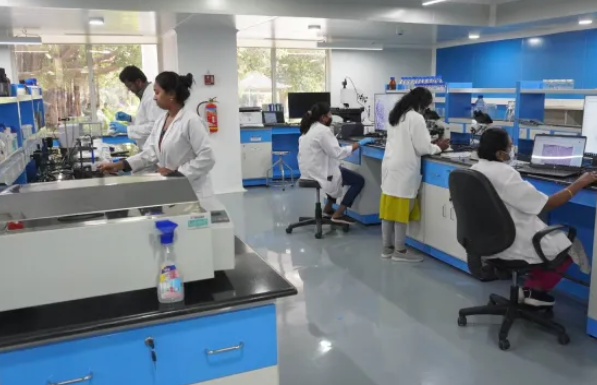
CHENNAI, Nov 23: The Indian Institute of Technology (IIT) Madras has expanded its healthcare research infrastructure with the inauguration of a specialised Sleep Study Facility and an Autism Lab, alongside the launch of an electric cart ambulance service aimed at improving medical assistance within its campus.
Union Health Secretary Punya Salila Srivastava inaugurated the facilities on November 22 during her visit to the institute, highlighting the growing role of academic institutions in developing affordable medical technologies, strengthening specialised healthcare research and addressing unmet medical needs.
The newly established Sleep Study Facility at the campus health centre will provide specialised assessment, consultation and treatment for sleep-related disorders affecting students, faculty members, staff and researchers. Specialists associated with Kauvery Hospitals, Chennai, will support the facility in delivering clinical services.
Apart from providing medical consultations, the centre will also create opportunities for research into sleep patterns and different categories of sleep disorders. Such studies will be undertaken subject to institutional ethics approval and informed consent from participants.
The institute intends to develop indigenous and cost effective sensors for monitoring and analysing sleep patterns. The proposed technology could contribute to more accessible diagnostic solutions and strengthen domestic capabilities in medical device development.
Sleep related problems have become an important area of healthcare research because they can affect physical health, mental well being, concentration and everyday functioning. Sleep disturbances may also be associated with several underlying medical conditions, making proper assessment and diagnosis important.
By combining clinical services with research activities, IIT Madras aims to create an environment where medical professionals and technology researchers can work together to understand sleep disorders and explore improved monitoring methods.
The facility is expected to support the campus community while also contributing to broader scientific understanding of sleep-related conditions.
Another major development during the visit was the inauguration of the Autism Lab, which will investigate Integrated Varmam Therapy for children with Autism Spectrum Disorder (ASD).
The initiative combines traditional Indian medical knowledge with clinical expertise and modern technology. It forms part of the activities leading towards the establishment of the Centre for Indian Medical Knowledge at IIT Madras.
The institute plans to collaborate with the Paediatric Neurology team at AIIMS Jodhpur to scientifically evaluate the treatment protocol. The team has experience in administering the integrated therapy to more than 800 children.
The proposed collaboration will provide an opportunity to examine the treatment approach through structured research and clinical evaluation. Researchers also intend to investigate possible genetic, molecular and epigenetic mechanisms associated with the therapy, subject to the necessary ethical approvals.
An important technological component of the initiative is the proposed development of indigenous pressure-sensing gloves. These devices are expected to provide real-time feedback to practitioners during the application of the therapy.
The use of such instruments could help researchers document treatment procedures more systematically and examine different aspects of the intervention. However, the initiative remains a research programme, and its clinical effectiveness will need to be established through appropriate scientific assessment.
Autism Spectrum Disorder is a neurodevelopmental condition associated with differences in communication, social interaction and behaviour. The condition affects individuals differently, and children may require varying levels of educational, developmental and therapeutic support.
The proposed research at IIT Madras seeks to bring together different disciplines to examine an integrated therapeutic approach. Its scientific evaluation will be important in determining whether the intervention can offer measurable benefits alongside established care practices.
During her visit, Srivastava also reviewed several other healthcare research facilities at the institute, including the Sudha Gopalakrishnan Brain Centre, Department of Medical Sciences and Technology, National Cancer Tissue Biobank, Healthcare Technology Innovation Centre and National Centre for Assistive Health Technologies.
At the Sudha Gopalakrishnan Brain Centre, she was briefed on research involving high-resolution, three-dimensional digital mapping of the human brain at cellular resolution.
The centre is working towards creating detailed digital maps of more than 100 human brains representing different stages of life, including brains affected by neurological diseases.
Such research could help scientists understand the organisation of brain cells, examine neurological conditions and improve knowledge of the biological mechanisms associated with different disorders.
The visit also highlighted C-STROKE, an ischaemic stroke atlas comprising more than 1,000 annotated brain sections. The atlas is intended to contribute to research into stroke-related changes in the human brain.
The Department of Medical Sciences and Technology, established in 2023, is another important component of the institute’s healthcare research ecosystem. It brings together medical sciences, engineering and technology to address challenges that require interdisciplinary solutions.
Its research areas include cardiovascular medicine, neurology, oncology, medical imaging, artificial intelligence in healthcare and medical device development.
The department also focuses on developing physician-scientists and engineering physiologists who can combine clinical understanding with technological expertise.
At the National Cancer Tissue Biobank, the Health Secretary reviewed the collection and preservation of cancer tissue samples for research purposes. The facility is a joint initiative of the Department of Science and Technology and IIT Madras.
Cancer tissue samples collected with patients’ informed consent can help researchers investigate the biological characteristics of different cancers and improve understanding of their diagnosis and treatment.
The institute’s wider cancer research ecosystem also includes the Bharat Cancer Genome Atlas, launched in February 2025. The initiative aims to establish an India-specific cancer genomic database that could support early diagnosis, targeted therapies and personalised treatment strategies.
The development of such databases is important because cancer can differ significantly between patients, even when the disease affects the same organ. Understanding genetic variations may help researchers identify biological differences and explore more targeted approaches to treatment.
Srivastava also visited the Healthcare Technology Innovation Centre, where researchers are developing indigenous medical technologies designed to improve access to healthcare.
Among the innovations presented were a Mobile Eye Surgical Unit for conducting cataract operations in remote areas, 3nethra for early detection of eye diseases, a Neonatal Transport Unit, iQuant for rapid diagnostic testing and ArtSens for cardiovascular health assessment.
These technologies address different healthcare requirements, ranging from eye care and newborn transportation to diagnostic services and cardiovascular monitoring.
The Mobile Eye Surgical Unit is particularly relevant for communities where access to specialised surgical facilities can be difficult. Similarly, rapid diagnostic technologies can help healthcare providers obtain information more efficiently and support timely clinical decisions.
The National Centre for Assistive Health Technologies also featured prominently during the visit. Its work focuses on affordable equipment and mobility solutions for persons with disabilities and elderly individuals.
The technologies include lightweight wheelchairs, power-assisted mobility devices, swimming pool lifts and walking aids for children with cerebral palsy.
One of the centre’s notable innovations is YD One, an ultra-lightweight active wheelchair designed to improve independent mobility.
The development of assistive technologies is an important part of inclusive healthcare because mobility limitations can affect education, employment, social participation and everyday independence.
The electric-cart ambulance service launched at the institute hospital is another initiative aimed at improving campus-level medical assistance. It will facilitate transportation within the campus, particularly for elderly people and patients who require mobility support.
The service forms part of IIT Madras’ campus wellness initiative and is intended to make access to medical assistance more convenient.
Srivastava was accompanied by IIT Madras Director V. Kamakoti and Dean (Planning) R. Sarathi during the visit.
The inauguration of the new facilities and the review of existing research centres underline the institute’s efforts to connect scientific research with practical healthcare requirements.
By combining clinical services, engineering expertise, medical research and indigenous technology development, IIT Madras is seeking to contribute to solutions that can eventually benefit healthcare institutions and patients beyond its campus.
The initiatives also reflect the importance of collaborations between academic institutions, hospitals and government agencies in advancing specialised medical research and improving access to affordable healthcare.

