


India Criticizes US Panel’s Report on Religious Freedom, Labels It Malicious and Politically Driven
New Delhi, 03-10-2024: India has strongly condemned the latest report from the U.S. Commission on International Religious Freedom (USCIRF), characterizing it as a biased and politically motivated document that aims to promote a distorted narrative regarding religious freedom in the country. The USCIRF’s report asserts that religious freedom conditions in India continued to deteriorate in 2023, a claim that New Delhi vehemently disputes.
In its report, the USCIRF reiterated its recommendation to the U.S. State Department to designate India as a “country of particular concern” due to what it describes as “systematic, ongoing, and egregious violations of religious freedom,” as outlined by the International Religious Freedom Act (IRFA) of the United States. This recommendation comes amidst a series of high-level engagements between India and the United States, including a recent bilateral meeting between President Joe Biden and Prime Minister Narendra Modi.
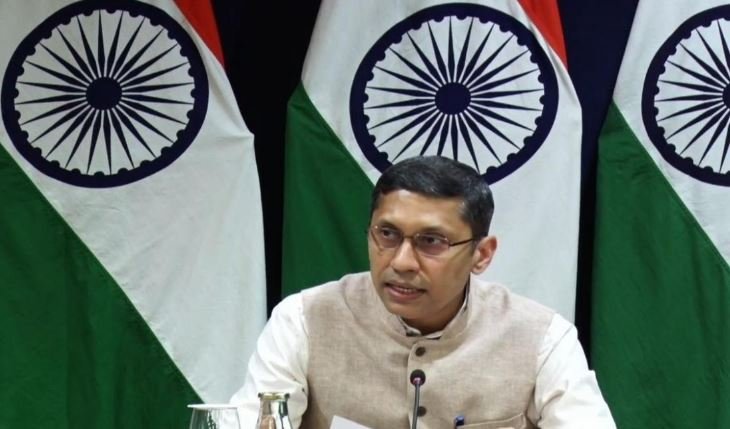
The Ministry of External Affairs (MEA) in New Delhi responded to the USCIRF’s claims by labeling the commission a “biased organization with a political agenda.” MEA spokesperson Randhir Jaiswal emphasized that the commission has consistently misrepresented facts and propagated a motivated narrative about India’s religious landscape. “We reject this malicious report, which only serves to further discredit the USCIRF,” Jaiswal stated, urging the organization to focus on addressing human rights issues within the United States rather than promoting agenda-driven narratives.
The USCIRF’s report, titled “India’s Collapsing Religious Freedom Conditions,” was released shortly after President Biden hosted Prime Minister Modi for discussions on the sidelines of the Quad summit on September 21. This report alleges that the Indian government, led by the Bharatiya Janata Party (BJP), has reinforced “discriminatory nationalist policies,” perpetuated hateful rhetoric, and failed to address communal violence that disproportionately affects various religious minorities, including Muslims, Christians, Sikhs, Dalits, Jews, and Adivasis (indigenous peoples).
The commission expressed concerns regarding the enforcement of laws such as the Unlawful Activities Prevention Act (UAPA), Foreign Contribution Regulation Act (FCRA), Citizenship Amendment Act (CAA), as well as laws related to anti-conversion and cow slaughter. The USCIRF claims these laws have led to the arbitrary detention, surveillance, and targeting of religious minorities and those advocating for their rights.
Furthermore, the USCIRF has recommended that the U.S. government impose targeted sanctions against individuals and entities responsible for severe violations of religious freedom, including freezing assets and restricting entry into the United States based on human rights-related financial and visa authorities.
Despite ongoing discussions and collaborations between New Delhi and Washington, the USCIRF’s report underscores a contentious area of U.S.-India relations. In the lead-up to the Modi-Biden meeting, White House officials had engaged with representatives from American Sikh organizations, some of which are known to support secessionist campaigns for an independent Khalistan. This interaction, combined with a U.S. court summons for the Indian government regarding allegations of attempts on the life of a secessionist leader, has intensified scrutiny of India’s intelligence operations abroad.
In addition, a member of the American House of Representatives, Adam Schiff, has introduced the Transnational Repression Reporting Act of 2024, which would require the U.S. Attorney General to report on cases of transnational repression against individuals in the U.S., further complicating the narrative surrounding India’s actions in the international arena.

