


India, Japan Strengthen Defence Ties, Review Maritime Security Cooperation in Tokyo
Rajnath Singh and Japanese Defence Minister Shinjiro Koizumi discuss underwater and missile technologies, information-sharing mechanisms and a stronger Indo-Pacific partnership during bilateral talks in Tokyo.
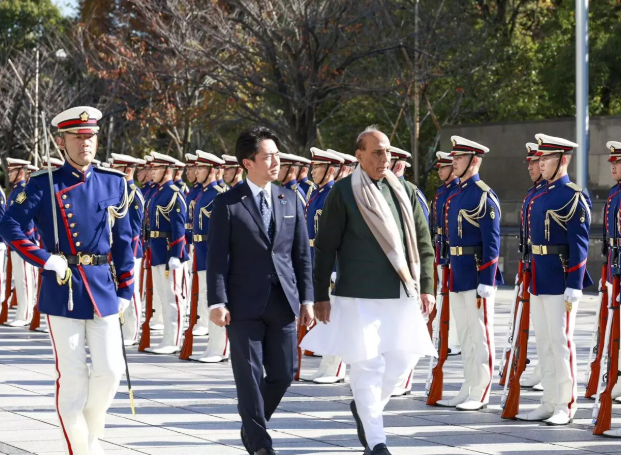
TOKYO, Nov 19: India and Japan have agreed to further strengthen their defence and security partnership, with particular emphasis on maritime security, advanced defence technologies and industrial collaboration, following high-level discussions in Tokyo on Thursday.
Defence Minister Rajnath Singh held bilateral talks with his Japanese counterpart, Shinjiro Koizumi, on the sidelines of the fourth India-Japan Foreign and Defence Ministers’ Dialogue, popularly known as the 2+2 meeting. The discussions focused on reviewing ongoing defence engagements and identifying new areas for cooperation amid evolving regional and global security challenges.
Following the meeting, Singh shared details of the discussions in a post on social media platform X, highlighting the growing strategic partnership between the two countries.
The ministers reviewed progress in bilateral defence cooperation, including maritime security and technology development. They also exchanged perspectives on strengthening a free, open and rules-based Indo-Pacific region, which remains a key priority in their shared regional approach.
The talks formed part of broader efforts by New Delhi and Tokyo to deepen their strategic engagement and enhance coordination on security matters. Both countries have consistently emphasised the importance of maintaining stability, freedom of navigation and respect for international law in the Indo-Pacific.
Addressing the outcomes of the 2+2 dialogue, Singh said India and Japan had decided to accelerate collaboration in specialised underwater and missile technologies. The two sides also agreed to expedite practical initiatives under their recently signed Memorandum of Arrangement on Maritime Security Cooperation.
The agreement is expected to provide a framework for expanding cooperation in several important areas, including maritime and air domain awareness, search and rescue operations, and information-sharing mechanisms.
Improving coordination in these fields is expected to strengthen the ability of both countries to monitor developments across strategically important maritime routes and respond more effectively to emerging security situations.
Another significant area discussed during the dialogue was cooperation in mine-countermeasure capabilities. Both sides agreed to enhance engagement in this field, recognising its importance in ensuring safer maritime operations and protecting vital sea routes.
Defence technology and industrial partnerships also featured prominently in the discussions. India and Japan have been exploring opportunities to expand cooperation in advanced technologies, defence manufacturing and industrial development, creating possibilities for greater collaboration between their respective defence sectors.
The 2+2 dialogue brought together the foreign and defence ministers of both countries to assess the progress of their strategic partnership and discuss regional and international developments.
The meeting provided an opportunity for the two governments to strengthen policy coordination and establish priorities for future cooperation in defence and security.
India and Japan have developed increasingly close strategic relations, supported by shared interests in regional stability, economic security and a rules-based international order. Their defence partnership has expanded through regular high-level exchanges, joint exercises and cooperation in maritime security.
The latest discussions in Tokyo underline the importance both countries attach to strengthening their security relationship and expanding practical cooperation in emerging defence technologies.
With a renewed focus on maritime coordination, advanced military capabilities and information-sharing, New Delhi and Tokyo are seeking to build a more comprehensive partnership capable of addressing changing security requirements across the Indo-Pacific.

