


India Manufacturing Rebounds as September Factory Activity Hits Seven-Month High
Factory activity accelerates after three months of slowdown, while stronger demand and hiring provide support despite oil and global financial risks.
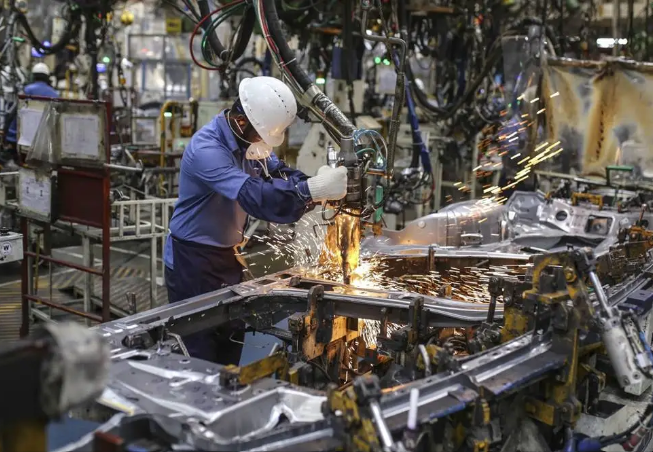
India, Oct 02 : India’s manufacturing sector staged a strong recovery in September, ending a three-month period of slowing activity as improved demand helped factories increase production, hiring and business confidence.
The HSBC India Manufacturing Purchasing Managers’ Index, compiled by S&P Global, rose to 55.1 in September from 52.8 in August. The latest reading marked the strongest expansion in factory activity since February and represented a significant improvement from the five-year low recorded in August. However, the final figure was slightly below the preliminary estimate of 55.7.
The September improvement indicates that India’s manufacturing economy regained momentum toward the end of the quarter after losing some pace during the preceding three months. A reading above 50 indicates expansion, while a figure below that level signals contraction.
The rebound was supported by stronger demand for manufactured goods, which encouraged companies to increase output. The improvement in activity also helped revive employment in the sector, according to the survey.
The recovery comes at a time when the broader Indian economy is dealing with a more complicated external environment. Rising crude oil prices, international financial market volatility, currency pressure and uncertainty surrounding global trade conditions have created challenges for businesses and policymakers.
The Finance Ministry’s September Monthly Economic Review, released on October 1, said high-frequency indicators for July and August pointed to some moderation after India’s economy recorded 7.8 per cent growth in the April-June quarter. The ministry also highlighted elevated oil prices, uncertainty over US trade relations and India’s limited participation in global artificial-intelligence developments as factors affecting the country’s ability to attract capital.
Despite those concerns, the latest manufacturing survey provides evidence of continued domestic demand. Stronger factory activity can support supply chains involving raw materials, transport, logistics and business services, while increased hiring can provide additional support to household consumption.
The improvement is particularly significant because August had produced one of the weakest manufacturing readings in recent years. The jump from 52.8 to 55.1 in a single month therefore represents a noticeable change in momentum.
The September survey also comes as Indian businesses enter an important period of the year, with festive demand expected to influence sales across several consumer-facing sectors. Manufacturers producing automobiles, consumer goods, electronics, household products and other merchandise may see demand conditions change as the festive season progresses.
However, the manufacturing recovery is taking place against rising input-cost risks. Crude oil has emerged as one of the most important variables for India’s economy because the country remains heavily dependent on imported energy. Higher international oil prices can increase transportation and production expenses and can also affect inflation and the country’s trade balance.
On October 1, the rupee fell to a two-month low against the US dollar as higher oil prices and a global bond-market sell-off placed pressure on Indian financial assets. The rupee declined about 0.5 per cent to 96.3150 per dollar, while India’s 10-year government bond yield climbed to a two-year high.
The same external pressures affected Indian equities. The Sensex fell 570.59 points, or 0.79 per cent, on October 1 to close at 71,909.70, while the Nifty 50 declined 198.50 points, or 0.88 per cent, to 22,421.95. Foreign institutional investors sold shares worth about Rs 10,148 crore, although domestic institutional investors bought approximately Rs 11,272 crore.
The contrast between the manufacturing data and financial-market performance illustrates the different forces currently affecting the Indian economy. Domestic economic activity showed signs of improvement in September, while international developments continued to create volatility for currencies, bonds and equities.
Global bond markets experienced a sharp sell-off at the start of October as investors became increasingly concerned about inflation, government borrowing and the possibility of higher interest rates. US 10-year Treasury yields climbed above 5.3 per cent, while borrowing costs in several other major economies also reached multi-decade highs.
Such developments matter for India because higher yields in developed markets can influence international capital flows. When returns on US and other major sovereign bonds rise, emerging-market assets can face greater competition for global investment.
The Finance Ministry has also identified tighter global financial conditions as a potential source of imported inflationary pressure. Its assessment pointed to geopolitical tensions and higher crude prices as risks to the rupee, capital flows and domestic price stability. At the same time, the ministry noted that India’s services exports, remittances and foreign exchange reserves provide important buffers against external shocks.
India’s foreign exchange reserves were reported at $765.9 billion in the ministry’s review, equivalent to about 11.1 months of import cover. This provides a substantial cushion as policymakers monitor developments in global commodity and financial markets.
The manufacturing recovery also comes at a time when policymakers are seeking to strengthen domestic production and reduce vulnerabilities arising from international supply disruptions. Expanding local manufacturing can improve domestic value addition and support a broader industrial ecosystem, although the pace of progress will depend on investment, infrastructure, technology adoption and access to global markets.
For businesses, the September PMI improvement offers a positive signal on domestic demand but does not remove external risks. Companies remain exposed to fluctuations in energy costs, exchange rates, borrowing expenses and overseas demand.
The outlook for manufacturers will therefore depend on whether the improvement in new demand can be sustained in the coming months. A continuation of stronger factory activity could support employment and investment, while a renewed rise in input costs could squeeze margins.
The September data nevertheless mark a clear change from the slowdown seen during the previous three months. With the PMI returning to its strongest level since February, manufacturers entered October with improved operating conditions.
The challenge now is to determine whether that momentum can withstand the combination of expensive energy, volatile financial markets and uncertain global trade conditions. For India’s business sector, the next phase will depend not only on domestic consumption but also on how companies adapt to a rapidly changing international economic environment.

