


India Opposes Burdening Developing Nations with Historical Emissions at COP31
Environment Minister Bhupendra Yadav urges developed countries to fulfil climate finance commitments, stressing that equitable development and climate action must go hand in hand at COP31.
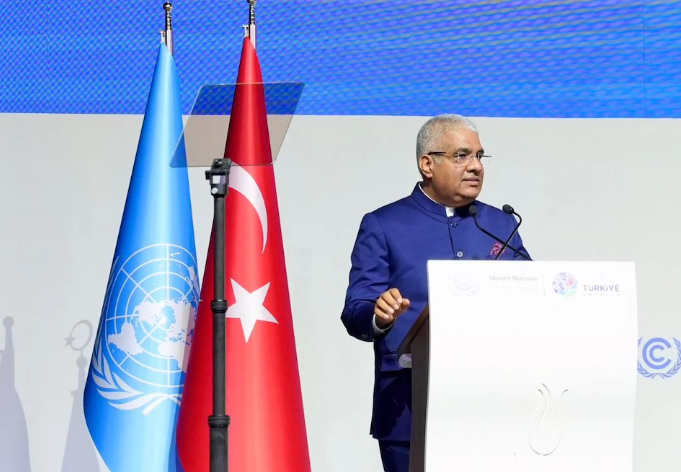
ANKARA (TURKIYE), Nov 18: India on Wednesday urged the international community to ensure fairness and accountability in global climate negotiations, asserting that developing nations should not be made to shoulder the consequences of greenhouse gas emissions accumulated over centuries of industrialisation in developed countries.
Presenting India’s national statement at the United Nations Climate Change Conference (COP31), Union Environment Minister Bhupendra Yadav said the climate crisis was largely rooted in nearly 200 years of industrial expansion and economic development in certain parts of the world, driven by continuous greenhouse gas emissions.
Yadav maintained that developing countries must not be forced to compromise their development priorities in the name of climate action. He emphasised that access to quality healthcare, education, decent living conditions and economic opportunities remained legitimate aspirations that needed to be protected alongside environmental commitments.
He also stressed that developing nations must receive an equitable share of the remaining global carbon budget, describing this as an essential requirement for achieving climate justice.
“COP decisions and their implementation must be firmly grounded in equity and CBDR-RC,” the minister said.
Explaining India’s position, Yadav highlighted the principle of Common but Differentiated Responsibilities and Respective Capabilities (CBDR-RC), which acknowledges that countries have varying levels of responsibility for climate change and different capacities to address its consequences.
He cautioned against the use of unilateral trade restrictions in the name of environmental protection, observing that such measures were placing additional pressure on developing economies.
The minister called upon developed nations to honour their climate finance commitments without further delays, stressing that financial assistance was essential for enabling vulnerable and developing countries to undertake meaningful climate initiatives.
On the ongoing negotiations, Yadav said the Mitigation Work Programme should remain supportive and facilitative rather than imposing prescriptive requirements on participating countries. He further underlined the importance of ensuring that the Global Stocktake continues to guide collective climate efforts while respecting the circumstances and priorities of individual nations.
He also called for the proposed Just Transition Mechanism to be firmly based on equity, ensuring that the shift towards sustainable economic systems does not disproportionately affect developing countries and vulnerable communities.
Highlighting India’s domestic climate efforts, Yadav said the country’s Nationally Determined Contributions (NDCs) were aligned with its long-term vision of building a developed nation, or ‘Viksit Bharat’, by 2047 while maintaining a sustainable development pathway.
He noted that international climate cooperation must take into account changing climatic conditions, demographic developments and rapid technological advancements. According to him, these factors would play an important role in determining how countries collaborate to address environmental challenges.
Referring to the central theme of COP31, ‘Dialogue, Consensus and Action’, the minister said the effectiveness of the conference should be judged by concrete progress rather than declarations alone.
He emphasised that meaningful outcomes would require effective implementation of agreed commitments, timely delivery of financial and technological resources to countries that need them, and wider adoption of successful climate solutions.
India’s intervention at the conference reiterated its position that global climate action must be based on fairness, shared responsibility and respect for the development priorities of emerging economies.

