


India Women End 44-Year Wait for Asian Games Hockey Gold
Lalremsiami’s early strike and Savita Punia’s crucial penalty stroke save helped India defeat China 1-0 and secure qualification for the 2028 Los Angeles Olympics.
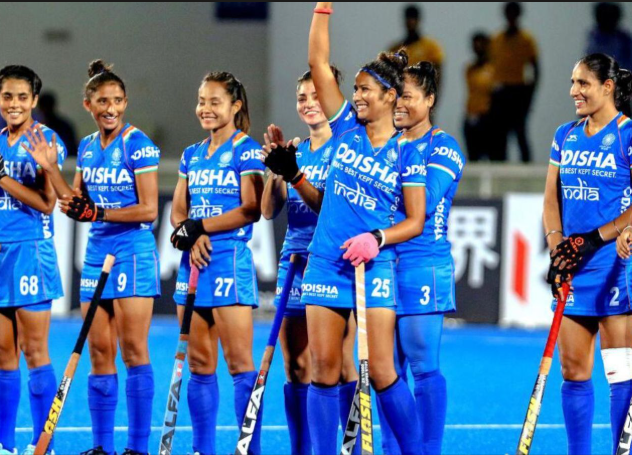
AICHI-NAGOYA, Oct 2: India’s women’s hockey team ended a 44 year wait for Asian Games gold after defeating hosts China 1-0 in a tense final, securing the continental title and a direct qualification place for the 2028 Los Angeles Olympics.
Lalremsiami scored the only goal of the match in the 10th minute, giving India an early advantage that the team defended until the final whistle.
China repeatedly attempted to find an equaliser, but India’s defensive organisation remained firm. Goalkeeper Savita Punia produced a decisive intervention by stopping a penalty stroke, preserving the narrow lead during a tense contest.
The victory marked India’s first women’s Asian Games hockey gold since 1982.
Lalremsiami Provides Early Breakthrough
India began the final with clear attacking intent and quickly put pressure on the Chinese defence.
The breakthrough arrived in the 10th minute.
Captain Salima Tete initiated the move into the striking circle before finding Sakshi Rana. The ball was then worked towards Lalremsiami, who produced a reverse-stick finish to put India ahead.
The goal was particularly memorable because it came during Lalremsiami’s 200th international appearance.
Rather than allowing the early advantage to change their approach, India continued to focus on defensive structure and controlled possession whenever possible.
China Apply Sustained Pressure
China responded by increasing the intensity of its attacks.
The home side looked for openings through quick movements and pressure around the Indian circle, forcing the Indian defence to remain alert.
India’s defenders repeatedly managed to close down dangerous situations before they developed into clear scoring opportunities.
The second and third quarters proved especially demanding as China attempted to break through.
India’s ability to remain compact became one of the defining features of the final.
The team understood that a single goal could decide the championship and therefore concentrated heavily on limiting China’s opportunities.
Savita’s Crucial Intervention
One of the most important moments came when China earned a penalty stroke.
With India protecting a 1-0 advantage, the opportunity offered China a direct route back into the match.
Savita Punia responded with an outstanding save.
The experienced goalkeeper denied the penalty stroke and ensured that India retained its lead.
The intervention was critical because the match had already developed into a close defensive battle. Had China converted the opportunity, the momentum could have shifted significantly.
Instead, India survived the threat and continued to protect its advantage.
Defence Holds Firm
As the final progressed, India increasingly relied on its defensive organisation.
China continued searching for an opening, but India’s players remained disciplined in their positioning.
The Indian midfield also played an important role by helping the defence absorb pressure and attempting to create opportunities on the counter.
With the margin only one goal, every possession became important.
India could not afford unnecessary mistakes, while China had to commit players forward in search of an equaliser.
That situation created a tense final phase, but India managed to maintain its structure until the closing moments.
Historic Asian Games Title
The victory ended a 44-year wait for the Indian women’s team.
India had previously won the women’s hockey gold at the Asian Games in 1982. Since then, the team had been unable to reclaim the continental title.
The triumph therefore represented a significant moment in the history of Indian women’s hockey.
The players also had the added incentive of securing qualification for the 2028 Olympics.
The Asian Games gold provides a direct route to Los Angeles, removing the need for India to depend on another qualification tournament for a place in the Olympic hockey competition.
Salima Tete Leads From the Front
Captain Salima Tete played an important role in the attacking move that produced the decisive goal.
Her leadership was also significant as India faced sustained pressure from China during the remainder of the final.
The captain had guided the side through a successful tournament campaign, with India reaching the final after defeating South Korea 2-0 in the semifinal.
India had earlier remained unbeaten in the group stage, defeating Uzbekistan, Indonesia, Thailand, Japan and Singapore to progress to the knockout rounds.
That consistency helped establish the foundation for the gold-medal campaign.
A Team Effort
Although Lalremsiami scored the decisive goal and Savita made the match-changing save, the result was built on a collective performance.
India’s defenders had to deal with repeated Chinese attacks, while the midfielders worked to restrict passing options and support the back line.
The forwards also had to remain prepared to create counterattacking opportunities whenever possession changed.
The narrow scoreline reflected how closely contested the final was rather than a lack of opportunities or intensity.
India’s ability to protect a one-goal advantage against sustained pressure ultimately proved decisive.
Recognition for Indian Hockey
The gold medal was celebrated widely in India.
Prime Minister Narendra Modi congratulated the women’s team and described the victory as a special moment for Indian hockey. He highlighted the squad’s teamwork and determination and expressed hope that the achievement would contribute to greater popularity for the sport across the country.
The result also generated praise from former India captain Eliza Nelson, who was part of the team that won the women’s hockey gold at the 1982 Asian Games.
Nelson described the achievement as an emotional moment and highlighted the significance of the current team carrying forward the legacy of Indian women’s hockey.
Olympic Road Opens
For the Indian players, the victory has an importance beyond the Asian Games medal ceremony.
Qualification for the 2028 Los Angeles Olympics gives the team additional time to prepare for the global competition.
India will now be able to plan its Olympic cycle knowing that the place in the tournament has been secured.
The team can use the next phase to strengthen its combinations, improve attacking efficiency and build on the defensive discipline shown in the Asian Games final.
The continental title also provides a confidence boost after a tournament in which the team consistently delivered results.
A Defining Moment
The 1-0 scoreline may appear narrow, but the circumstances surrounding the result underline its significance.
India had to withstand sustained pressure from China after taking the lead in the opening quarter.
The team’s response under pressure became the defining feature of the contest.
Lalremsiami’s goal provided the breakthrough, while Savita’s penalty save protected it. The defenders then helped ensure that China could not find the equaliser.
The final whistle confirmed an achievement that had eluded Indian women’s hockey for more than four decades.
The gold medal ends the long wait for another Asian Games title and simultaneously sends India to the 2028 Olympics.
For a team led by Tete and backed by an experienced goalkeeper in Savita, the achievement represents the culmination of a successful campaign in Aichi-Nagoya.
India’s women have now reclaimed the Asian Games title, with the 1-0 victory over China adding a new chapter to the history of the national hockey programme.

