


India Women’s Squash Team Secures Asian Games Medal After Beating Singapore
Anahat Singh and Tanvi Khanna win their singles matches as India advances to the semifinals of the women's team competition.
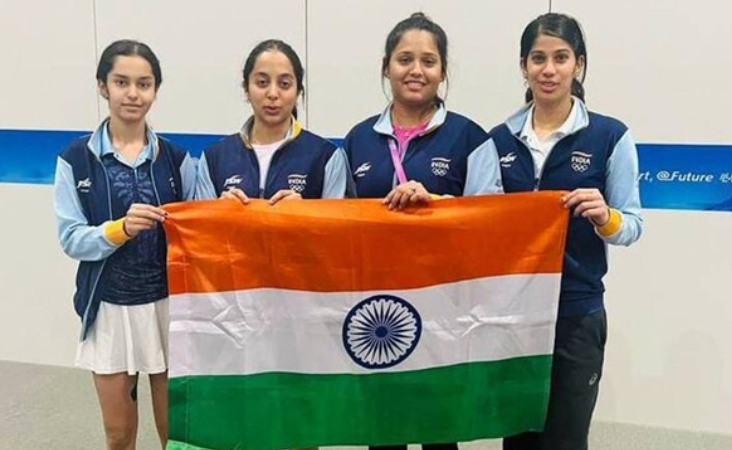
India, Sep 30 : India’s women’s squash team secured at least a bronze medal at the 2026 Asian Games after defeating Singapore 2-0 in the quarterfinals on September 30.
The result moved India into the semifinals of the team competition and guaranteed another podium finish for the country at the Aichi-Nagoya Games. Anahat Singh and Tanvi Khanna produced the victories that settled the tie before a deciding third singles match was required.
The Indian team entered the quarterfinal with a clear objective of reaching the medal rounds, and the players delivered a controlled performance against Singapore.
Anahat was one of the key players in the tie, winning her singles encounter to give India an important advantage. Tanvi then followed with another victory, allowing India to close out the contest 2-0.
The result means India cannot finish outside the medal positions in the women’s team squash competition. Under the Asian Games format, both losing semifinalists receive bronze medals, making the semifinal qualification enough to guarantee a podium place.
The achievement adds another medal to India’s growing squash record at the tournament.
Anahat Singh has already been one of the country’s most closely followed squash players at the Games. Her presence in the team competition came after she competed in the women’s singles event, where she faced Malaysia’s Sivasangari Subramaniam in the final.
Sivasangari had won the singles title, while Anahat took the silver medal. The Malaysian player had also secured qualification for the 2028 Los Angeles Olympics, where squash will make its Olympic debut.
Anahat’s move from the individual event into the team competition therefore provided India with another opportunity to challenge for a medal.
The quarterfinal against Singapore was decided without the need for a third match, reducing the workload on the Indian squad and allowing the team to progress efficiently into the last four.
Tanvi’s contribution was equally important. Her victory in the second singles match ended the tie before Singapore could force a deciding contest.
The Indian team will now turn its attention to the semifinal, where the challenge will become more demanding as the competition reaches its medal stage.
The medal assurance is also significant for Indian squash because the sport has developed into one of the country’s regular sources of success at major Asian competitions. The presence of experienced players alongside younger competitors has helped India remain competitive across individual and team events.
At the 2026 Games, squash has already produced medals for India in other events, with the women’s team now adding another guaranteed podium finish.
The quarterfinal result came on a busy day for the Indian contingent. Athletes were competing in archery, boxing, wrestling, hockey, shooting, cycling, tennis, golf and several other disciplines.
The women’s squash team nevertheless had a specific target: secure a place in the semifinals. That goal was achieved through two straight wins.
The structure of the contest meant that every singles match carried considerable importance. The opening victory gave India the lead and placed pressure on Singapore to win the next match. Tanvi responded successfully, closing the tie before the opposing team could build momentum.
The victory also highlights the importance of team depth. While Anahat remains one of India’s best-known squash players, the team format requires multiple players to contribute across the competition. Tanvi’s win demonstrated that India’s medal challenge does not depend solely on one athlete.
For the Indian camp, the result provides an opportunity to continue competing for the colour of the medal. Although a podium finish is now guaranteed, the semifinal will determine whether India can advance to the gold-medal match.
The team will also be aware that the knockout stage leaves little room for recovery from a poor start. A semifinal defeat would still produce a bronze medal, while victory would put India into the championship contest and create an opportunity to fight for gold.
The September 30 victory over Singapore therefore represents an important milestone rather than the conclusion of India’s campaign.
The result is also part of a wider strong showing by Indian athletes in Aichi-Nagoya. By September 30, the country’s medal tally had continued to grow through performances in multiple sports. Reports from the Games showed India moving into the top 10 during the competition after a productive run of results.
Squash’s contribution is particularly valuable because the sport requires a combination of speed, endurance, tactical awareness and the ability to respond quickly during rallies. In a team competition, those demands are multiplied because players must perform according to the needs of the tie.
Anahat’s presence gives India a player capable of handling high-pressure matches, while Tanvi’s contribution against Singapore ensured the quarterfinal did not go to a deciding contest.
The Indian team can now prepare for the semifinal knowing that it has already achieved a medal finish. That removes the immediate pressure of avoiding elimination but does not reduce the significance of the next match, where a place in the final will be at stake.
The quarterfinal victory also adds to India’s medal haul at a Games where the country has collected podium finishes across traditional and emerging disciplines.
For Singapore, the 0-2 result brought its women’s team campaign to an end, while India advanced into the final four.
The semifinal will provide a stronger test and require another disciplined performance from the Indian players. The team will need to manage the physical demands of successive matches while maintaining concentration in the individual contests that determine the overall result.
For now, however, the immediate achievement belongs to Anahat Singh and Tanvi Khanna, whose victories delivered the required two points and sent India through.
The women’s squash team has therefore guaranteed itself an Asian Games medal and kept alive its hopes of reaching the final. The next stage will determine whether India’s latest squash campaign ends with bronze, silver or gold, but the country is assured of returning to the podium from the team event.

