


Ishan Kishan Overtakes Abhishek to Claim Top Spot in T20I Batting Rankings
The India wicketkeeper-batter rises to the top of the latest ICC men’s T20I batting charts after a prolific T20 World Cup campaign, while Abhishek Sharma slips to second and Tilak Varma holds steady inside the top six.
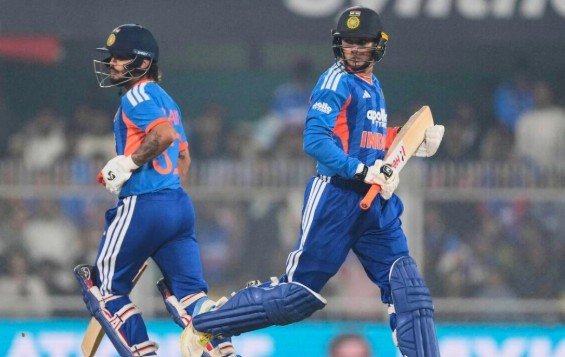
New Delhi, July 2: India wicketkeeper batter Ishan Kishan has climbed to the summit of the latest ICC men’s T20I batting rankings, displacing teammate Abhishek Sharma from the top position and underlining his growing stature as one of the format’s most explosive and reliable performers. The rankings update released on Wednesday confirmed Kishan’s rise to No. 1 with 876 rating points, a reward for the left-hander’s commanding run of form over recent months and, in particular, his influential performances at the T20 World Cup earlier this year.
Kishan’s ascent marks a significant milestone in his white-ball career and places him in a select group of Indian batters who have occupied the No. 1 position in ICC men’s T20I batting rankings. With the latest update, he joins Virat Kohli, Suryakumar Yadav and Abhishek Sharma as one of the few Indian players to have reached the pinnacle of T20I batting. The development is both a personal triumph for Kishan and another indication of India’s continued depth in the shortest format, where multiple batters have consistently challenged for the highest individual honours in recent years.
The rise has come on the back of a stellar T20 World Cup campaign in which Kishan emerged as one of India’s most dangerous batting forces. The flamboyant left-hander amassed 317 runs during the tournament at a strike rate approaching 200, combining volume with relentless aggression in a way that made him one of the defining players of the competition. His innings were not merely quick or eye-catching; they were often decisive, shifting momentum and setting the tone for India’s batting efforts in high-pressure matches. Among the standout performances was his Player of the Match display against Pakistan in Colombo, an innings that carried both statistical weight and emotional significance given the magnitude of the contest.
That tournament performance appears to have tipped the balance in the rankings race. Abhishek Sharma, who had held the top position for nearly 12 months, slipped to second place with 869 points, narrowly behind Kishan. The margin is small enough to suggest that the battle for the top spot remains finely poised, but the symbolism of the change is considerable. Abhishek’s tenure at No. 1 had represented both consistency and the evolution of India’s aggressive T20 batting template. Kishan replacing him at the summit does not diminish that achievement; rather, it reflects how intensely competitive India’s batting stocks have become in a format increasingly defined by attacking range, adaptability and scoring speed.
For Kishan, the ranking rise is the latest chapter in a career that has often oscillated between immense promise and the challenge of locking down a permanent role in a star-studded Indian side. Few have doubted his talent. From his early domestic exploits to his reputation as a fearless stroke-maker capable of taking apart pace and spin alike, Kishan has long been seen as a natural fit for T20 cricket. What makes this moment particularly notable is that it reflects not just talent or occasional brilliance, but a sustained body of work strong enough to elevate him above every other batter in the international T20 game.
His batting at the World Cup offered a clear explanation for why the rankings have moved in his favour. Kishan was not simply accumulating runs; he was doing so at a tempo that altered the complexion of games. A strike rate of nearly 200 across a major tournament is a remarkable indicator of dominance, especially when combined with consistency over multiple innings. It speaks to a batter capable of blending calculated aggression with situational awareness—someone who can take on bowlers from the outset without losing control of the innings.
That combination has become increasingly valuable in modern T20 cricket, where teams expect top-order batters to attack early, exploit field restrictions and maintain scoring momentum through the middle overs. Kishan’s left-handedness adds another dimension to his value, disrupting bowling plans and creating match-up headaches for opponents. His range of strokes—particularly through the leg side, over extra cover and behind square—allows him to score freely against different types of bowling, while his willingness to take risks ensures that he remains a constant pressure point for opposition captains.
The latest rankings also offer a snapshot of India’s strong representation at the top end of the T20I batting table. While Kishan now leads the list and Abhishek follows closely in second, India have additional presence in the top 10. Newly appointed vice-captain Tilak Varma remains steady in sixth place with 747 rating points, a reflection of his growing importance in the team’s middle-order plans. Former captain Suryakumar Yadav, meanwhile, has slipped one place to eighth, though his continued presence in the top tier reinforces the depth of India’s batting resources in the format.
Tilak’s steady position is especially noteworthy given his evolving leadership role within the side. His appointment as vice-captain signals the management’s confidence not only in his batting but also in his temperament and tactical maturity. To remain inside the top six while also taking on added responsibility suggests a player moving into a more central role in India’s T20 future. His game is stylistically different from Kishan’s or Abhishek’s often more measured in construction before accelerating but equally suited to the demands of modern T20 cricket.
Suryakumar’s slight drop in the rankings is unlikely to overshadow his standing as one of the most innovative batters in the format. His recent slide reflects the unforgiving nature of ICC rankings more than any dramatic loss of relevance. In a system where minor shifts in form, match volume and comparative performances can alter positions quickly, even elite players can move down without any broader change in status. Suryakumar remains a proven match-winner and one of the players most associated with India’s T20 transformation over the last few years.
Beyond the Indian contingent, Pakistan’s Sahibzada Farhan occupies third place in the latest list with 848 points, though he remains some distance behind the two Indian left-handers above him. His presence in the top three highlights the increasingly competitive nature of T20I batting rankings, where players from multiple nations are being rewarded for sustained attacking performances in bilateral series, tournaments and global events. Still, the current rankings narrative is unmistakably centred on India, whose batters continue to dominate the upper reaches of the list.
Kishan’s climb to No. 1 also revives discussion around India’s batting hierarchy and team balance heading into the next phase of T20 cricket. Rankings, of course, do not determine selection on their own, nor do they fully capture role-specific demands within a side. But they do offer a useful measure of output, impact and consistency, and in Kishan’s case they strengthen the argument that he has become indispensable to India’s T20 plans. A player who can keep wicket, open the batting or adapt to different top-order roles while maintaining a high strike rate brings obvious strategic flexibility.
The timing of the rise may prove significant as well. India are in a phase of transition and consolidation in T20 cricket, with leadership changes, role redefinitions and a growing emphasis on building towards future ICC events. In that environment, having multiple batters ranked among the world’s best is not just a matter of prestige; it provides the side with tactical options and internal competition that can sharpen performance standards. Kishan reaching No. 1 sends a clear message that India’s next generation of T20 stars is no longer emerging—it has already arrived.
From a broader perspective, Kishan’s ranking jump reflects the way T20 batting standards continue to evolve. Traditional measures such as average remain relevant, but strike rate, phase control and the ability to dominate high-quality bowling attacks in short bursts have become central to a batter’s value. Kishan’s World Cup numbers stand out because they align with that new benchmark: high volume, extreme pace and influence in marquee games. In many ways, his rise is emblematic of the modern T20 batter—fearless, versatile, left-handed, boundary-oriented and capable of changing a match in the space of a few overs.
It is also a reminder of how quickly the T20 landscape can shift. Abhishek had spent nearly a year at the summit and looked well placed to extend his stay, only for Kishan’s World Cup surge to alter the equation. The closeness of the ratings suggests the top spot may continue to change hands depending on performances in the coming months. That uncertainty adds intrigue to India’s internal competition, where multiple players have the ability to dominate global rankings if they string together a run of impactful innings.
For Kishan personally, however, the immediate significance lies in validation. Rankings are not the sole measure of a player, but they do offer recognition for sustained excellence at the highest level. To be rated the best T20I batter in the world is an acknowledgement of both output and influence, and it caps a period in which Kishan has looked increasingly assured of his game and his place in the side. It is the kind of milestone that can strengthen confidence, sharpen focus and reinforce a player’s authority within the dressing room.
The challenge now will be to stay there. The No. 1 ranking brings prestige, but it also brings expectation. Opponents will prepare more specifically, scrutiny will intensify and every innings will be measured against the standards that carried him to the top. Yet if Kishan’s recent form is any indication, he is equipped for that challenge. He has shown the range, temperament and tempo that modern T20 cricket demands, and his latest rise suggests he is not merely enjoying a purple patch but establishing himself as one of the format’s defining players.
For Indian cricket, the rankings update offers another encouraging sign at a time when the T20 side is reshaping itself around a blend of proven performers and younger match-winners. With Kishan at No. 1, Abhishek close behind, Tilak firmly in the top six and Suryakumar still among the elite, India’s batting depth looks formidable. That does not guarantee trophies or smooth selection calls, but it does reinforce a central truth of the current era: few teams in world cricket can match India’s wealth of T20 batting talent.
As the international calendar moves forward and new contests reshape the rankings, Kishan’s rise will stand as one of the defining moments of India’s T20 year so far. It is a story of form, timing and opportunity converging at the right moment—of a player seizing the stage at a global tournament and converting that surge into the sport’s most visible individual batting honour. For now, the top of the ICC men’s T20I batting rankings belongs to Ishan Kishan, and it has been earned through the kind of fearless, high-impact cricket that the format now celebrates above all else.

