


Multimedia Exhibition ‘Viksit Bharat’ concludes at Udhampur
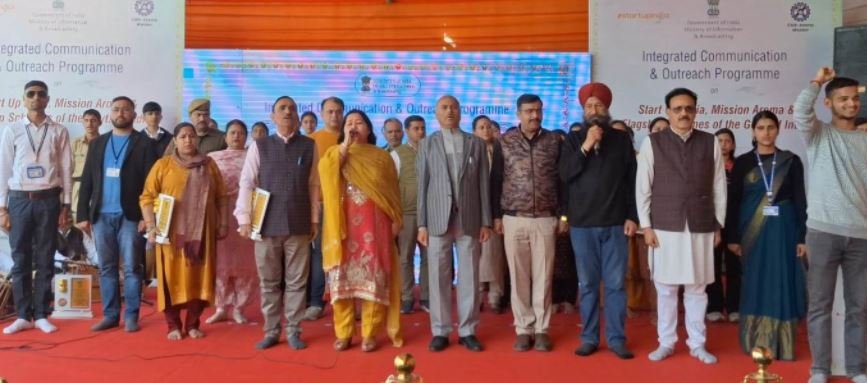
UDHAMPUR, FEBRUARY 27: The Multimedia Exhibition organized by the Central Bureau of Communication (CBC), Field Office Udhampur, in close coordination with Field Office Doda concluded here today. The event successfully merged the soulful heritage of India with a modern roadmap for economic and social progress, leaving the audience inspired and deeply informed about the nation’s developmental trajectory.
The valedictory function commenced with a divine Ganesh Vandana, followed by a stirring rendition of the National Song, Vande Mataram, performed by the senior artists of the Central Bureau of Communication. The musical ensemble featured Neeraj verma on Tabla, Varinder Gazal singer on harmonium, Sunil kumar on flute Ram Lal & Sunita Attri singers. The performance was nothing short of captivating, soul-stirring and a combination of culture demonstrating themes of Government of India.
Programme Officer ICDS Subash Chander was the Chief Guest. He delivered an insightful keynote address that deeply resonated with the attendees. He highly appreciated the Central Bureau of Communication for its meticulous work. “This organization plays a pivotal role in bridging the gap between the government and the public,” he emphasized and added that such multimedia exhibitions are essential tools for mass awareness. He also lauded the artists and experts, stating that the integration of culture and technology at the venue provided a unique platform to the youth to understand the future of “Viksit Bharat.”
A significant segment of the concluding day focused on Startup India by Pooja Jamwal- representative from the social welfare department. She highlighted how the initiative, which began on January 16, 2026 has become a milestone for overcoming job shortages and creating sustainable opportunities.
The success of companies in quick credit management and e-commerce—such as PhonePe, Flipkart, Meesho and Zepto—were cited as vibrant examples of how startups are the need of the hour in the internet age. She also shed light on Mission Aroma and the “Purple Revolution” as transformative forces for rural upliftment. “In regions like Jammu, the cultivation of lavender, rose and other aromatic plants is being recognized as the future for farmers and marginalized villages. This shift toward aromatic medicinal plants is seen as a primary way to cope with employment requirements in rural India and also boosting the local economy,” she noted. Alongside these agricultural shifts, she also highlighted the initiatives like Mission Shakti and other welfare schemes designed to empower women and vulnerable sections of society.
Ankita, representing the Health Department, provided a comprehensive explanation of India’s three-tier healthcare system. “The primary level is supported by the Ayushman Card, while the secondary level is bolstered by the Sehat Card, which covers full family health insurance and includes a specific 5+5 lakh top-up for patients over 70 years of age at empanelled hospitals. At the tertiary level, the importance of the ABHA card and the creation of unique digital health IDs were emphasized to streamline specialized medical care,” she informed.
The exhibition also featured insights from Pooja Pathania, an expert in handicrafts, who discussed the potential for self-employment through traditional arts and earlier in the day, Vikram Uppal explained visitors through the interactive multimedia stalls.
Painting Competition, Theme based Cultural items were the other attractions of the day long programme.
The proceedings concluded with a formal vote of thanks presented by Gurnam Singh

