


Nine-Judge Supreme Court Bench to Hear ‘Industry’ Definition Case on March 17
Constitution bench to examine interpretation of ‘industry’ under the Industrial Disputes Act and its implications for government activities.
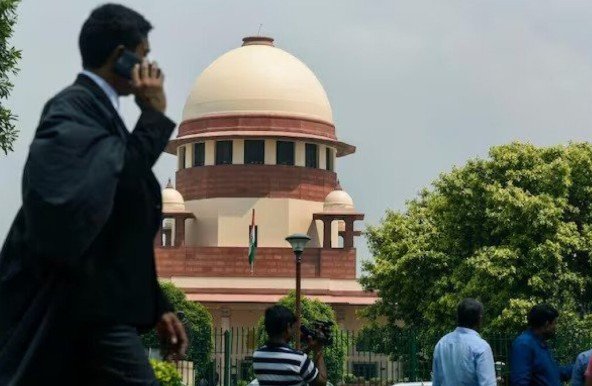
New Delhi: A nine judge Constitution bench of the Supreme Court of India will begin hearing arguments on March 17 regarding the interpretation of the term “industry” under the Industrial Disputes Act, 1947. The matter is considered significant due to its wide-ranging implications for labour laws and government institutions.
According to the court’s cause list, the bench will be headed by Chief Justice of India Surya Kant and include Justices B. V. Nagarathna, P. S. Narasimha, Dipankar Datta, Ujjal Bhuyan, Satish Chandra Sharma, Joymalya Bagchi, Alok Aradhe and Vipul M. Pancholi.
The court had earlier framed key questions that the bench will address, including whether the test laid down by Justice V. R. Krishna Iyer in the landmark 1978 judgment in the Bangalore Water Supply and Sewerage Board v. A. Rajappa case correctly defines when an enterprise qualifies as an “industry”.
Another issue to be examined is whether subsequent legal developments, including the Industrial Disputes (Amendment) Act, 1982 and the Industrial Relations Code, 2020, have any bearing on interpreting the term within the principal law.
The bench will also consider whether activities such as social welfare schemes or projects undertaken by government departments and public bodies can be treated as industrial operations under Section 2(j) of the Act.
The court has allowed all parties involved in the case to submit updated or consolidated written arguments before the hearing. The proceedings are scheduled to start on March 17 and conclude the following day.
The case has a long judicial history. In 2017, a seven-judge Constitution bench headed by former Chief Justice T. S. Thakur recommended that the matter be examined by a larger bench due to its complex legal implications. Earlier, a five-judge bench in 2005 had also referred the issue for further consideration, citing the need to clarify the scope of the definition after decades of differing interpretations by various benches of the apex court.

